Skip to content
  • Home
  • Writing Services
    • Ghost Writing
    • e-Book Writing
    • Fiction Writing Services
    • Non-Fiction Writing Services
    • Memoir Writing Services
    • Novel Writing Services
    • Biography Writing Services
    • Autobiography Writing Services
  • Publishing Services
    • E-Book Publishing
    • Amazon Publishing Services
  • Editing Services
    • Book Editing
    • Book Proofreading
    • Book Formatting
  • Other Services
    • Book Marketing
    • Audio Book
    • Book Formatting
    • Blog Writing
    • Website Content Writing
    • Book Cover Design
    • Book Video Trailer
    • Author Website Design
    • Article Writing
  • Resources
    • Blogs
    • Case Studies
    • Testimonials
    • FAQs
    • About Us
    • Contact Us
logo
  • Home
  • Writing Services
    • Ghost Writing
    • e-Book Writing
    • Fiction Writing
    • Non-Fiction Writing
    • Memoir Writing
    • Novel Writing
    • Biography Writing
    • Autobiography Writing
  • Publishing Services
    • E-Book Publishing
    • Amazon Publishing
  • Editing Services
    • Book Editing
    • Book Proofreading
    • Book Formatting
  • Other Services
    • Book Marketing
    • Audio Book
    • Blog Writing
    • Website Content Writing
    • Book Cover Design
    • Book Video Trailer
    • Author Website Design
    • Article Writing
  • Resources
    • Blogs
    • Case Studies
    • Testimonials
    • FAQS
    • Services Rate

    • About Us
    • Contact Us
  • +1 (855) 479-4213
  • Book a Call
  • Get a Quote
  • Live Chat

Author : Charles Maynes

22nd Apr 2026

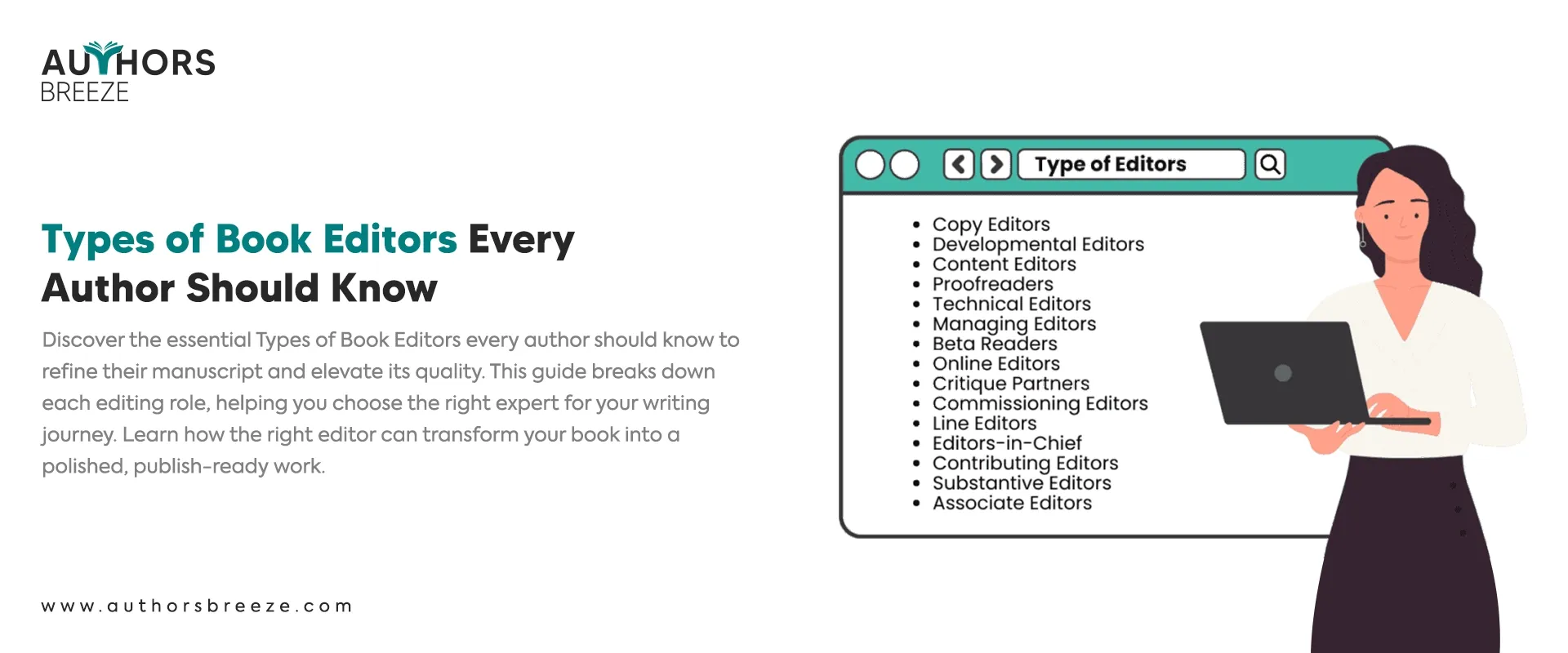
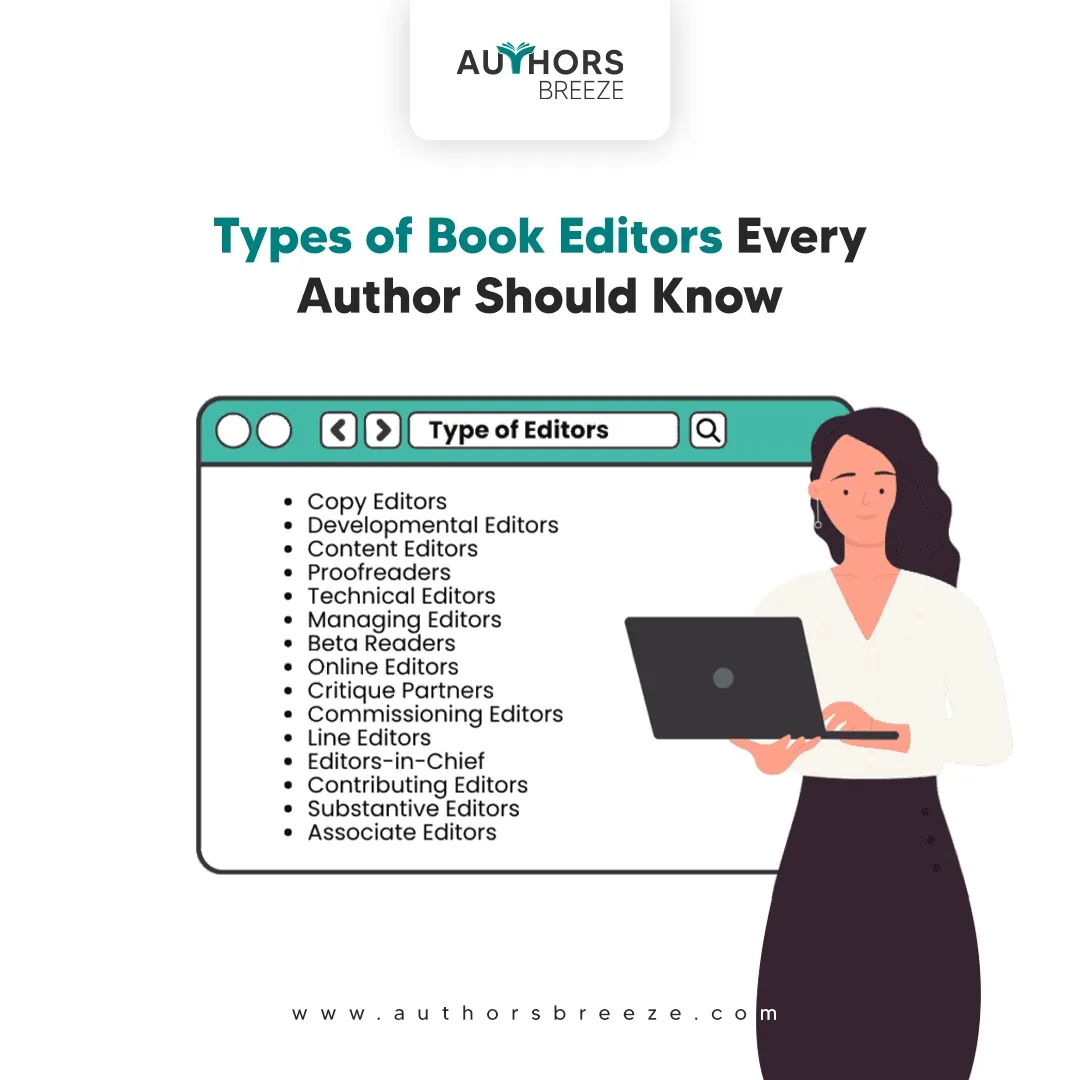
Types of Book Editors Every Author Should Know

Types of Book Editors

Key Takeaways

  • Understanding the types of book editors is essential for turning a rough manuscript into a polished, publication-ready book.
  • Editing is a multi-stage process that goes beyond grammar and includes structure, clarity, tone, and consistency.
  • Developmental editors focus on the big picture, including story structure, plot flow, pacing, and character development.
  • Line editors refine sentence-level writing by improving flow, readability, tone, and word choice without changing meaning.
  • Copy editors ensure technical accuracy by correcting grammar, spelling, punctuation, and style consistency.
  • Proofreaders provide the final quality check before publishing by removing minor errors and formatting issues.
  • Publishing editors work within publishing houses and manage manuscript selection, editing direction, and production coordination.
  • The editing process follows clear levels of editors, where each stage builds on the previous one for complete refinement.
  • A book editor improves structure, readability, and engagement while maintaining the author’s original voice.
  • Choosing the right editor for a novel depends on genre, experience, editing stage, and manuscript needs.
  • The idea that editors “remove creativity” is a misconception; instead, they strengthen clarity and impact.
  • Professional editing significantly increases the chances of successful publishing and reader engagement.

Ready to Publish a Professional Quality Book?

Your manuscript deserves expert attention before it reaches readers. With professional editing, your ideas become clearer, stronger, and publication-ready.

Get Editing Service

Introduction

Every manuscript begins as an idea, but it is rarely ready for publication in its first draft. In fact, most writers discover that their work needs refinement, structure, and clarity before it can truly shine. This is exactly where professional editing becomes essential. At Authors Breeze, we understand that strong editing is the backbone of successful publishing, because every great book is shaped through expert revision.

Moreover, many writers often struggle to understand the types of book editors involved in the publishing process. As a result, confusion arises about who does what, when they are needed, and how they improve a manuscript. Therefore, understanding editorial roles becomes a crucial step for every author aiming for publication.

In this blog, you will learn everything about editing roles, levels, responsibilities, and how each editor contributes to turning a draft into a polished book.

What Are Editors and Why Do They Matter?

To begin with, editors are professionals who refine written content to improve clarity, structure, accuracy, and readability. Although writing comes from creativity, editing ensures that creativity is effectively communicated.

Furthermore, editors play a major role in shaping manuscripts so they meet publishing standards. Without them, even strong ideas may fail to reach readers clearly.

In addition, editing goes far beyond grammar correction. Instead, it focuses on flow, consistency, tone, structure, and overall readability. Therefore, editors are essential collaborators in the publishing journey.

Key roles of editors include:

  • Improving readability and flow
  • Enhancing structure and coherence
  • Correcting language and grammar issues
  • Preparing manuscripts for publication

Consequently, editing transforms raw writing into professional-quality work that is ready for readers.

Types of Book Editors

Understanding the types of book editors is extremely important because each editor performs a unique function. Moreover, every stage of editing builds upon the previous one, ensuring complete refinement of a manuscript.

1. Developmental Editors

First and foremost, developmental editors focus on the big picture of a manuscript. They analyze structure, plot, pacing, character development, and overall storytelling quality.

Additionally, they help authors strengthen weak areas in the narrative. For example, if a story feels rushed or unclear, developmental editing provides structural improvements.

They typically work on:

  • Story structure
  • Plot development
  • Character arcs
  • Chapter organization

Therefore, this stage is often considered the foundation of editing.

2. Line Editors

Next, line editors focus on sentence-level improvement. Unlike developmental editors, they do not change the story structure. Instead, they refine language, tone, and flow.

Moreover, they ensure that each sentence reads smoothly and naturally. As a result, the writing becomes more engaging and polished.

They improve:

  • Sentence clarity
  • Word choice
  • Tone consistency
  • Flow and readability

In short, line editing enhances how the story is told.

3. Copy Editors

After that, copy editors focus on technical accuracy. Grammar, punctuation, spelling, and consistency are carefully checked at this stage.

Additionally, style guides are followed to ensure uniform formatting throughout the manuscript. Consequently, the text becomes error-free and professional.

They handle:

  • Grammar correction
  • Spelling and punctuation
  • Style consistency
  • Fact-checking

Thus, copy editing ensures correctness in every detail.

4. Proofreaders (Final Stage)

Finally, proofreaders perform the last review before publication. At this stage, only minor errors are corrected.

Furthermore, formatting issues, typos, and overlooked mistakes are removed. Since this is the final step, accuracy is extremely important.

They check:

  • Typographical errors
  • Formatting issues
  • Missed punctuation mistakes
  • Final presentation quality

Therefore, proofreading ensures that the manuscript is fully publication-ready.

5. Publishing Editor

In addition, publishing editors work within publishing houses and manage the entire editorial process. They often decide which manuscripts to get published. Moreover, they coordinate between authors, editors, and production teams.

They are responsible for:

  • Manuscript selection
  • Editorial direction
  • Author communication
  • Publishing decisions

As a result, publishing editors play a strategic role in the traditional publishing industry.

Fix Grammar, Structure & Flow with Experts

From sentence clarity to final proofreading, our editing experts ensure your manuscript meets industry publishing standards.

Contact Us Now

Levels of Editors in the Publishing Process

The editing process follows a structured hierarchy. Each level builds on the previous one to ensure complete refinement.

Typically, the workflow includes the following types of editing:

  1. Developmental Editing – structure and storytelling
  2. Line Editing – style and readability
  3. Copy Editing – grammar and accuracy
  4. Proofreading – final polish

Furthermore, this layered process ensures that no issue is left unresolved. Consequently, the manuscript becomes stronger at every stage.

What Does a Publishing Editor Do?

A publishing editor plays a broader role compared to other editors. Not only do they review manuscripts, but they also make publishing decisions.

Additionally, they evaluate market trends and determine which books have commercial potential.

Their responsibilities include:

  • Selecting manuscripts for publication
  • Guiding revisions
  • Managing editorial teams
  • Coordinating production processes

Thus, publishing editors connect creative writing with the publishing industry.

Editor Structure in Publishing

The editorial structure in publishing is highly organized. Each editor contributes at a specific stage, ensuring a smooth workflow.

The structure typically follows:

Author → Developmental Editor → Line Editor → Copy Editor → Proofreader → Publishing Editor

Furthermore, this structured approach ensures consistency, accuracy, and quality at every level. As a result, the final book becomes professionally refined.

Finding an Editor for a Novel

Finding the right editor is extremely important for any writer. However, the selection process should be based on manuscript needs rather than convenience.

Moreover, different editors specialize in different genres and editing levels.

When choosing an editor, consider:

  • Experience in your genre
  • Portfolio and sample work
  • Editing stage required
  • Budget and service scope

In addition, freelance editors and publishing house editors offer different advantages. Therefore, careful selection improves the final outcome significantly.

Common Misconceptions About Editors

Many writers believe that editors remove creativity from a manuscript. However, this is not true.

Instead, editors refine writing while preserving the author’s voice. Although changes are made, they aim to strengthen meaning rather than reduce originality.

Moreover, the idea that “editors take it out” is often misunderstood. In reality, unnecessary elements are removed so that the core message becomes clearer.

Consequently, editing enhances creativity rather than limiting it.

Types of Book Editors Comparison Table

Editor TypeFocus AreaStagePurpose
Developmental EditorStructure & storytellingEarly stageFix big-picture issues
Line EditorLanguage & flowMiddle stageImprove readability
Copy EditorGrammar & consistencyLater stageEnsure accuracy
ProofreaderFinal correctionsFinal stagePolish manuscript
Publishing EditorSelection & managementIndustry stageOversee publication

Conclusion

In conclusion, understanding the types of book editors is essential for every author who wants to publish a professional-quality book. Since each editor plays a unique role, the entire process works like a structured system that improves writing step by step.

Moreover, from developmental editing to proofreading, every stage ensures that your manuscript becomes clearer, stronger, and more engaging. Therefore, professional editing should never be overlooked.

At Authors Breeze, we support writers throughout their publishing journey by helping them refine, edit, and prepare their books for success. Ultimately, strong editing leads to strong publishing outcomes.

FAQs

What are the different types of book editors?

There are developmental editors, line editors, copy editors, proofreading editors, and publishing editors.

What does a book editor do?

A book editor improves the structure, clarity, grammar, and overall readability of a manuscript.

What is the difference between a publisher and an editor?

An editor improves the manuscript, while a publisher handles printing, marketing, and distribution.

How do I find an editor for a novel?

You should review experience, genre expertise, portfolio, and editing level before choosing an editor.

What are the levels of editors in publishing?

The levels include developmental editing, line editing, copy editing, and proofreading.

Your Manuscript Deserves a Professional Touch

Every story has potential—but the right editing brings it to life in its strongest form. Let Authors Breeze refine your work with expert care.
Get a Quote

Author : Charles Maynes

16th Apr 2026

I Want to Write A Book, Where Do I Start With Authors Breeze?

I Want to Write A Book

Key Takeaways

  • Writing a book starts with clarity, not confusion. Defining your idea early makes the entire process easier and more structured.
  • Many aspiring authors struggle at the beginning, which is normal. The key is to move step by step instead of trying to do everything at once.
  • A successful book follows a clear process: idea development, outlining, drafting, editing, and publishing.
  • Starting small is more effective than waiting for the perfect moment. Consistent progress matters more than perfection.
  • Professional support can significantly simplify the journey, especially when it comes to structuring ideas and maintaining flow.
  • Self-publishing support helps with formatting, cover design, and distribution, making the publishing process easier for beginners.
  • Authors Breeze provides end-to-end assistance, guiding authors from initial idea to final publication.
  • Anyone can write a book with the right guidance, structure, and support system in place.

Your Complete Book Journey Starts Here

Not sure where to start? Authors Breeze guides you from idea to published book step by step.

Contact Us

Introduction

“I want to write a book” is an exciting thought, but for many, it quickly turns into confusion. Where do you begin? How do you turn an idea into something real?

If you have ever asked yourself, I want to write a book, where do I start, you are not alone. Many aspiring authors struggle to move from inspiration to execution.

The truth is, writing a book does not have to feel overwhelming. With the right direction and the right support, you can turn your idea into a structured, polished manuscript. That is where Authors Breeze comes in, helping you navigate every step from concept to completion.

Understanding Your Starting Point

Every writing journey begins at a different place. Some people have a clear story in mind, while others only have a rough idea or a passion they want to explore.

If you are wondering, I want to write a book, where do I begin? Start by identifying your goal. Are you writing a novel, a memoir, or a nonfiction book? Clarity here makes everything easier.

Many new writers struggle with organizing ideas or knowing how to shape them into a book. This is why having expert guidance early on can make a huge difference. Professional writers and writing coaches can help turn scattered thoughts into a clear, workable outline.

How to Approach Book Writing the Right Way

Understanding how book writing works is key to avoiding frustration. Writing is not just about inspiration. It is about following a clear process.

Start by validating your idea, then create a structured outline before moving into drafting. Without this foundation, it is easy to lose direction midway.

Many authors choose to work with experienced teams who help develop outlines and guide the writing process, ensuring the content stays focused and impactful. With the right structure in place, writing becomes far less overwhelming and much more productive.

Turning Your Idea into a Real Book

If you want to write book content that resonates, you need to move beyond ideas and into execution. Every successful book follows a clear path: idea, outline, draft, refinement, and final manuscript.

However, writing a book project on your own can feel time-consuming and difficult, especially if you are unsure how to bring your ideas to life. This is where ghostwriting support from Authors Breeze can step in, helping transform your vision into a professionally written manuscript while keeping your voice intact.

Even after drafting, professional editing plays a critical role in refining your work, ensuring it reads smoothly and communicates your message clearly.

How to Start Writing a Novel or Story

Starting is often the hardest step. Whether you are learning how to start writing a novel or figuring out how to get started writing a novel, the key is to keep things simple.

Begin with a core idea, build your characters, and outline a basic plot. If you are unsure how to start writing a story, focus on creating an engaging opening that sparks curiosity.

A good way to start a book is by introducing conflict or emotions early on. Do not aim for perfection. Just aim to begin.

Writers who struggle with structure often benefit from professional ghostwriters at this stage, as they can help shape the story into something cohesive and engaging from the very beginning.

From Vision to Manuscript, We Bring Your Story to Life

Have a story but not sure how to write it? Let our professional ghostwriters bring your book to life.

Hire Expert Ghostwriting Services

From Writing to Publishing

Once your manuscript is complete, the next step is to understand how to write a book for publication. Writing is only part of the journey. Presentation and publishing are just as important.

For those exploring how to write a book for beginners, the process includes editing, formatting, and preparing the book for publishing platforms.

Many authors ask, how do you go about writing a book that actually gets published, and the answer lies in professional finishing touches. Expert editing ensures clarity, professional formatting makes your book readable across platforms, and premium publishing support helps you navigate technical requirements without stress.

With the right help, even first-time authors can confidently move from draft to published book without getting lost in the process.

Why Authors Breeze Is the Best Place to Write a Book

If you are looking for the best place to write a book, having access to the right expertise can make all the difference.

You might wonder, can you write a book without prior experience? The answer is yes. With the right support system, even beginners can produce high-quality work.

For anyone asking, who can help me write a book, Authors Breeze offers exactly that kind of support. It combines writing assistance, editing expertise, and publishing guidance into one seamless experience.

Instead of handling everything alone, you gain access to professionals who understand what it takes to turn an idea into a successful book.

Best Way to Start Writing a Book Today

The best way to start writing a book is to take the first step without overthinking it.

Define your idea, create a simple outline, and begin writing in small, consistent steps. Progress matters more than perfection.

At the same time, knowing when to seek help can save you time and improve your results. Whether it is structuring your book, refining your draft, or preparing it for publication, the right support can make your journey smoother and more efficient.

Conclusion

“I want to write a book” is more than just a thought—it’s the beginning of something meaningful. The challenge isn’t having the idea; it’s knowing how to turn that idea into reality.

With the right structure, guidance, and expert support, writing a book becomes a clear and achievable process. Authors Breeze simplifies every step, helping you move from confusion to completion with confidence.

You don’t have to wait for the “perfect moment” to start. Your story, your knowledge, and your voice matter—and now is the time to bring them to life.

Frequently Asked Questions

I want to write a book, where do I start?

Start with a clear idea, create an outline, and consider professional guidance to structure your writing effectively.

How to start writing a novel as a beginner?

Focus on a simple idea, build characters, and write consistently without worrying about perfection.

Can you write a book without experience?

Yes, with the right support, such as writing guidance and editing, beginners can successfully complete a book.

What is the best way to start writing a book?

Planning your content, staying consistent, and seeking expert help ensure better results.

Who can help me write a book professionally?

Professional services like Authors Breeze provide writing, editing, and publishing support to bring your book to life.

From Blank Page to Published Author, We Help You Start

Ready to turn your idea into a published book? Partner with Authors Breeze today and start your writing journey with expert support.

Get a Quote

Author : Charles Maynes

14th Apr 2026

How to Find a Editor for Your Book: A Complete Guide to Hiring the Right Editor

How to Find a Editor

Key Takeaways

  • Professional editing improves the clarity, structure, and overall quality of your manuscript.
  • Understanding how to find a editor helps you make smarter decisions during the publishing process.
  • There are different types of editors, and each one works at a different stage of writing.
  • Defining your editing needs is the first step before starting your search.
  • Reviewing an editor’s experience and requesting a sample edit helps ensure a good fit.
  • Clear communication about timelines, pricing, and expectations prevents problems later.
  • Choosing an editor with experience in your genre leads to better editing results.
  • Investing in professional editing increases your chances of publishing success.

Your Story Deserves Expert Eyes!

Work with top-tier editors at Authors Breeze to refine your writing, enhance clarity, and perfect your book for readers.

Book Your Editor Now!

Introduction

Completing a manuscript is a major milestone, but it is rarely the final step before publication. Even the most talented writers need editorial support to refine their work and prepare it for readers. A skilled editor can transform a rough draft into a clear, engaging, and professional piece of writing. Without proper editing, strong ideas may be overlooked because of poor structure, grammar issues, or inconsistent tone.

That is why understanding how to find a editor is essential for any writer who wants to publish successfully. From first-time authors to experienced professionals, everyone benefits from working with an editor who can provide objective feedback and technical expertise.

This guide explains how to find a editor, what qualities to look for, and how to work effectively with editing professionals. By the end, you will have a clear understanding of the process and feel confident about taking the next step toward publication.

Why You Need a Professional Editor

Many writers believe editing simply involves correcting spelling mistakes. In reality, professional editing is about improving communication. An experienced editor reviews your writing from a reader’s perspective and identifies areas that need clarification, improvement, or restructuring.

When writers learn how to find a editor, they often realize that editing is one of the most valuable investments in the publishing process. Editors help ensure that your message is clear, consistent, and easy to understand.

Professional editing services support writers by:

  • Improving organization and logical flow
  • Strengthening arguments or storytelling
  • Correcting grammar and punctuation
  • Maintaining consistency in tone and style
  • Enhancing readability

For self-publishing authors especially, understanding how do you find an editor is critical because there is no traditional publishing team to handle editing tasks. The editor becomes your main quality control partner.

Understanding the Types of Book Editors

Before you begin searching, it is important to understand the different types of editors available. There are different types of editing, and each type requires a specific editor. Each type of editor focuses on a specific stage of the writing process, and choosing the right one depends on the condition of your manuscript.

Writers who clearly understand the roles of editors find it much easier to decide how to find a editor that matches their needs.

The Main Types of Book Editors

Type of EditorFocus AreaWhen They Are Needed
Developmental EditorStructure, content, and organizationEarly draft stage
Line EditorStyle, tone, and readabilityAfter structural revisions
Copy EditorGrammar, punctuation, and consistencyNear final draft
ProofreaderFinal error correctionBefore publication

A developmental editor focuses on big-picture issues, while a proofreader concentrates on small technical errors. Knowing these differences helps writers make informed decisions when planning how to find a editor for their project.

For example, a novelist may need help with plot development, while an academic writer may require assistance with formatting and clarity. Each situation requires a different type of editor.

Also read: What is Line Editing, How to Do It, and how Can It Help You?

How to Find a Editor for Your Book or Manuscript

One of the most common questions authors ask is how to find an editor for your novel or nonfiction book. Fortunately, there are several effective ways to begin your search.

1. Professional Platforms and Directories

Editorial associations and freelance platforms are excellent places to find experienced professionals offering professional book editing services.

2. Writing Communities

Other authors can guide you based on their experiences. Recommendations often lead to trusted editors.

3. Freelance Marketplaces

You can hire an online novel editor through freelance platforms, but always review their portfolio and client feedback carefully.

4. Local Search

If you prefer in-person collaboration, try searching for book editors near me to find professionals in your area.

5. Books and Publications

Lastly, you can get information about editors in the acknowledgments section of the books or publication websites. You may also find editors on the author’s website. Authors often credit their editors there.

Looking For Editors That Can Make Your Book a Good Read?

Get expert help to refine your manuscript and ensure it meets professional publishing standards.

Get a Quote

How to Evaluate and Hire the Right Editor

Finding an editor is only the first step. The next step is choosing the right one, especially if you are looking for an editor for self-publishing. Writers who understand how to find a editor also recognize the importance of careful evaluation before making a commitment.

Hiring the wrong editor can lead to delays, frustration, and unnecessary expenses, so it is important to assess compatibility and professionalism.

Experience and Expertise

Choose an editor familiar with your genre. A fiction editor will approach storytelling differently from a technical editor.

Services Offered

Make sure you know exactly what the editor provides:

  • Will they give thorough, detailed feedback on your manuscript?
  • Will you receive a comprehensive editorial report outlining suggested improvements?

Communication Style

Since you will be closely working with editors, choose someone whose feedback style suits you. Some are direct, while others are more collaborative.

Budget and Timeline

Editing is an investment. While costs vary, remember that quality editing improves your book’s chances of success.

Also, book early. Experienced editors are often in high demand.

What Editors Do and Do Not Do

What Editors Do

  • Improve clarity and structure
  • Enhance readability
  • Provide professional insights
  • Help refine your writing

What Editors Do Not Do

  • Guarantee publishing success
  • Rewrite your entire book
  • Replace your role as the author

Even the best editor professional works as a partner, not a replacement.

Common Mistakes When Looking for an Editor

Even experienced writers make mistakes when searching and working with editors. Understanding these mistakes can help you avoid unnecessary problems and improve your results.

One of the most frequent errors is rushing the process without fully understanding how to find a editor. Writers sometimes choose the first available editor without reviewing qualifications or experience.

Other common mistakes include:

  • Not defining editing needs
  • Choosing based only on price
  • Ignoring genre expertise
  • Skipping the sample edit
  • Failing to communicate expectations

Avoiding these mistakes increases the likelihood of finding a reliable editor who supports your publishing goals.

How to Become an Editor

If you love working with words, you can turn that passion into a career and become an editor.

Editors play a crucial role in shaping manuscripts and helping authors produce polished, professional books.

Here’s how to get started:

  • Build strong language skills: Master grammar, punctuation, and different writing styles.
  • Learn different types of editing: Understand developmental editing, copyediting, and proofreading.
  • Gain practical experience: Practice editing drafts, volunteer for writers, or create sample edits to build a portfolio.
  • Network and connect: Join writing communities or professional associations to find opportunities and clients.

With dedication, you can turn your editing skills into a rewarding career while helping authors bring their stories to life.

Conclusion

Publishing a book is a major accomplishment, but professional editing is what turns a manuscript into a polished and reader-ready piece of writing. Editors improve clarity, strengthen structure, and ensure your work meets publishing standards. Understanding how to find a editor helps you make informed decisions and choose the right support for your project.

If you are ready to take the next step, trusted services like Authors Breeze can provide experienced editors who guide you through the final stages of preparation. Taking action now by researching options and requesting samples will move you closer to successful publication.

Frequently Asked Questions

How long does it take to find a professional editor for a book?

It usually takes a few days to a couple of weeks to find the right editor. The timeline depends on how quickly you research options and review sample edits.

How much does it cost to hire an editor?

Editing costs vary based on the type of editing, word count, and editor experience. Most professional services, including Authors Breeze, provide quotes after reviewing your manuscript.

Can I publish my book without hiring an editor?

Yes, you can publish without an editor, but it is not recommended for professional results. Editing helps improve clarity, credibility, and reader satisfaction.

Need An Editor Who Understands Your Vision?

Authors Breeze pairs you with skilled editors who understand your vision and bring out the best in your writing.

Connect With Us

Author : Charles Maynes

06th Apr 2026

Three-Act Structure: Master Storytelling with History, Examples, and Expert Tips

Three-Act Structure

Key Takeaways

  • Three-Act Structure Simplifies Storytelling – Divides any story into Setup, Confrontation, and Resolution, making it easier to plan and follow.
  • Act 1 – Setup – Introduces characters, the world, and the main conflict. The inciting incident hooks readers and sets the story in motion.
  • Act 2 – Confrontation – Builds tension, escalates stakes, and develops characters. Includes rising action, midpoint, and second plot point.
  • Act 3 – Resolution – Resolves conflicts, delivers the climax, and ties up loose ends, leaving readers satisfied.
  • Historical Importance – Originated from Aristotle’s ideas and developed in 3 act plays and tragedy in three acts, now used in novels, screenplays, and films.
  • Flexibility – The structure is a guide, not a strict rule. You can adapt it while keeping a clear narrative flow.
  • Avoid Common Mistakes – Ensure Act 1 hooks readers, Act 2 keeps tension high, and Act 3 delivers a strong, satisfying ending.
  • Works Across Genres – Useful for novels, mysteries, screenplays, short stories, and plays, including classic examples like Agatha Christie’s Three Act Tragedy.
  • Improves Engagement – Following the three-act structure keeps readers hooked, helps maintain pacing, and ensures a satisfying payoff.
  • Helps Plan Key Story Beats – Identifying inciting incidents, midpoints, climaxes, and resolutions makes writing more organized and purposeful.
  • Supports Narrative Clarity – Even complex stories benefit from a clear structure, keeping plots and characters consistent.

Struggling with pacing or plot?

Let our expert editors refine your story, strengthen Act 2 tension, and deliver a satisfying Act 3.

Hire expert editors

Stories have captivated humans for thousands of years, from ancient myths to modern films. Behind every compelling story is often a hidden framework that keeps readers hooked—the three-act structure.

Whether you’re writing a novel, screenplay, or mystery, mastering this framework helps create tension, maintain momentum, and deliver a satisfying ending.

In this guide, you’ll learn the history, see real examples, and understand how to apply it effectively in your own writing.

A Brief History of the Three-Act Structure

The roots of the three-act structure trace back to Aristotle, who argued that every story should have a beginning, middle, and end. This formed the foundation of structured storytelling and is often mirrored in parts of a story we recognize today.

During the 17th and 18th centuries, playwrights formalized the structure in 3 act plays and tragedies in three acts, carefully guiding audiences through emotional arcs.

In modern times, Syd Field adapted this structure for screenwriting. His insights into screenplay structure and film structure showed how to use acts, turning points, and climaxes to create compelling narratives that resonate with audiences.

What is the Three-Act Structure?

The three-act structure divides a story into three major sections:

  1. Act 1 – Setup: Introduces characters, setting, and the central conflict.
  2. Act 2 – Confrontation: Explores conflict, escalates tension, and develops characters.
  3. Act 3 – Resolution: Resolves the conflict and shows character growth.

Also known as the three-act story structure or simplified as three structure, it provides a roadmap that guides audiences through a story in a way that feels natural and satisfying.

At its simplest, storytelling follows a natural rhythm: one two three and—something begins, something changes, and something resolves.

Act 1: Setup – Hook the Audience

Act 1 is the foundation, often around 25% of the story. Its goal is to immerse readers in your world and set the stage for conflict.

Key Elements:

  • Exposition: Introduces the protagonist, setting, and parts of a story that define the character’s life before the change.
  • Inciting Incident: A disruptive event that forces the protagonist into action.
  • Plot Point One: A turning point that transitions into Act 2.

Example – Agatha Christie’s Three-Act Tragedy:

  • Act 1: A dinner party introduces Dr. Strange, the characters, and their relationships.
  • Inciting Incident: A mysterious death occurs at the party.
  • Plot Point One: Strange commits to investigating the murder, setting the stage for escalating tension.

Act 2: Confrontation – Build Conflict and Tension

Act 2 is the longest act, typically about 50% of the story. Here, the protagonist faces obstacles, develops relationships, and experiences rising stakes.

Key Components:

  • Rising Action: Challenges and conflicts intensify.
  • Midpoint: A revelation changes the direction of the story.
  • Escalation: Problems become bigger and more complex.
  • Plot Point Two: The protagonist prepares to confront the ultimate challenge.

Film Example – The Dark Knight:

  • Rising Action: Batman faces escalating threats from the Joker.
  • Midpoint: Harvey Dent’s transformation into Two-Face raises moral stakes.
  • Plot Point Two: Batman decides to confront the Joker directly, leading into Act 3.

Act 3: Resolution – Deliver the Payoff

Act 3, roughly 25% of the story, resolves the central conflict and reveals character growth.

Key Elements:

  • Darkest Moment: The protagonist faces near-defeat.
  • Climax: The main conflict is resolved in a decisive moment.
  • Denouement: Loose ends are tied up, and the world returns to a new normal.

Example – Agatha Christie’s Three-Act Tragedy:

  • Darkest Moment: Suspicion clouds everyone.
  • Climax: Strange identifies the true murderer.
  • Denouement: Justice is served, and the mystery concludes.

Three-Act Structure Made Simple

To make the three-act structure easy to understand, here’s a quick overview showing each act, its purpose and key events.

ActPurposeKey Events
Act 1 – SetupIntroduce characters, world, and conflictExposition, Inciting Incident, Plot Point One
Act 2 – ConfrontationBuild tension, escalate stakesRising Action, Midpoint, Escalation, Plot Point Two
Act 3 – ResolutionResolve conflict, climax, show changeDarkest Moment, Climax, Denouement

Unsure if your story keeps readers hooked?

Our experts will help you build a compelling three-act story structure.

Contact Us Now

How the Three-Act Structure Compares to Other Models

While the three-act structure is highly effective, there are other frameworks:

  • Five-Act Structure: Expands the story into more detailed stages, commonly used in classical drama.
  • 7 Point Story Structure: Focuses on key plot milestones rather than acts.
  • Variations: Some writers use additional beats, adding flexibility while retaining core principles.

Even unconventional structures often resemble the three-act framework at their core.

Applying the Three-Act Structure in Your Writing

Here’s how you can implement it effectively:

  1. Outline Your Story: Divide it into three acts.
  2. Identify Turning Points: Define inciting incident, midpoint, and climax.
  3. Maintain Rising Stakes: Every conflict should feel bigger than the last.
  4. Polish Your Draft: Editing ensures clarity, smooth pacing, and engagement.

Also read: Importance Of Proofreading: Weapon For Your Writing Career

Is the Three-Act Structure a Rule?

The three-act structure is not a strict rule but a flexible guide. Many stories experiment with form, but most still follow a recognizable pattern.

Even unconventional narratives often have a structure built in at one end that reflects this framework.

Common Mistakes Writers Make

Even with a three-act structure, many writers stumble:

  • Weak Act 1: Failing to hook readers.
  • Sagging Act 2: Middle becomes slow or repetitive.
  • Rushed Act 3: Ending lacks payoff.

Professional feedback from beta readers or proofreaders can prevent these errors.

Conclusion

The three-act structure is the foundation of effective storytelling. It helps you organize your ideas, build tension, and deliver a satisfying resolution.

Whether you are writing a novel, screenplay, or short story, mastering this framework will significantly improve your work.

If you’re ready to take your story from idea to publication, Authors Breeze offers expert ghostwriting, professional editing, and self-publishing services to help you craft, refine, and publish a book that stands out in the market.

Frequently Asked Questions

What is the three-act structure?

The three-act structure is a storytelling framework that divides a story into three parts: setup, confrontation, and resolution.

Why is the three-act structure important?

It helps organize your story, maintain tension, and ensure a satisfying ending for readers or viewers.

Can I use the three-act structure for novels and movies?

Yes! It works for novels, screenplays, short stories, and plays.

What are the key elements of each act?

Act 1: Setup and inciting incident
Act 2: Rising action and midpoint
Act 3: Climax and resolution

Do I have to strictly follow the three-act structure?

No, it’s a flexible guide. You can adapt it while keeping the story balanced and engaging.

Turn your story idea into a fully crafted book.

Our expert ghostwriters can help you structure your story perfectly with the three-act framework.

Hire professional ghostwriters

Author : Charles Maynes

24th Mar 2026

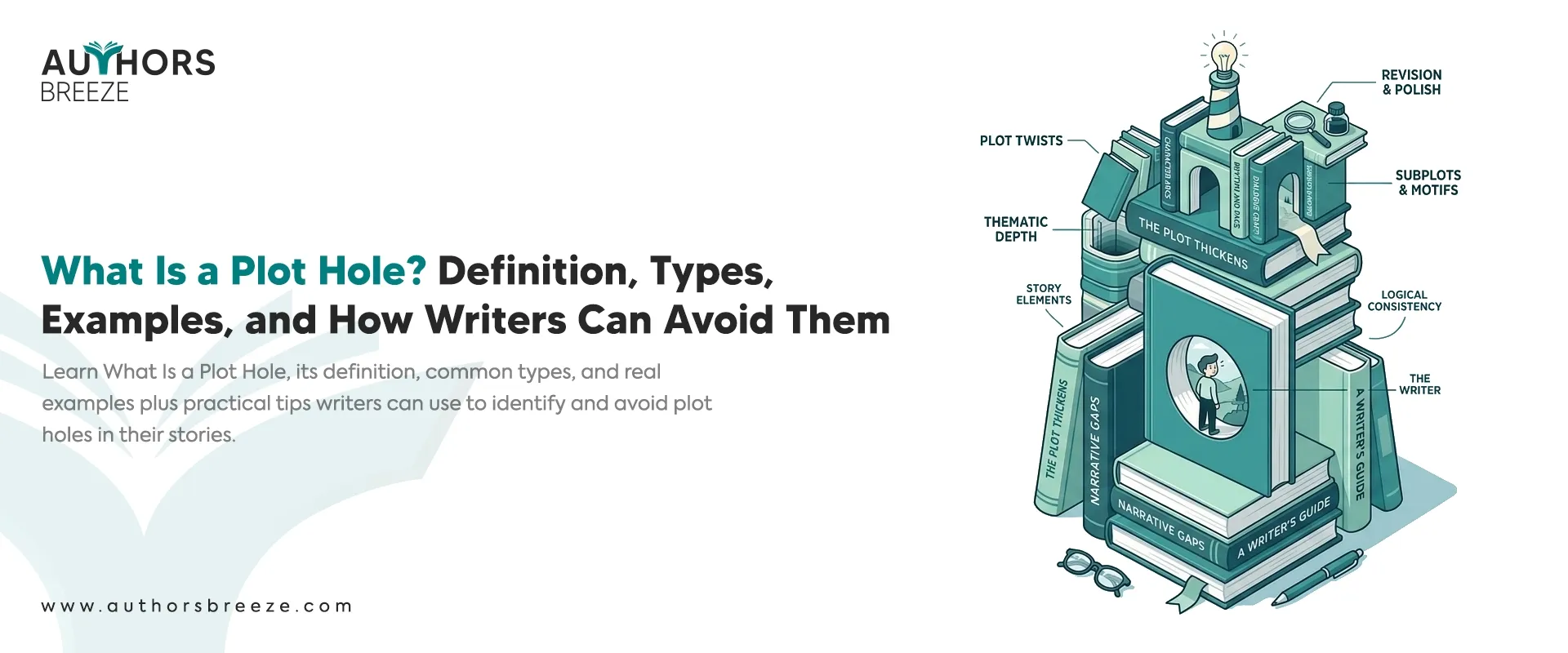
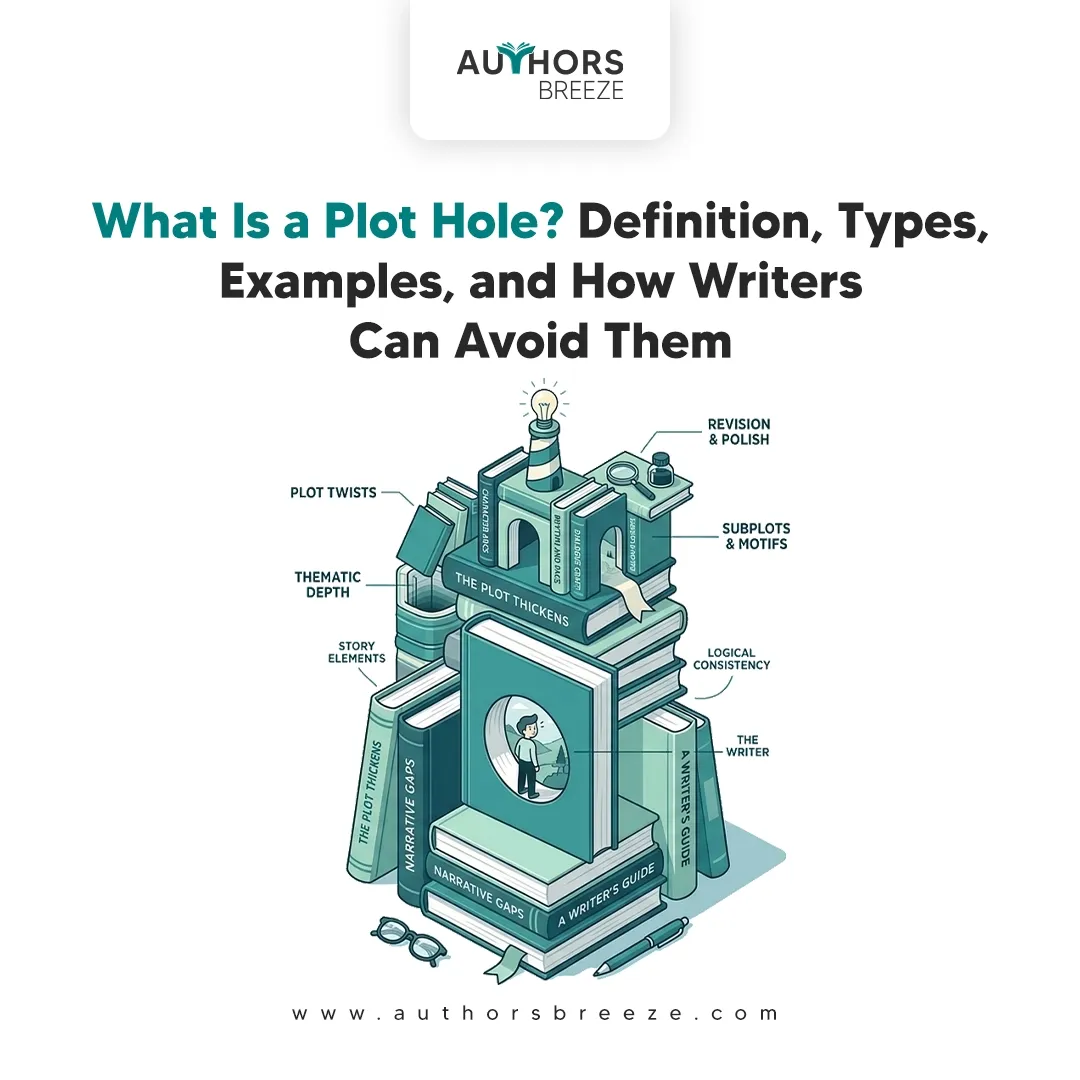
What Is a Plot Hole? Definition, Types, Examples, and How Writers Can Avoid Them

What Is a Plot Hole
What Is a Plot Hole

Key Takeaways

  • A plot hole is an inconsistency, contradiction, or gap in a story that breaks its internal logic.
  • Plot holes can appear in many forms: logical inconsistencies, character inconsistencies, knowledge gaps, continuity errors, plausibility issues, factual errors, impossible events, unresolved plot threads, or convenient solutions.
  • Not every confusing moment is a plot hole—realistic character flaws, suspense, and mystery are often intentional.
  • Major plot holes can disrupt immersion, weaken reader trust, and reduce storytelling quality.
  • Common causes of plot holes include lack of planning, forgotten details, revisions that contradict earlier events, and managing multiple timelines or subplots.
  • Strategies to detect and fix plot holes: review story structure, analyze character motivations, check consistency, ask “why” for key events, and get feedback from beta readers or editors.
  • Prevent plot holes by planning your story in advance, keeping detailed notes, maintaining a clear sequence of events, revisiting earlier chapters, and editing multiple times.
  • Minor plot holes may be overlooked if the story is engaging, but major inconsistencies should be addressed to maintain credibility and immersion.

Polish Your Story, Avoid Plot Holes

Ensure your narrative is consistent and engaging. Let Authors Breeze help you edit and refine your manuscript.

Get Professional Editing Support

Stories are built on logic, emotion, structure, and consistency. Whether you are writing a novel, screenplay, or short story, your audience expects the narrative to make sense within the world you have created. When everything aligns, readers stay immersed. But when something does not quite add up, it creates a disruption, also called a plothole.

Plot holes are one of the most common challenges writers face. Even experienced authors encounter them during drafting or revision. Understanding what they are, why they matter, and how to handle them can significantly improve the quality of your storytelling. In literary terms, it is important to define plot in literary terms before examining where plot holes appear in your work.

Define Plot Hole: What It Means

A plot hole definition is an inconsistency, contradiction, or gap in a story that breaks its internal logic. It happens when events, character actions, or established rules do not align, making the narrative feel confusing or unrealistic.

In simple terms, a plot hole occurs when the story sets something up but later contradicts it or fails to explain it. This helps clarify the plot holes’ meaning for writers who want to maintain a coherent story.

For example, if a character is clearly established as someone who cannot swim but later jumps into deep water and swims effortlessly without explanation, it creates a logical inconsistency. Similarly, if a character suddenly knows information they were never told, or a major holes conflict is resolved without proper buildup, readers may question the story’s credibility.

Some plot holes are obvious, while others only become noticeable upon closer inspection. Once identified, they can weaken the reader’s trust and pull them out of the story experience.

Why Plot Holes Matter

Plot holes may seem like small mistakes, but they can significantly impact how your story is perceived.

First, they break immersion. When readers encounter something that does not make sense, their focus shifts from the story to the flaw. This interrupts emotional engagement and reduces the overall impact of the narrative.

Second, plot holes weaken trust. A well-crafted story builds an unspoken agreement between the writer and the audience. Readers trust that the events, characters, and world rules will remain consistent. When inconsistencies appear, that trust is compromised.

Third, plot holes affect storytelling quality. Even a compelling idea with strong character development can feel incomplete or poorly executed if the plot lacks coherence. Readers may enjoy parts of the story but still feel dissatisfied overall.

In genres like fantasy or science fiction, where the world operates under unique rules, consistency becomes even more important. Readers are willing to accept anything as long as it follows the logic established within the story.

What Is Not a Plot Hole

It is important to understand that not every confusing or imperfect moment qualifies as a plot hole.

A character making a poor or irrational decision is not a plot hole as long as it aligns with their personality, emotions, or circumstances. Humans are flawed, and realistic characters often reflect that.

Unanswered questions are also not necessarily plot holes. Writers sometimes leave certain elements open-ended to create mystery, tension, or interpretation. As long as the core narrative remains logical, this is a valid storytelling technique.

Similarly, unlikely or improbable events do not automatically count as plot holes. If something is rare but still possible within the story’s world, it may stretch believability without breaking logic. Understanding this distinction is crucial to avoid confusing showing hole meaning with actual plot flaws.

Types of Plot Holes

Plot holes can appear in different forms depending on where the inconsistency occurs. Recognizing these types can help you identify issues more effectively.

Logical or Narrative Inconsistencies

These occur when events do not follow a clear cause-and-effect relationship or contradict previously established information.

Character Inconsistencies

When characters act in ways that do not match their established personality, motivations, or development, it creates a disconnect in the narrative.

Knowledge Plot Holes

These arise when a character knows something they were never told or has access to information without a clear source.

Continuity Errors

Continuity issues involve contradictions in details such as timelines, physical objects, injuries, or events. For example, an injury disappearing in the next scene without explanation is a classic case.

Plausibility Issues

These occur when events are technically possible but feel too unrealistic, stretching the reader’s suspension of disbelief.

Factual Errors

Incorrect real-world information, such as historical inaccuracies or scientific mistakes, can also function as plot holes, especially in realistic settings.

Impossible Events

This type appears when a story breaks its own established rules. For instance, if a magic system has clear limitations but those limits are ignored later, it creates inconsistency.

Unresolved Plot Threads

When important subplots or story elements are introduced but never resolved, readers may feel confused or unsatisfied, especially if those elements were central to the story.

Convenient Solutions

This occurs when a conflict is resolved too easily or suddenly, without proper setup. An unexpected rescue or solution that lacks foreshadowing can feel forced and unrealistic.

Examples of Plot Holes

You might ask, what is an example of a plot that illustrates a plot hole? Here are a few simplified examples:

  • A locked-room mystery in a holes script where no explanation is given for how the culprit escaped
  • A character traveling long distances instantly without explanation
  • A villain having a clear chance to succeed but failing to act without a valid reason
  • A character suddenly possessing knowledge or skills they were never shown to have

These moments may seem minor, but they can significantly affect how readers interpret and evaluate the story.

Plot Holes vs Suspense and Mystery

Not every unanswered question is a flaw. In many cases, writers intentionally withhold information to build suspense or create intrigue.

The key difference lies in intent and resolution. A mystery is deliberate and eventually explained, while a plot hole is an unintentional gap that remains unresolved.

Strong writers can even use a literary device that covers up plot holes to disguise minor inconsistencies while maintaining reader engagement.

How Plot Holes Happen

Plot holes are common, even among experienced writers. One major cause is a lack of planning. Without a clear structure, it becomes easier for inconsistencies to slip into the narrative. Thoughtful plotting something in advance reduces the risk.

Other causes include forgetting details, revisions that introduce contradictions, or managing multiple timelines, subplots, and character arcs.

How to Identify and Fix Plot Holes

Detecting plot holes in your own writing can be difficult because you understand the story’s intended logic.

Strategies include reviewing the story structure, analyzing character motivations, checking consistency, and asking why for every major event. Feedback from beta readers or editors can also help.

Fixing plot holes often involves adding missing information, adjusting the plot, strengthening cause and effect, removing unnecessary elements, or rewriting problematic scenes. Minor inconsistencies can be addressed with a literary device that covers up plot holes, while major gaps may require more extensive revision.

Tips to Avoid Plot Holes

Preventing plot holes is easier than fixing them later. Writers can reduce the risk by maintaining clarity and organization:

  • Plan the story in advance
  • Keep detailed notes on characters, timelines, and world-building
  • Create a clear sequence of events
  • Revisit earlier chapters while writing
  • Edit multiple times

Consistency should always be a priority.

Can Plot Holes Be Ignored?

Not all plot holes completely ruin a story. Audiences sometimes overlook minor inconsistencies if the story is engaging. Strong characters, emotional depth, and compelling storytelling can outweigh small flaws. However, major plot holes, especially those affecting the central narrative, are much harder to ignore.

As a writer, the goal is not perfection but coherence. Your story should feel believable within its own framework.

Final Thoughts

A plot hole is more than just a minor mistake. It is a break in the logic that holds your story together. While they are a natural part of the writing process, addressing them strengthens immersion and audience trust.

By understanding what plot holes are, recognizing their different types, and learning how to identify and fix them, writers can create stronger, more engaging narratives. Moreover, for authors looking to publish confidently, Authors Breeze helps writers bring their polished, coherent stories to life with professional guidance and support.

Frequently Asked Questions

What is a plot hole in a story?

A plot hole is a gap, inconsistency, or contradiction in a story that breaks its internal logic.

How can writers avoid plot holes?

Writers can avoid plot holes by planning their story, keeping notes, reviewing timelines, and revising carefully.

Can plot holes ruin a story?

Minor plot holes may be overlooked, but major ones can confuse readers and reduce the story’s credibility.

Professional Story Support for Authors

Avoid plot pitfalls and ensure your book reads smoothly with Authors Breeze’s publishing services.

Contact Us Today

Author : Charles Maynes

16th Mar 2026

How to Write an Amazon Book Description That Sells

How to Write an Amazon Book Description

Key Takeaways

  • A strong book description acts as a sales pitch that persuades readers to explore your book further.
  • The first lines of your description must capture attention before readers click “Read More.”
  • A well-written blurb to Amazon should highlight the main idea, reader benefit, and curiosity without revealing everything.
  • Clear formatting and concise paragraphs improve readability on an Amazon book page.
  • Strategic keywords help readers discover your book when browsing Amazon books.
  • Professional editing, publishing, and marketing support can strengthen your book listing and improve visibility.

Craft a Description That Sells

Turn browsers into buyers. Our ghostwriters create compelling Amazon blurbs that highlight your story and spark curiosity.

Get Ghostwriting Services

Introduction

Publishing a book on Amazon opens the door to a massive global audience. Every day, millions of readers browse Amazon books searching for their next read. However, with so many titles available, standing out can be challenging.

After readers notice your cover and title, the next thing they usually examine is the description. This short piece of text often determines whether they continue exploring your book or move on to another option.

A strong description does not simply summarize the story or topic. Instead, it works like a persuasive marketing copy. It tells readers what makes the book valuable, why it matters, and why they should read it.

Many authors spend months writing a book for Amazon, yet they rush through the description. Unfortunately, that mistake can affect book sales. Learning how to craft a compelling description helps authors present their work professionally and attract the right audience.

In this guide, you will learn the structure and strategies professionals use to create Amazon book descriptions that convert casual browsers into buyers.

Understand the Purpose of an Amazon Book Description

Before writing anything, it is important to understand the role of the description.

The description of a book on Amazon works as a marketing tool. Instead of summarizing the entire story or listing every topic, it focuses on persuading readers to click the buy button. It is one of the most practical book marketing strategies.

Think of it as the digital version of a back cover blurb. It introduces the most compelling idea in the book and builds interest without revealing everything.

Readers browsing the top-selling Amazon books often compare multiple titles before choosing one. A clear and engaging description helps your book stand out during that comparison process.

Professional publishing teams often spend significant time refining descriptions and help ensure that every section of your book listing communicates value effectively.

Start With a Powerful Hook

The opening sentence is the most important part of your description. On an Amazon book page, only the first few lines appear before readers must click “Read More.”

Because of this, your opening should immediately capture attention.

A strong hook may introduce a surprising idea, a relatable problem, or an intriguing situation. Fiction descriptions might highlight a dramatic conflict, while nonfiction books often begin with a challenge readers face.

Many successful bestseller Amazon books follow this exact pattern. Their descriptions begin with a statement or question that sparks curiosity and encourages readers to continue.

When writing your hook, imagine a reader quickly scanning the page. Your first lines should make them pause and want to know more.

Explain the Core Idea of the Book

After the hook captures attention, the next step is to explain what the book is about.

This section should provide the key context while keeping the message clear and focused. Avoid summarizing every chapter. Instead, highlight the central idea or conflict.

Many authors wonder, how do you describe a book in a short paragraph? The answer is to focus on one main theme rather than multiple details.

For nonfiction books, this often involves presenting the primary problem the book helps solve. For fiction, the description may introduce the main character and the situation that drives the story.

If readers quickly understand the concept and feel intrigued, they are far more likely to explore the book further.

Highlight the Value for the Reader

Once the context is clear, the description should emphasize why the book matters.

For nonfiction, explain what readers will gain from reading the book. This may include new skills, insights, or practical strategies. Many people searching online want to learn how to write a book and sell on Amazon, so showing clear benefits can make your book more appealing.

For fiction, focus on emotional stakes. Readers want to know what the character stands to gain or lose. When the tension is clear, the story becomes more compelling.

Some authors review book description examples from successful titles to understand how professionals highlight value while maintaining curiosity.

Use Clear Structure and Formatting

Readers browsing Amazon often skim quickly. Because of this, the description should be easy to read and visually organized.

Short paragraphs work best. They create natural breaks that help readers absorb information quickly. Clear spacing also improves readability on digital screens.

When thinking about how to describe a book, remember that simplicity often works better than complexity. Avoid long explanations or unnecessary details. Instead, focus on clear and engaging sentences that guide readers through the description.

Moreover, many authors seek help from professional editors to refine their descriptions so they remain clear, persuasive, and reader-friendly.

Transform Your Words into Sales

A polished description makes readers click “Buy Now.” Let our editors sharpen your copy for clarity, impact, and engagement.

Get Expert Editing Services

Add Relevant Keywords Naturally

Amazon functions as a search engine as well as an online bookstore. Because of this, relevant keywords can improve discoverability.

Readers sometimes try to find a book by description of the plot when they cannot remember the title. Others perform a book search by plot keywords to discover stories with specific themes.

Including relevant phrases in your description can help your book appear in these searches. For example, someone may want to find a book based on a description that matches a certain genre or storyline.

However, keywords should always appear naturally within the text. Overloading the description with search phrases can make the writing feel forced and less engaging.

Build Credibility and Trust

Readers are more likely to purchase a book when they trust the author.

You can build credibility by briefly mentioning your expertise, experience, or achievements. For nonfiction books, this reassurance is especially important.

Many top-selling authors on Amazon include short credibility statements in their descriptions. These may mention professional experience, previous books, or notable accomplishments.

This section should remain concise while reinforcing the author’s authority.

End With Curiosity

A strong ending encourages readers to take action.

Instead of revealing every detail, the final lines should leave readers wondering what happens next. Fiction descriptions often end with an unresolved question or conflict.

For nonfiction books, the closing may emphasize the transformation readers will experience after applying the ideas in the book.

Remember that the goal is not only to inform readers but also to motivate them to explore the book further.

Examples of Effective Amazon Book Descriptions

Seeing examples helps you understand how to apply the strategies we discussed. Here are some sample descriptions for both fiction and nonfiction:

Fiction Example

Book Title: Whispers in the Dark

“When Emma moves to the quiet town of Ravenwood, she expects peace—but she finds secrets lurking in every shadow. As strange events unfold, she must uncover the truth before it’s too late. Will she survive the darkness or become part of the town’s sinister history?”

Why it works:

  • Starts with a hook that introduces intrigue.
  • Highlights the main conflict and stakes.
  • Leaves readers curious without revealing the ending.

Nonfiction Example

Book Title: The Productivity Blueprint

“Feeling overwhelmed and behind on your goals? This step-by-step guide shows you how to manage your time, prioritize tasks, and boost productivity without burning out. Learn practical strategies used by top achievers to reclaim control of your day and accomplish more.”

Why it works:

  • Opens with a problem the reader can relate to.
  • Clearly explains the value and benefits.
  • Encourages the reader to take action by offering practical solutions.

Conclusion

A strong Amazon description helps readers quickly understand your book and feel excited to explore it. By starting with a clear hook, explaining the main idea, and highlighting reader value, authors can create descriptions that attract attention and encourage purchases.

Success on Amazon also depends on presenting your book professionally. While learning how to create a book on Amazon is important, optimizing elements like book details and marketing strategy makes a real difference. With expert support from Authors Breeze, authors can refine their book listings, improve visibility, and reach the right audience more effectively.

Frequently Asked Questions

What is the ideal length of an Amazon book description?

Most descriptions range between 150 and 250 words. This length keeps the content informative while remaining easy to read.

What should a book description include?

A strong description typically includes a hook, the core idea of the book, the value readers will gain, and a closing statement that builds curiosity.

How can keywords help a book description?

Keywords help Amazon understand what your book is about and improve its visibility in search results.

Can a professional service help with book descriptions?

Yes. Professional editing and marketing services can refine descriptions and improve overall book presentation.

Why is the opening line important?

The opening lines appear before the “Read More” button on Amazon, so they determine whether readers continue reading the description.

Take the Guesswork Out of Amazon Marketing

Struggling with your book description or listing? Seek guidance from our team to create a copy that attracts readers and drives sales.

Contact Us Today

Author : Charles Maynes

12th Mar 2026

Why Hire the Best Ghostwriting Services from Authors Breeze?

Best Ghostwriting Services

Key Takeaways: Why Authors Breeze for Best Ghostwriting Services?

Why select Authors Breeze for the best ghostwriting services when you have too many options available? The answer is in the blog. So continue reading, but if you are in a hurry, have a quick look at the key points to help you make an informed decision.

  • We have experience and are known for writing quality, streamlined workflow, pricing transparency, and confidentiality. You can request samples and check reviews to ensure that we understand your needs.
  • Our ghostwriters save time, improve content quality, and help authors overcome creative roadblocks. We can adapt to different writing styles, making sure the final product aligns with your vision.
  • You can choose from freelance ghostwriters, agencies, ghostwriting companies, publishing firms, and specialists. However, with little clarity and the constant fear of investing in the wrong choice, we are the right option because we offer professional, full-service solutions.
  • We are one of the top ghostwriting companies since we offer more than just writing. We provide book editing, proofreading, formatting, cover design, ebook publishing, audiobook production, book marketing, and website design for authors.

Exemplary Services for Your Work

Overwhelmed by unfinished ideas, endless drafts, and no time to write? Opt for our ghostwriters today and bring your ideas to life.

Get Professional Ghostwriting Services

Introduction

Here are some common issues people with literary ideas often face.

  • Time management – Either they don’t have enough time to write, or they are unable to handle other tasks with writing.
  • Getting Started/Writer’s Block – They find it difficult to put their ideas into words or even keep writing.
  • Imposter Syndrome (Self-doubt) – They doubt their abilities and the value of their work.

If you encounter any of the above, you can hire a ghostwriter for your ease. But you might then have to deal with:

  • Losing your voice – The work might not sound like you.
  • Communication barriers – Either you are unable to explain your ideas clearly to the ghostwriter, or they cannot understand your vision.
  • Budget Concerns – Hiring a ghostwriter can be pricey.
  • Trust Issues – Keeping faith in the ghostwriter to ensure your ideas remain private as well as follow your vision.

To address the above concerns, you must choose the right ghostwriting services to ensure:

  • your ideas are captured authentically,
  • your voice is preserved, and
  • the process is smooth, secure, and within your budget.

The real question is, why select Authors Breeze from the best ghostwriting companies to pick a professional ghostwriter? Let’s explore. But before, if you are new to ghostwriting, you should know what ghostwriting is and who a ghostwriter is.

What is Ghostwriting?

Ghostwriting is the professional service where a person creates content (such as writing a book) on behalf of someone who lacks the time or skills to do it independently. However, the one who writes (ghostwriter) doesn’t get any credit for it, and the ownership and recognition are attributed to the hiring individual or organization.

Ghostwriting has existed for many years now, but its demand has recently increased. Writers also often hire ghostwriters to help them with their different types of content writing projects, such as:

  • White papers
  • Business reports
  • Articles, etc.

What is a Ghostwriter?

A ghostwriter is a professional writer who creates content such as books, articles, speeches, or other texts without taking any credit but money. They use this deceptive strategy, allowing people, often public figures or professionals, to produce written material without personally authoring it.

Curious to know more? Then, have a look at: “What is a Ghostwriter? And Why Hire One”

Why Hire The Best Ghostwriting Services?

There are many reasons why an author should consider the best ghostwriting service, such as Authors Breeze. For instance, some authors, either professionals or not, face writer’s block, which means they struggle to put their ideas into words.

Sometimes, the case is due to a lack of time or availability. In such instances, ghostwriters are also hired. They have the skills and ability to convert your ideas into compelling and well-written content, saving you time and energy.

In addition to this, you can get several other benefits if you hire the perfect ghostwriting service. Let’s discuss some:

  • An expert ghostwriter has the unique skill of combining words to create an engaging literary masterpiece that enhances various emotions in readers.
  • Their expertise and experience enable them to create many different styles and tones. As a result, they can quickly adapt to your writing needs and preferences.
  • A ghostwriter acts as a reliable partner, relieving the stress of writing and freeing up the time for core expertise.

Types of Professional Ghostwriting Services

The best ghostwriting services can come from different types of providers. Each offers unique benefits. Here’s an easy breakdown for you:

Freelance Ghostwriters

These are independent writers that you can hire directly for your projects. They’re usually affordable and flexible, but their work might vary in quality. Platforms such as Fiverr and Upwork are popular if you want to find freelancers.

Ghostwriting Companies

These are firms with teams of writers who handle everything from books to marketing content. They’re reliable and well-organized, but their services often cost more.

Ghostwriting Agencies

Similar to companies, agencies focus on big projects such as book series and standalone novels. They’re professional and can manage complex work, but they’re not as personal and can be pricey.

Publishing Firms

These include ghostwriting as part of services like editing, formatting, and publishing. They’re great for authors who want everything handled in one place, but they can be more expensive.

Ghostwriting Specialists

Some writers or small teams focus on specific areas, such as scholarly papers, screenplays, or genre-specific books. They’re perfect if you need an expert for a particular type of project.

Which Option Is Best For You?

You can choose freelancers for smaller, budget-friendly projects. However, go with companies such as Authors Breeze for bigger, more professional work.

What Other Services Can You Expect From The Best Ghostwriting Companies Like Authors Breeze?

We offer more than just ghostwriting services. Not only will we help you polish your book to perfection, but you will also be able to publish a book to reach readers worldwide. So, let’s take a look at some additional services you can expect from us:

Ebook Writing

Our ebook writers help you convert your manuscript into ebooks. They are crucial if you want to tap into a more lucrative market. We align our ebook writing services with ghostwriting in order to maintain your voice and vision throughout the digital book.

Book Editing

An extension of the best ghostwriting services is editing. The primary purpose of it is to refine and enhance the initial drafts produced by the ghostwriter. Our book editors have hands-on experience in every type of editing. They ensure your work, whether in print or digital format, is coherent, engaging, and professional. That is vital for your literary success.

Proofreading

Once your manuscript has been written and revised, it requires refinement from experts with a keen eye for details. Proofreading by our certified proofreaders means your book is free from errors. As a result, you will get a clean and polished final product ready for publishing.

To find the best proofreaders, you can read our blog: “12 Best Proofreading Companies for Authors.”

Book Formatting

Book formatting makes the manuscript easy to read and attractive. Our book formatters help you prepare your book in various formats, be it print or digital. Thus enhancing the experience of readers.

Also Read: “How to Format a Book for Publishing?”

Book Cover Services

The book cover design is often the first point of contact between the book and potential readers. That is why we include book cover design services as an add-on in our ghostwriting packages. Our book cover designers ensure the visuals of your book match the quality and theme of the written content.

Ebook Publishing

Our best ghostwriting services encompass ebook publishing services. We can help you navigate the complex book publishing process by getting your books to online publishing platforms. Our team also assists you with ISBN registration, distribution agreements, and placing your book on major platforms.

Audiobook Production

Audiobooks have recently gained immense popularity because many readers prefer listening to books rather than reading them. Our audiobook services transform written content into audio formats, thereby reaching an audience that prefers listening to reading.

Book Marketing

As soon as you complete your book, it would be best to promote it to reach your target audience and increase book sales. However, creating a book marketing plan can be challenging. This is where we provide book marketing services to boost visibility, reach target audiences, and increase sales.

Book Video Trailer

Video trailers create a visual teaser for your book, similar to a movie trailer. Running them as book advertisements can be a clever marketing strategy. We craft book video trailers to generate interest and buzz, showcasing key themes and elements of your story. As a result, these book promos help capture the essence of the book in a dynamic format, attracting a wider audience.

Author Website

Websites serve as a central platform for authors, and we include author website design services to help authors showcase their work, build their brand, and interact directly with readers. Our web content writers also produce SEO-optimized content for author websites. We ensure that the site ranks well in search engines and attracts and engages visitors effectively.

Blog and Article Writing

Maintaining a blog helps authors to connect with their audience, share insights, and build a community. At the same time, articles can help authors establish authority in their niche.

Our blogging experts write craft posts that are informative, engaging, and reflective of the author’s writing style. We also provide article-writing services to help authors share expertise, reach new readers, and enhance their reputation in the literary community.

Write and Publish Your First Book

We help writers of every genre (fiction or nonfiction) and experience level (new or seasoned) complete, refine, publish, and market their books. Join 1000+ of satisfied clients.

Get a Free Consultation

How Authors Breeze Ghostwriting Services Work?

Our entire ghostwriting process ensures a high-quality, professionally written book tailored to your vision while maintaining your unique voice & vision and keeping you in control of the final product.

Here is how we work:

  1. We begin with a consultation where you discuss your book idea, goals, target audience, and preferred writing style with the Authors Breeze team.
  2. Then, a dedicated ghostwriter works with you to create a detailed outline and conduct the necessary research to ensure the book aligns with your vision.
  3. The ghostwriter crafts the manuscript in stages. They ensure a compelling narrative with engaging content while keeping you involved in the creative process.
  4. Once written, you review each draft and provide feedback. Revisions are made to refine the content until it fully meets your expectations.
  5. After the manuscript is complete, expert editors proofread and polish the text for clarity, consistency, and quality.
  6. At last, the finalized manuscript is formatted according to publishing standards, whether for print or digital distribution.
  7. Also, if needed, Authors Breeze assists with self-publishing, cover design, and book marketing strategies to help your book reach the right audience.

How are Self-Publishing Companies like Authors Breeze Better than Regular Ghostwriting Agencies?

The line between ghostwriting agencies and publishing companies can often feel blurry, especially as many agencies now claim to offer publishing services. However, the approaches they use are worlds apart.

The truth is that agencies often rely on a “middleman” model, outsourcing projects to cheap freelancers. This can lead to subpar results for authors. Genuine publishing companies, like Authors Breeze, prioritize expertise and quality at every step of the process.

But how can you tell them apart? Let’s explore:

Quality vs. Quantity

Publishing companies often focus on delivering high-quality, customized services tailored to an author’s needs. For example, Authors Breeze offers personalized solutions, ensuring each book receives meticulous attention. Agencies that rely on subcontractors, however, are often more concerned with churning out projects in volume, potentially sacrificing quality.

Full-Service Offerings

Companies like Authors Breeze manage the entire publishing process in-house—from editing and formatting to marketing and design. This ensures consistency and quality control. Ghostwriting agencies typically outsource these tasks, which can result in varying quality and a disjointed final product.

Client Support and Expertise

As a reputable publishing company, we invest in the success of our clients, providing expert guidance and ongoing support throughout the process. Agencies, on the other hand, might lack the industry knowledge or resources to offer meaningful advice, leaving authors feeling unsupported.

How Can You Tell the Difference Between Vanity Publishing and Legitimate Self-Publishing Companies Like Authors Breeze?

With the rise in scams targeting authors, you should know which self-publishing companies to avoid. But how can you? Let’s discuss:

Portfolio and Experience Matter

A reliable self-publishing firm proudly showcases its work. Authors Breeze, for example, features case studies of published authors, giving potential clients a clear sense of how we can help them. Vanity publishers, on the other hand, often avoid displaying their completed projects.

Key Insight:

“If you can’t see examples of any work of the company, it’s a red flag that they might not meet professional standards.”

Transparency in Pricing

Legitimate publishing companies like Authors Breeze clearly outline their starting pricing on their website. This openness ensures you know exactly what you’re paying for, whether it’s editing, ghostwriting, or publishing services.

By contrast, many ghostwriting agencies avoid listing prices and instead ask clients about what they want. This lack of transparency can indicate hidden fees or inconsistent pricing practices.

Also Read: “How to Become a Ghostwriter?”

What are the Benefits of Hiring Authors Breeze for The Ghostwriting Services?

Writing and publishing a book to reach readers worldwide is not something that everyone can do. That is where we come in and help you. You can get us at your disposal so you can focus on other essential aspects of your personal and professional life while the ghostwriter you hire for your book from us is busy completing it.

Other than that, there are a few more reasons to hire an experienced ghostwriter from Authors Breeze for your writing project. Let’s take a look at those compelling benefits:

Expertise and Experience

Our ghostwriters have skills and years of experience in writing and publishing literary content. We can help you develop your ideas, structure your content, and create a polished final product in a way that is compelling and catchy for the readers.

Time and Energy

Let’s just face it. Writing a book is not an easy task as it requires so much of your time and energy. However, our ghostwriters can help you with your content and free up your time and energy so you can focus on other aspects of your life.

Also Read: “How Long Does It Take To Write A Book”

Confidentiality

Reliable ghostwriting services like ours maintain strict confidentiality when it comes to your ideas and intellectual property. We produce content under your name and make sure you receive full credit for it.

Adaptability and Quality

Our ghostwriters are writing specialists who can adapt to different writing styles and formats in order to deliver high-quality content. We make sure that your book is convincing enough to attract readers.

Conclusion

When you have a story to tell but lack the appropriate words to convey it, or you don’t have enough time to complete it, that is where ghostwriters and their services rescue you. They will help you write your book on your behalf.

However, you need to select the right company to provide you with the best ghostwriting services to make your book clear and professional. Authors Breeze is that company. We not only enhance the quality of your writing and satisfy your specifications but also help you publish your book and reach readers worldwide.

Frequently Asked Questions

What is a ghostwriting service, and how does it work?

A ghostwriting service provides professional writers who create content on behalf of an author while keeping the author’s name as the credited writer. Typically, the process involves:

  • Initial consultation to understand the project and goals
  • Interviews and research to gather content and ideas
  • Drafting chapters and reviewing them with the client
  • Editing, proofreading, and formatting for publication
  • Optional publishing and marketing support

Ghostwriters ensure your ideas are clearly communicated, professionally written, and ready for market.

How long does it take to complete a ghostwritten book?

Timeframes depend on the type of book, research needed, and revisions:

  • Short books: 1–3 months
  • Standard nonfiction or fiction books: 4–8 months
  • Memoirs, autobiographies, or complex research-based projects: 6–12 months

Regular communication between the author and ghostwriter ensures deadlines are met.

Will I retain full rights and authorship?

Yes. Reputable ghostwriting services provide legal agreements guaranteeing that the author retains:

  • Full copyright and intellectual property rights
  • Creative control over content
  • Credit as the book’s author

Confidentiality is a standard practice, so your ideas and drafts are protected.

Find the Best, Hire the Expert

Choose the best-suited ghostwriter from our pool of writers to ensure your book reflects your voice and vision while meeting professional publishing standards.

Contact Us

Author : Charles Maynes

03rd Mar 2026

What Is a Book Dedication and How to Write It

Book Dedication
Book Dedication

Key Takeaways 

  • A book dedication is usually a short, personal note placed in the front of your book.
  • It can honor a person, group, memory, or inspiration.
  • Dedications can be serious, humorous, poetic, or simple depending on your book’s tone.
  • Keep it brief—usually one sentence or a few lines—for maximum impact.
  • Use sample book dedication pages or dedication page examples as inspiration.
  • Writing a novel dedication helps set the emotional tone for readers.
  • Handwritten book dedications add a personal and unique touch.
  • Avoid common mistakes: too long, vague, or including private jokes.
  • Reviewing best dedications or short and meaningful book dedication quotes can guide first-time authors.

Struggling to Write a Heartfelt Dedication?

Even the most meaningful ideas can get lost if you’re unsure how to express them. Let our ghostwriters craft a sincere, polished book dedication to attract readers.

Hire Professional Ghostwriters

Introduction 

A book dedication may be short, but it carries deep meaning. It is often the first personal note a reader encounters, appearing before the story or main content begins. In just a few lines, an author can express gratitude, love, respect, or inspiration. Whether you are writing fiction, nonfiction, poetry, or an academic book, a thoughtful book dedication adds a human touch that connects the author to the reader.

In this blog, we will cover what is the dedication page of a book, share dedication page examples, and provide practical steps for writing your own. You will also find sample book dedication page ideas and dedication real world examples to inspire your message.

What Is a Book Dedication? 

A book dedication is a short message placed in the front matter of a book, usually on its own page after the title page. Many people refer to this as a dedication page, and it often sets the tone for the work. A book dedication is written to honor a person, group, idea, or memory that played an important role in the creation of the book.

Unlike acknowledgments, which are longer and more detailed, a book dedication is brief and focused. It does not explain contributions in detail. Instead, it simply recognizes emotional, personal, or inspirational significance.

A dedication page example can be:

  • One line or a short paragraph
  • Serious, emotional, poetic, or lighthearted
  • Personal or broadly addressed

Whether you are looking for best dedications or a novel dedication, there are no strict rules, which makes it one of the most flexible parts of a book.

Why a Book Dedication Matters 

Many authors underestimate the importance of a book dedication, but it serves several valuable purposes.

First, it allows the author to express gratitude. Writing a book is rarely a solo journey. Emotional support, inspiration, or belief from others often plays a major role. Some authors include a book dedication in memory of a loved one or mentor, highlighting the personal significance behind their work.

Second, a book dedication adds authenticity. Readers often enjoy seeing the personal side of an author before diving into the content. Reviewing dedication real world examples shows how even a single heartfelt line can resonate deeply with readers.

Third, it sets the emotional tone. A heartfelt dedication can prepare the reader for an emotional story, while a humorous or playful dedication page example can signal a lighter read.

Finally, from a professional standpoint, a well-written book dedication page contributes to a complete and polished book structure, which matters in self-publishing and traditional publishing alike.

Do You Need a Book Dedication? 

A book dedication is optional. Some authors choose not to include one, and that is perfectly acceptable. However, if someone or something played a meaningful role in your writing journey, including a dedication page can feel both rewarding and appropriate.

Many authors write their novel dedication at the very end of the process, once the full journey is complete. Others prefer to write it early as a reminder of who or what inspired them. Learning how to write a dedication page in a book can help first-time authors craft a message that feels genuine and memorable.

Who Can You Dedicate a Book To? 

One of the strengths of a book dedication is its flexibility. You can dedicate your book to almost anyone or anything that holds meaning for you.

Common choices include:

  • A spouse, partner, or family member
  • Parents, children, or grandparents
  • Friends or mentors
  • Teachers or guides
  • Readers or a specific community

Some authors choose a broader approach and dedicate their book to:

  • A group of people with shared experiences
  • Dreamers, survivors, or learners
  • A belief, idea, or value
  • A memory or life experience

The key is intention. Knowing how to write a heartfelt book dedication for someone special is about focusing on emotional significance rather than obligation.

Choosing the Right Tone 

The tone of your book dedication should match both your personality and your book’s overall mood.

For example:

  • A memoir may call for an emotional and sincere tone
  • A romance novel may use warmth or poetry
  • A humor book may include a playful dedication
  • A business or self-help book may keep the tone respectful and appreciative

Simple and honest language often creates the most impact. Reviewing best book dedication examples for first-time authors shows that authenticity resonates more than elaborate phrasing.

How Long Should a Book Dedication Be? 

Most book dedication pages are very short. One sentence is often enough. Some authors use two or three lines. Rarely does a dedication exceed a short paragraph.

If you feel the urge to explain, list many names, or describe contributions, that content usually belongs in the acknowledgments section instead. Keeping a short and meaningful book dedication quotes approach ensures your dedication is memorable and impactful.

How to Write a Book Dedication Step by Step 

Step 1: Identify the Most Meaningful Influence 

Decide who or what you want to honor in your book dedication. It could be a person, group, idea, or experience that played a significant role in your writing journey.

Step 2: Define the Reason for the Dedication 

Clarify why you are dedicating the book. Whether it is for gratitude, inspiration, love, or remembrance, knowing the reason helps you choose sincere and focused words. Many authors even create a handwritten book dedication for added personal touch.

Step 3: Consider the Tone of Your Book 

Match the dedication’s tone with your book’s overall mood. Serious books may need a respectful tone, while creative works can be warm, poetic, or playful. Looking at dedication page examples can help you decide on a suitable style.

Step 4: Decide on the Length 

Keep your book dedication short and impactful, usually one sentence or a few lines. Avoid long explanations or multiple names, which are better suited for acknowledgments. Understanding how do you write a dedication page ensures clarity and simplicity.

Step 5: Write Using Simple and Honest Language 

Use clear and natural language that reflects your genuine feelings. Avoid overcomplicating the message or using dramatic expressions. Reviewing a sample book dedication page can help you frame your words naturally.

Step 6: Review for Clarity and Accuracy 

Read your dedication as a first-time reader would. Ensure all names are correct, the wording is easy to understand, and the message feels heartfelt. Dedication real world examples can provide helpful references.

Step 7: Format and Place It Correctly 

Place the dedication on its own page near the front of your book, usually after the title page. Keep the formatting simple and centered for a clean, professional appearance. A dedication page of a book example typically follows this standard.

Ensure Your Dedication Looks Perfect

A well-written dedication can lose impact if poorly formatted. Let our formatters place it professionally for a polished, reader-ready dedication.

Get Expert Book Formatting

Common Mistakes to Avoid 

There are a few common errors that can reduce the impact of a book dedication page:

  • Making it too long — readers expect a brief message.
  • Being too vague or generic — the dedication should feel intentional.
  • Using private jokes or obscure references — it can confuse readers.
  • Spelling names incorrectly or using unclear wording — always proofread carefully.

Examples of Book Dedication Styles 

Personal Dedication:
“To my parents, for their unwavering support.”

Thematic Dedication:
“For every dreamer who ever opened a window into their imagination.”

Poetic Dedication: 
“To those who chase the impossible with open hearts.”

Humorous Dedication:
“To my enemies — look at me now.”

These are best dedications and dedication page examples that can inspire your own novel dedication.

Final Thoughts 

A book dedication may be one of the shortest parts of your book, but it carries lasting emotional weight. It is your chance to pause, acknowledge, and honor someone or something meaningful before inviting readers into your work. By keeping it simple, sincere, and intentional, you create a small but powerful moment that adds depth and professionalism to your book.

Whether you are writing your first book or revising an old manuscript, learning how to write a heartfelt book dedication for someone special or referencing dedication page examples can make the process easier and more meaningful. Services like Authors Breeze can help streamline the publishing process, ensuring your book dedication page and front matter are polished and professional.

Frequently Asked Questions

What is the dedication page of a book? 

It is a short page at the front of the book where the author honors someone or something meaningful.

How do you write a dedication page? 

Identify the person or idea, clarify the reason, choose a tone, keep it short, and format it on a separate page.

Can ghostwriters help with a book dedication? 

Yes, ghostwriters can help craft a meaningful dedication that reflects the author’s voice.

What is a handwritten book dedication? 

It is a personal, often signed dedication written by the author, adding a unique and emotional touch.

Can I include multiple names in a book dedication? 

While possible, it’s best to keep the book dedication page short. Detailed recognition should go in the acknowledgments.

Get Your Book Dedication Done Right

Unsure how to start your dedication or place it professionally? Let Authors Breeze handle it with precision and make your book front matter shine.

Get a Quote

Author : Charles Maynes

27th Feb 2026

Amazon Ads for Authors: A Complete Guide to Advertising Your Book on Amazon

Amazon Ads for Authors

Key Takeaways 

  • Amazon Ads for Authors help writers reach readers exactly when they’re searching to buy. 
  • Start with a strong book listing — cover, description, and keywords matter. 
  • Use a mix of automatic and manual campaigns to discover and refine profitable keywords. 
  • Track performance regularly, pause poor performers, and scale what works. 
  • Professional support, like Authors Breeze, can make campaigns more efficient and profitable. 

Want Predictable Sales From Amazon Ads?

Managing keywords, bids, and campaigns is overwhelming for many authors. Let our expert marketers create structured ad campaigns so your book reaches more readers.

Get Expert Marketing Services

Introduction 

Publishing a book is only half the journey. Getting it in front of the right readers is where most authors struggle. With millions of titles competing for attention, relying on organic visibility alone is rarely enough. This is why Amazon Ads for authors have become one of the most effective tools for modern writers. 

This blog explains how does amazon advertising work, whether is amazon ads worth it, and how authors can use a structured approach to turn ad for books into a reliable sales channel. 

Understanding Amazon Advertising for Books 

Amazon’s advertising platform allows authors to promote their books directly within Amazon, reaching readers while they are actively searching or browsing. Ads appear in search results and on product pages, making them feel native rather than disruptive. 

For authors, this form of publishing advertising is powerful because intent is already high. Readers are not just discovering content—they are looking to buy. 

Are Amazon Ads Worth It for Authors? 

Many writers ask if Amazon sponsored ads are worth it before investing their budget. The answer depends on preparation and execution. 

Amazon ads work best when: 

  • Your book has a professional cover and polished description 
  • Pricing is competitive within your genre 
  • Categories and metadata are correctly set 

Multiple Amazon advertising case studies show that ads do not compensate for weak listings, but they dramatically amplify strong ones. When done right, Amazon Ads for Authors become an accelerator, not a gamble. 

Choosing the Right Amazon Ads Strategy 

A successful Amazon Ads strategy balances discovery with control. 

  • Automatic campaigns allow Amazon to match your book to relevant searches, helping uncover opportunities you may miss. 
  • Manual campaigns give you precision, letting you target specific keywords or book placements. 

Most authors see the best results by combining both. Automatic campaigns gather data, while manual campaigns refine performance and profitability. 

How to Advertise Your Book on Amazon Step by Step 

Understanding how to advertise your book on amazon requires a clear, repeatable process. Below is a practical step-by-step framework authors can follow. 

Step 1: Optimize Your Book Listing First 

Before launching any book advertisement, your product page must be ready to convert. Ads drive traffic, but your listing closes the sale. 

Focus on: 

  • Genre-appropriate cover design 
  • A compelling description that highlights reader value 
  • Accurate categories and keywords 

Without this foundation, ad spend is often wasted. 

Step 2: Set Up Your Amazon Ads Account 

Access Amazon Ads using the same account linked to KDP. Start with Sponsored Products campaigns, as they are the most direct and effective option for individual titles. 

Step 3: Decide on Budget and Bids 

The cost to advertise on amazon varies by genre and competition. Start with a sustainable daily budget that allows data collection without overspending. Amazon’s suggested bids provide a useful benchmark. 

Understanding your royalty margins is essential, especially when managing Amazon KDP advertising cost long term. 

Step 4: Launch Automatic Campaigns 

Automatic campaigns help Amazon test your book against relevant searches and placements. These campaigns are invaluable for discovering which terms and book pages attract genuine reader interest. 

Step 5: Create Manual Campaigns 

Once data is available, build manual campaigns using proven keywords. Separate campaigns by match type and keep them focused. This step is central to learning how to run amazon ads effectively. 

Step 6: Review Search Term Reports 

Search term reports show what readers actually typed before clicking your ad. Use them to: 

  • Identify converting terms 
  • Remove irrelevant traffic 
  • Understand patterns within Amazon’s popular searches 

Step 7: Optimize Through Testing 

Ongoing refinement is critical. Lower bids or pause targets that generate clicks without sales, and scale keywords that perform well. Structured click testing for authors helps ensure decisions are based on data, not guesswork. 

Step 8: Scale Profitable Campaigns 

Once certain campaigns consistently convert, increase budgets gradually and expand keyword variations. At this stage, advertising books on Amazon becomes a repeatable system rather than trial and error. 

Make Your Amazon Ads Work Harder for You

Poorly structured campaigns can drain your budget without results. With Authors Breeze, your Amazon book marketing is precise, optimized, and profitable.

Contact Us

Creating Ads That Actually Sell 

Running ads that sell book copies requires relevance and clarity. Target genre-specific terms rather than broad keywords, and ensure your book’s promise aligns with reader expectations. When ads match intent, conversion rates rise and wasted spend drops. 

Beyond Basic Campaigns 

Authors with multiple titles can explore advanced formats such as Amazon Headline Search Ads campaigns, which showcase several books at once and support author branding. These campaigns are especially useful for series and backlist promotion. 

Some placements also align with curated browsing experiences, similar to themed collections like Amazon’s Living Good Daily Book, helping books gain visibility beyond direct searches. 

Why Professional Amazon Book Marketing Services Matter 

While many authors start independently, scaling ads requires time, analysis, and expertise. Specialized Amazon book marketing services focus exclusively on publishing ads, ensuring campaigns are structured for profitability rather than vanity metrics. This level of support is often the difference between steady growth and stalled results. 

Conclusion 

Amazon Ads for authors are not a shortcut, but they are one of the most powerful tools available to writers today. When approached with structure, testing, and optimization, they support sustainable sales and long-term visibility. 

For authors who want expert guidance rather than trial and error, Authors Breeze provides data-driven Amazon advertising solutions tailored specifically for books. With the right strategy and execution, Amazon ads can become a predictable engine for growing your readership and revenue. 

Frequently Asked Questions

Are Amazon ads worth it for authors? 

Yes. When your book listing is polished and your audience is targeted, Amazon ads can increase visibility, clicks, and sales. 

How much does it cost to advertise a book on Amazon? 

Costs vary by genre, competition, and keywords. You pay per click, and budgets can start small and scale as you see results. 

Which campaign type should I start with? 

Start with Sponsored Products campaigns. They appear in search results and on book pages, giving direct exposure to readers. 

How do I know if my ads are working? 

Monitor search term reports, clicks, conversions, and ROI. Adjust bids, pause low-performing keywords, and scale profitable campaigns. 

Can I manage Amazon ads myself, or should I hire a service? 

Beginners can start themselves, but professional services like Authors Breeze help optimize campaigns faster and maximize profitability. 

Need a Cost Estimate for Amazon Book Advertising?

Advertising books effectively requires strategy and investment. Connect with us for a detailed quote and find the best plan for your goals.

Get a Quote

Author : Charles Maynes

17th Feb 2026

What Is a Book Synopsis and How to Write One for Your Novel

Book Synopsis
Book Synopsis

Key Takeaways

  • A book synopsis is a concise, structured summary of your novel for editors, agents, or collaborators.
  • Include main characters, central conflict, key events, and resolution.
  • Keep it clear, concise, and in the third person, present tense.
  • Standard length is 1–3 pages (500–800 words); avoid subplots or fluff.
  • A brief synopsis is a one-page version for query letters or pitch emails.
  • A strong synopsis guides editors and marketers, streamlining the publishing process.

Ready to Pitch Your Book with Confidence?

Let our professional writers craft your synopsis so you can focus on your writing journey.

Get expert writing services

Writing a novel is a huge achievement, but crafting a book synopsis is often where authors get stuck. Many writers pour months into character development, plot, and world-building, only to freeze when asked to summarize their story in a few pages. Yet a clear, professional book synopsis is one of the most powerful tools in a self-publishing author’s toolkit.

A book synopsis is more than just a summary. It is a concise, structured overview of your story designed for editors, agents, or ghostwriters. It clarifies your narrative, highlights the protagonist’s journey, and lays out the full story arc, including the ending. For self-published authors, a strong synopsis also supports marketing, positioning, and collaboration with professional writing services.

This blog will help you write a compelling book synopsis while staying true to your novel, with clear instructions and examples that make the process easier.

What Is a Book Synopsis and Why Does It Matter

A book synopsis is a professional summary of your novel that explains:

  • The main characters
  • The central conflict
  • Key events that drive the story
  • How the story resolves

Unlike a book blurb, it does not hide spoilers. Instead, it presents the full narrative in a concise and readable way.

For self-published authors, a book synopsis is essential because it:

  • Helps editors provide accurate feedback
  • Guides ghostwriters and collaborators
  • Supports book positioning and marketing
  • Clarifies the story arc for the author

Think of it as the backbone of your novel: if the synopsis is clear, the story itself will be too.

What Is a Brief Synopsis

A brief synopsis is a shorter version of your full synopsis, usually one page or less. It focuses on the main plot, introduces the protagonist, and highlights the central conflict and resolution.

Brief synopses are useful for:

  • Query letters
  • Pitch emails
  • Situations where professionals need a quick understanding of your story

Even though it is shorter, a brief synopsis should clearly convey your story’s essence. You can see the following short synopsis example of the story of Jack and Jill to understand how much detail to include without overwhelming the reader.

Example of synopsis:

“Jack and Jill is the story of a boy and a girl who went up a hill together. They went to fetch a pail of water, but unfortunately, their plan is disrupted when Jack falls and hits his head, and rolls back down the hill. Then, Jill falls too, and comes tumbling down after Jack.”

Book Synopsis vs Book Blurb: Know the Difference

A very common mistake that many authors make is confusing a book synopsis with a book blurb.

  • Book Blurb: Written for readers. It teases the story and encourages them to buy the book. Avoids spoilers.
  • Book Synopsis: Written for editors, agents, or collaborators. Explains the full story, including spoilers, key decisions, and resolutions.

Additionally, understanding the difference between a synopsis and a summary is also important. A summary may be informal and short, while a synopsis is polished, structured, and professional.

How Long Should a Novel Synopsis Be?

A novel synopsis should be long enough to cover your story completely but concise enough to be easy to read. Editors and agents need to see the full plot, including the ending, however without knowing the unnecessary details.

Key guidelines for a novel synopsis:

  • Standard length: 1–3 pages, depending on your story and submission requirements
  • Word count: Typically 500–800 words
  • Format: Third person, present tense, double-spaced, and easy-to-read font

Focus on clarity and completeness rather than marketing language. Include all major plot points, but avoid minor subplots or extra details. A well-structured, concise synopsis makes your story easy to understand and evaluate.

How to Structure a Novel Book Synopsis

A well-structured synopsis follows the story’s natural flow. Use a beginning → middle → end format:

1. Beginning: Introduce Characters and Setting

  • Introduce your protagonist and their defining trait
  • Establish the setting if relevant
  • Present the central conflict

Example:
“Lena Carter is a young journalist struggling to rebuild her career after a public failure. When she uncovers a hidden crime in her hometown, she must confront her past to bring the truth to light.”

2. Middle: Key Conflicts and Turning Points

Focus on the main plot, including cause-and-effect events:

  • How the protagonist responds to challenges
  • Obstacles that arise and raise the stakes
  • Important relationships influencing the story
  • Escalation toward the climax

Avoid minor subplots or excessive detail. The goal is a clear narrative flow. Looking at some best novel synopsis examples can help you see how professionals balance brevity and depth.

3. Ending: Resolution and Outcome

Clearly outline how the story concludes:

  • Show the final conflict
  • Explain the protagonist’s choice
  • Present the outcome and character growth

This completes the synopsis of the story and makes sure your synopsis reflects the full narrative.

Writing Style Tips for an Effective Book Synopsis

Use a professional, easy-to-read style. For example:

  • Third person, present tense
  • Clear, direct sentences
  • Focus on actions and decisions
  • Name characters specifically
  • Avoid dialogue, flowery language, or long descriptions

If you want, you can follow a format for a synopsis to ensure structure, flow, and readability.

Common Mistakes to Avoid

Following are some of the common mistakes that new authors/writers make while writing a book synopsis:

  • Confusing the synopsis with a blurb
  • Including too many characters or subplots
  • Leaving out the ending
  • Using vague or dramatic language
  • Exceeding recommended length

If needed, refer to an example of a book summary or a guide on how to write a plot summary to see a clean, professional approach.

What to Include in a Novel Synopsis

  • Protagonist’s name and defining trait
  • Central conflict and stakes
  • Key events driving the story
  • Turning points and character decisions
  • Ending and character growth
  • Clear, concise language
  • Third person, present tense

How a Book Synopsis Helps Self-Published Authors

For self-published authors, a synopsis is more than a submission requirement. It acts as a roadmap that guides every stage of the publishing process:

  • Guides editors to provide accurate feedback
  • Helps ghostwriters maintain your story vision
  • Allows ebook writers to structure chapters efficiently
  • Supports book marketers in positioning your novel

When to Get Professional Help

Writing a book synopsis is a different skill from writing a novel. If you struggle with condensing your story or ensuring clarity, professional support can save time and stress.

Thus, an expert ghostwriter or editor can help create a polished document that accurately reflects your story, making it easier to collaborate and market your book.

Conclusion

A well-written book synopsis is not just a requirement. It is a powerful tool that strengthens your novel from the inside out. It clarifies your story, improves collaboration, and supports successful self-publishing.

Moreover, if you want expert guidance at any stage of your writing journey, Authors Breeze is here to help. We support authors from idea to publication and beyond. Whether you need professional writing services or strategic book marketing to launch and promote your book, our team makes sure your novel reaches its full potential.

Frequently Asked Questions

What is the format of a book synopsis?

A book synopsis is usually 1–3 pages, written in the third person, present tense, and includes the main plot, key characters, conflicts, and the ending.

What are the 5 steps to writing a synopsis?

5 Simple Steps for Writing a Synopsis

  1. Start with the Beginning: Introduce your main character and the main problem or theme.
  2. Summarize the Middle: Explain the key events and challenges your character faces.
  3. Show the Ending: Describe how the story is resolved and how the character changes.
  4. Add Your Voice: Keep it clear, but let your style shine through.
  5. Check and Improve: Read it again, make it clear, and fix any mistakes.

How detailed should a book synopsis be?

It should include all major plot points and the ending, but avoid minor subplots or unnecessary details.

What is an example of a short synopsis?

Lena Carter, a young journalist, uncovers a hidden crime in her hometown. She faces danger and must confront her past to reveal the truth, ultimately restoring justice and her own confidence.

Posts navigation

Older posts

Categories

  • Audio Book
  • Author Website
  • Blog Writing
  • Book Cover
  • Book Editing
  • Book Formatting
  • Book Marketing
  • Book Writing
  • Content Writing
  • Creative Exploration
  • eBooks
  • Fictional Writing
  • Ghost Writing
  • Novel
  • Proofreading
  • Publishing
Authors Breeze Home Logo

We create content that converts. Every asset aligns with your commercial goals, speaks directly to your audience and builds a conversation around your brand.

  • US OFFICE:
  • Address: 5101 Santa Monica Blvd # 8, Los Angeles, CA 90029, United States
  • Phone: +1 (855) 479-4213
  • UK OFFICE:
  • Address: 43 ELM PARK ROAD READING BERKSHIRE RG30 2TP
  • Phone: +44 204 586 1189

Services We Provide :

  • e-Book Cover
  • e-Book Marketing
  • e-Book Formatting
  • e-Book Writing
  • Book Video Trailer
  • Author Website
  • Article Writing
  • Ghost Writing
  • e-Book Editing
  • e-Book Publishing
  • e-Book Proofreading
  • Audio Book
  • Blog Writing
  • Website Content Writing

Company :

  • About Us
  • Testimonials
  • Contact Us
  • FAQ's

    Follow Us

Trust verified, protected by Copy Escape icon Visa, master, Discover Logo
  • © Authors Breeze 2026. All rights reserved.

  • |
  • Terms of Services
  • |
  • Privacy Policy

Disclaimer:
The services provided by Authors Breeze become clients' property once delivered. Authors Breeze will not hold any ownership rights once your work is successfully accepted by a publishing house.

X
Book
Authors Breeze BookPublishing AT 50% OFF
Contact No Incorrect

Signup Today to Claim Your Discount. Get Started before it’s too late!