Skip to content
  • Home
  • Writing Services
    • Ghost Writing
    • e-Book Writing
    • Fiction Writing Services
    • Non-Fiction Writing Services
    • Memoir Writing Services
    • Novel Writing Services
    • Biography Writing Services
    • Autobiography Writing Services
  • Publishing Services
    • E-Book Publishing
    • Amazon Publishing Services
  • Editing Services
    • Book Editing
    • Book Proofreading
    • Book Formatting
  • Other Services
    • Book Marketing
    • Audio Book
    • Book Formatting
    • Blog Writing
    • Website Content Writing
    • Book Cover Design
    • Book Video Trailer
    • Author Website Design
    • Article Writing
  • Resources
    • Blogs
    • Case Studies
    • Testimonials
    • FAQs
    • About Us
    • Contact Us
logo
  • Home
  • Writing Services
    • Ghost Writing
    • e-Book Writing
    • Fiction Writing
    • Non-Fiction Writing
    • Memoir Writing
    • Novel Writing
    • Biography Writing
    • Autobiography Writing
  • Publishing Services
    • E-Book Publishing
    • Amazon Publishing
  • Editing Services
    • Book Editing
    • Book Proofreading
    • Book Formatting
  • Other Services
    • Book Marketing
    • Audio Book
    • Blog Writing
    • Website Content Writing
    • Book Cover Design
    • Book Video Trailer
    • Author Website Design
    • Article Writing
  • Resources
    • Blogs
    • Case Studies
    • Testimonials
    • FAQS
    • Services Rate

    • About Us
    • Contact Us
  • +1 (855) 479-4213
  • Book a Call
  • Get a Quote
  • Live Chat

Author : Christina N Hummel

29th Feb 2024

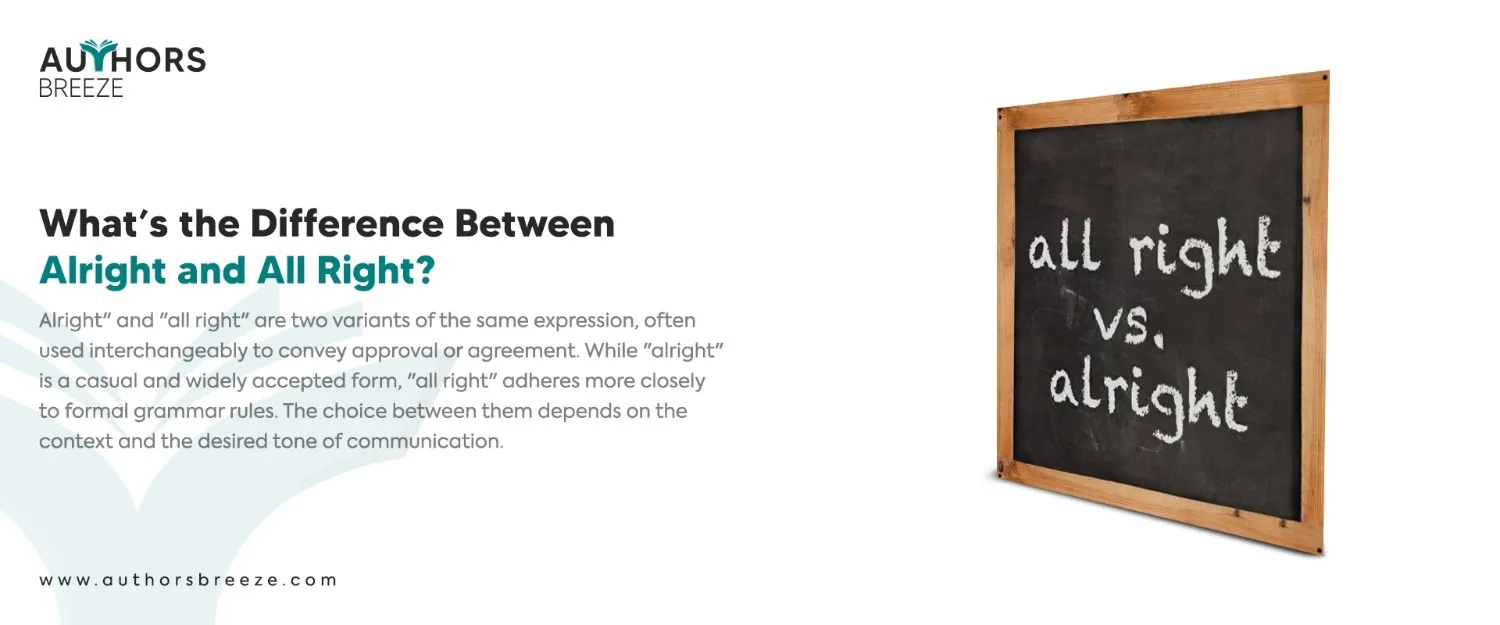
What’s the Difference Between Alright vs All Right?

Alright vs All right

Key Takeaways: The Difference between Alright vs All Right

  • “All right” is the traditional as well as standard form historically accepted in formal writing.
  • “Alright” is a more modern contraction. It has faced controversy over its legitimacy, but now people are accepting it in informal contexts.
  • Both terms indicate something is satisfactory, acceptable, or okay, but their usage can depend on the formality of the context.
  • “All right” is versatile, serving as an adjective, adverb, interjection, or for agreement and reassurance.
  • The choice between “all right” and “alright” may also depend on the audience’s expectations and regional language variations.
  • Language evolves, and “alright” is gaining acceptance in more contexts, though “all right” remains the more universally accepted form in formal writing.

Compose A Flawless Ebook

Choose Authors Breeze for error-free writing and elevate your ebook above the rest, particularly with tricky words such as “alright and all right.”

Avail Ebook Writing Services

Introduction to Alright vs All Right Debate

[The biggest difference between all right and alright is that one (all right) is a commonly used phrase that’s been accepted by dictionaries and grammar stylebooks for ages, while the other (alright) technically isn’t, well, a word” – Brian A. Klems”]

The debate between “alright vs all right” has perplexed writers and grammarians for decades. Both variants convey the sense of being satisfactory or acceptable. Yet, their usage often stirs a bit of controversy in formal and informal writing.

Historically, “all right” has been the standard form, rooted in English for centuries. The term signifies that everything is in a satisfactory condition. The contraction “alright” emerged more recently and sparked debates on its legitimacy. While traditionalists are unwilling to accept “alright,” various dictionaries and style guides now recognize it, especially in informal contexts.

Alright Definition: What Does Alright Mean?

Alright Meaning: “Alright” is a word in English to signify something is satisfactory, acceptable, or okay. You can use it in various contexts, such as:

  • To express agreement,
  • To indicate that something is okay,
  • Or to reassure someone that a situation is under control.

The term is less formal than “all right,” which has the same meaning. Still, people use both versions in everyday language.

The usage of “alright vs all right” is a matter of stylistic preference or adherence to specific style guides. Some people argue that “alright” is not entirely proper English. However, “alright” is now increasingly common in informal communication. In addition, people generally understand and accept it.

In summary, “alright” means:

1- Satisfactory but not exceptionally or especially good, for example:

“The movie was alright.”

2- Safe or well, for example:

“Are you alright?”

3- In a satisfactory manner or to a fair extent, for example:

“It worked out alright in the end.”

Its usage reflects the speaker’s or writer’s acknowledgment of a situation’s acceptability without necessarily implying enthusiasm or excellence.

All Right Definition: What Does All Right Mean?

All Right Meaning: “All right” is a phrase in English that generally means satisfactory, acceptable, or correct. You can utilize it in various contexts, such as:

  • An adjective, adverb, or interjection.
  • To express agreement, approval, or that something is adequate or in a satisfactory condition.

When it comes to “alright vs all right,” “all right” is a more grammatically correct form. However, people widely use and understand both expressions. Here are the primary uses and meanings of “all right”:

Adjective

As an adjective, “all right” indicates that something is satisfactory, in good order, or acceptable. For example:

“The answers you provided are all right.”

Adverb

You can describe something done satisfactorily or to a satisfactory extent by using “all right” as an adverb. For example:

“The project turned out all right.”

Express Agreement or Consent

People can make use of “all right” when they agree with someone else or give permission. For example:

“All right, we can go to the movies.”

Inquire or Reassure

“All right” can be used to inquire or reassure about someone’s well-being, such as:

“Are you all right?”

“Everything will be all right.”

Interjection

“All right,” as an interjection, can introduce a statement or transition to a new topic, often with a sense of resignation or acquiescence. For example:

“All right, let’s move on to the next topic.”

“All right” is versatile. It can convey a range of shades based on context, intonation, and situation, from mere adequacy to warm approval.

Craft Stand Out Articles

Authors Breeze specializes in tackling common confusions like “All right vs Alright.” We ensure your articles are both impactful and impeccably written.

Get Article Writing Services

What is the Difference Between Alright and All Right?

People often use “Alright” and “all right” interchangeably in everyday language. However, the difference between them primarily revolves around:

Alright vs All Right: Formality and Acceptance

“All right” is the traditional, grammatically accepted form. In addition, it has been in use for a longer time. It is considered more formal and is preferred in legal writing and publishing, academic contexts, and by many style guides. “Alright” is a more modern blend of “all right.” It is seen as less formal and more colloquial. People are accepting it in informal writing and speech. However, it remains controversial in formal contexts.

Alright vs All Right: Usage

Both “alright” and “all right” can convey meanings of adequacy, agreement, or well-being. However, “all right” can be more versatile. It functions clearly as an adjective, adverb, interjection, or part of a dialogue. On the other hand, “alright” is more commonly used to express general acceptance or to reassure.

Alright vs All Right: Preference and Context

The choice between the two often depends on the following:

  • The writer’s or speaker’s preference
  • Intended audience
  • Context

Writers usually choose “All right” for clarity and formality. In contrast, they may use “alright” for brevity or in less formal situations.

Alright vs All Right: Stylistic Guidelines

Some editors and style guides explicitly prefer “all right” over “alright,” citing traditional standards of English. Others accept “alright” in informal writing or specific cases that fit the publication’s voice or audience.

Also Read:  Affect vs Effect: What’s The Difference

When to Use Alright and All Right?

The usage of “alright vs all right” depends on several factors, such as:

  • Formality
  • Context
  • Personal Writing Style
  • Institutional Style Preference

Here’s a guide on when to use “Alright vs All right”:

When to Use All Right in a Sentence?

Formal Writing

In academic papers, business correspondence, formal essays, and other formal writings, “all right” is the safer and more traditionally correct choice.

Following Style Guides

Suppose you are writing for a publication or institution that follows a specific style guide (such as APA, Chicago, MLA). In that case, it’s best to use “all right” unless the guide specifies otherwise. Most style guides prefer “all right.”

Clarity and Versatility

Use “all right” when you need clarity or want to use the term in its adverbial, adjectival, or interjectional forms. It’s versatile and universally understood in various contexts.

When to Use Alright in a Sentence?

Informal Writing and Speech

In informal talks, texts, emails to friends, or casual blog writing, “alright” is generally acceptable and widely used.

Creative Writing

For dialogues in novels or scripts or in other forms of creative writing where the voice is conversational or stylized, “alright” can convey a more casual tone.

Personal Preference

If you prefer the brevity of “alright” and are writing in a context where formal correctness is not paramount, using “alright” is acceptable.

Captivate Readers with Compelling Content

We ensure your content is engaging and linguistically accurate. Our team eliminates common mistakes such as “All right vs Alright” that detract from your message.

Acquire Content Writing Services

Alright vs All Right: Considerations

Audience Expectations

Consider the expectations of your audience. A formal audience will likely expect “all right.” On the other hand, a more relaxed or younger audience might find “alright” perfectly acceptable.

Regional Preferences

In some English-speaking regions, “alright” might be more commonly used and accepted than in others. Be mindful of regional variations in language use.

Evolution of Language

Language evolves, and the acceptance of “alright” in formal contexts is growing, though it is not universally accepted. Keep abreast of changes in usage norms, especially in professional or academic fields.

Frequently Asked Questions

Is Alright a Word?

"Alright" emerged as a single-word variant of the phrase "all right" in the 1880s. It is frequently utilized in informal writing and written dialogue. However, "all right" remains the sole form recognized as acceptable in formal and edited writing.

Is It Alright or All Right?

So, is it all right or alright? The phrase "all right," typically spelled with space, is the most commonly found form in formal writing. "Alright" is widely used in casual communication. However, its acceptance as a correct spelling varies, with some dictionaries hesitating to endorse it. However, notable exceptions include Merriam-Webster and the Oxford English Dictionary (OED). Both of them acknowledge "alright" as an acceptable variant.

Is it are you alright or all right?

"Alright vs all right" are both accepted spellings of the same expression, with subtle differences in their usage. "Are you alright?" and "Are you all right?" can be used interchangeably. However, "all right" is recognized by a greater number of dictionaries and is generally regarded as the more formal variant of the two.

What is correct, "Is everything all right" or "Is everything alright"?

Both the expressions "Is everything all right" and "Is everything alright" are correct, and people use them widely in English. They serve similar purposes, allowing for interchangeable use when inquiring about someone's well-being or the status of a situation.

Alright versus all right: Which is correct?

Choosing between "all right" and its modern, condensed form, "alright," boils down to personal preference. While both variants are technically correct, their acceptance varies among writers and editors. For those seeking to err on the side of caution, especially in formal contexts, the traditional "all right" is more universally accepted and recommended.

Conclusion

The debate between “alright vs all right” reflects broader themes of language evolution. In addition, it showcases the balance between traditional standards and modern usage. “All right” has been the historically accepted form. On the other hand, “alright” has carved out its place, especially in informal contexts. However, the choice between them depends on the context, formality, audience, and personal or institutional style preferences.

You should consider these factors when deciding which form to use. In addition, keep in mind that English speakers around the world understand and use both variants. Ultimately, you need to understand the complexity, and appropriate contexts for each can help ensure clear and effective communication. However, if you still have any confusion, Authors Breeze is here to help.

Present Your Work with Confidence

Ensure perfection in your manuscript down to the last detail with particular attention to common pitfalls, such as the “alright vs all right” dilemma.
Hire The Best Proofreading Services

Author : Shirley Gibson

28th Feb 2024

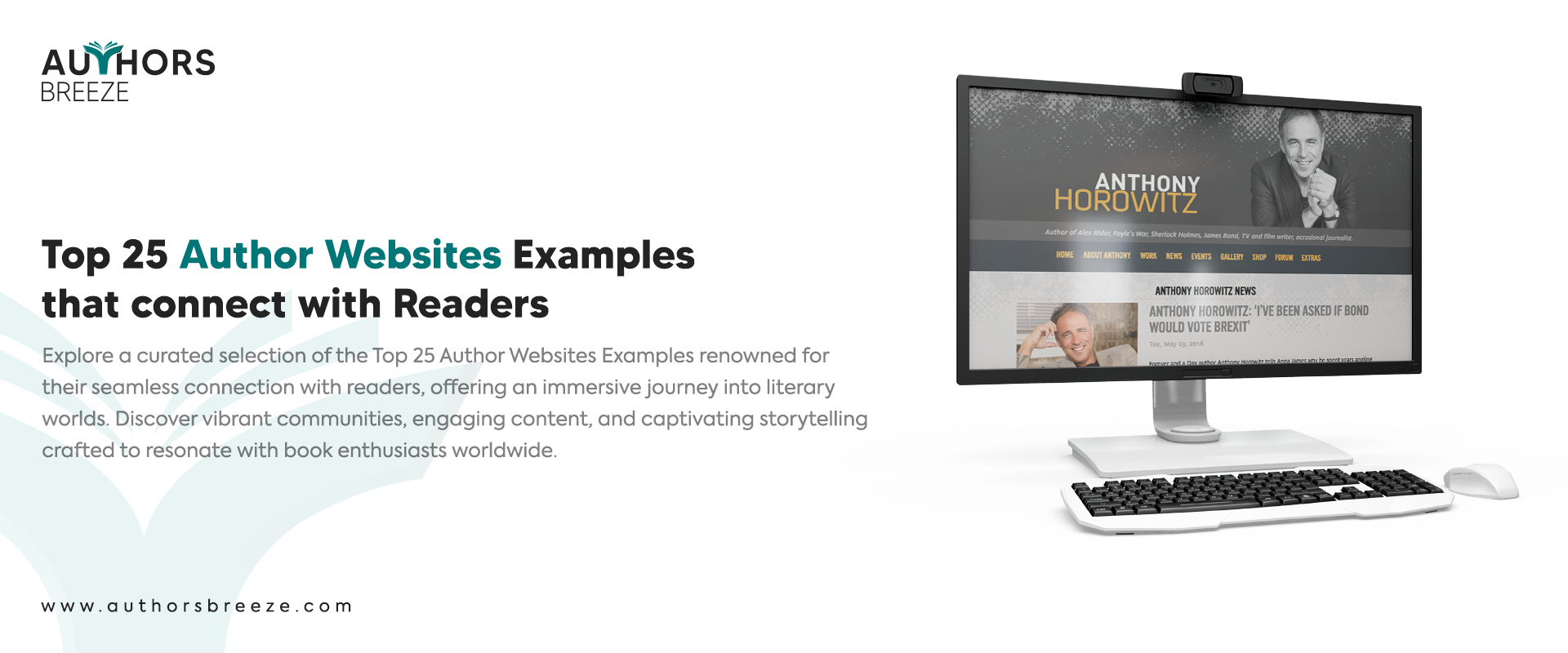
Top 25 Author Websites Examples That Connect With Readers

author websites

Key Takeaways: Top Author Websites Examples

  • Author websites should be easy to navigate so visitors can find what they are looking for quickly, such as your books.
  • The website should be visually appealing. So, add pictures and videos for engagement.  Also, use bold colors and interactive patterns.
  • Your author websites should include plenty of information about yourself and your books, such as your upcoming events and writing tips.
  • The website should be optimized for mobile devices so visitors can easily access it on their phones or tablets without any problems.
  • You can incorporate multimedia content such as videos and podcasts to enhance the user experience and keep visitors engaged.

Make Your Own Author Website

Showcase your work, connect with readers, and build your online presence through a stunning author website.

Acquire Author Website Design Services

Introduction To The Top Author Websites Examples

Dive into our blog, where we explore some of the best author websites out there. If you love reading books or you want inspiration for your own author website, then we’ve got you covered. In this blog, we will showcase 25 amazing author websites that are visually appealing as well as offer plenty of inspiration for new authors.

In addition, we will cover the websites of the best selling authors and emerging writers as well. Moreover, these websites are a great resource if you want to know about the writers or their works. So, get ready to discover some fantastic author websites that will inspire you a lot.

5 Qualities of Great Author Websites

Clear Navigation

One quality of best author websites is that you can easily move around. It means you can find what you’re looking for quickly, such as books, info about the author, or contact details.

Engaging Design

Author websites that are termed as good are usually engaging for the users. So, this means that the website looks nice and interesting. Moreover, it might have cool pictures, colors, or patterns that make you want to stay and explore.

Informative Content

The website tells you lots of things about the author and their books. In addition, you can learn about their background and upcoming events and maybe even get some blog writing tips.

Mobile-Friendly

You can easily use author websites on your phone or tablet without any problems. Moreover, the words and pictures still look good and are easy to read.

Multimedia Content

Besides just words, the author websites also incorporate multimedia content such as:

  • Book Video Trailers
  • Podcasts
  • Book Cover Design

Let Your Book Cover Shine

Capture attention and entice readers with a stunning book cover design that stands out.

Get Professional Book Cover Design

The Top 25 Author Websites Example

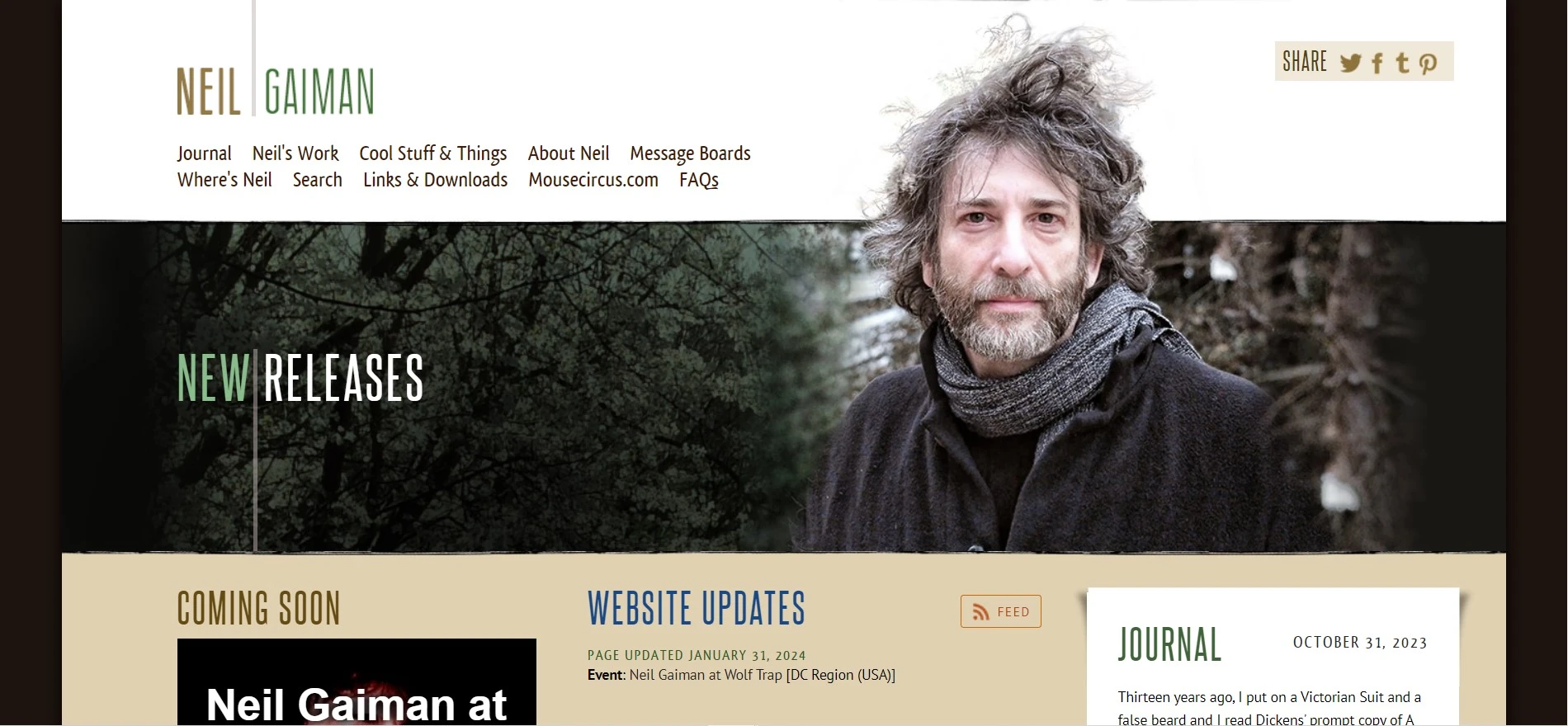
1. Neil Gaiman

Neil Gaiman is one of the best book authors and the master of fantasy and storytelling. Just like his stories, his website is also engaging. Furthermore, it reflects the extraordinary fiction stories he creates in his books. Gaiman’s website offers a ton of content for his fans, such as:

  • His latest releases
  • Upcoming events
  • Exclusive blog posts

One highlight of his website is the “FAQs” section. Moreover, Gaiman answers questions from readers and gives them a sneak peek into his creative process.

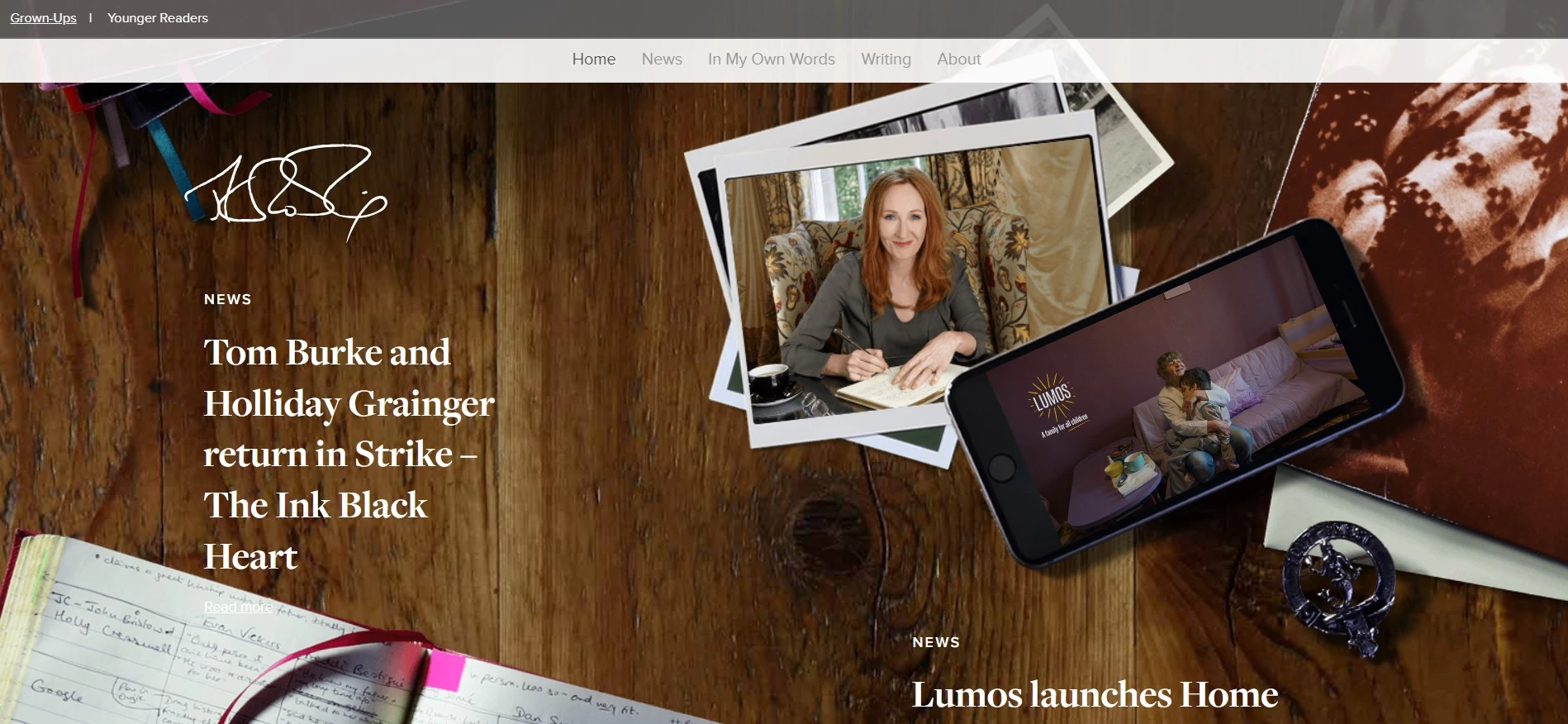
2. J.K. Rowling

If you are a writer or want to write a book, then you may know J.K Rowling, as she is one of the popular authors. If you do not know her then step into the magical place of J.K. Rowling through her website. It is the same place where the wizarding world of Harry Potter comes to life. Rowling’s website is a beautiful mix of different things, which include:

  • News Updates
  • Personal Anecdotes
  • Behind the Scenes of Her Writing Journey

Apart from that, fans can explore interactive features like the “Wizarding World Book Club.” They can also check out the exclusive content related to the Harry Potter series and others as well.

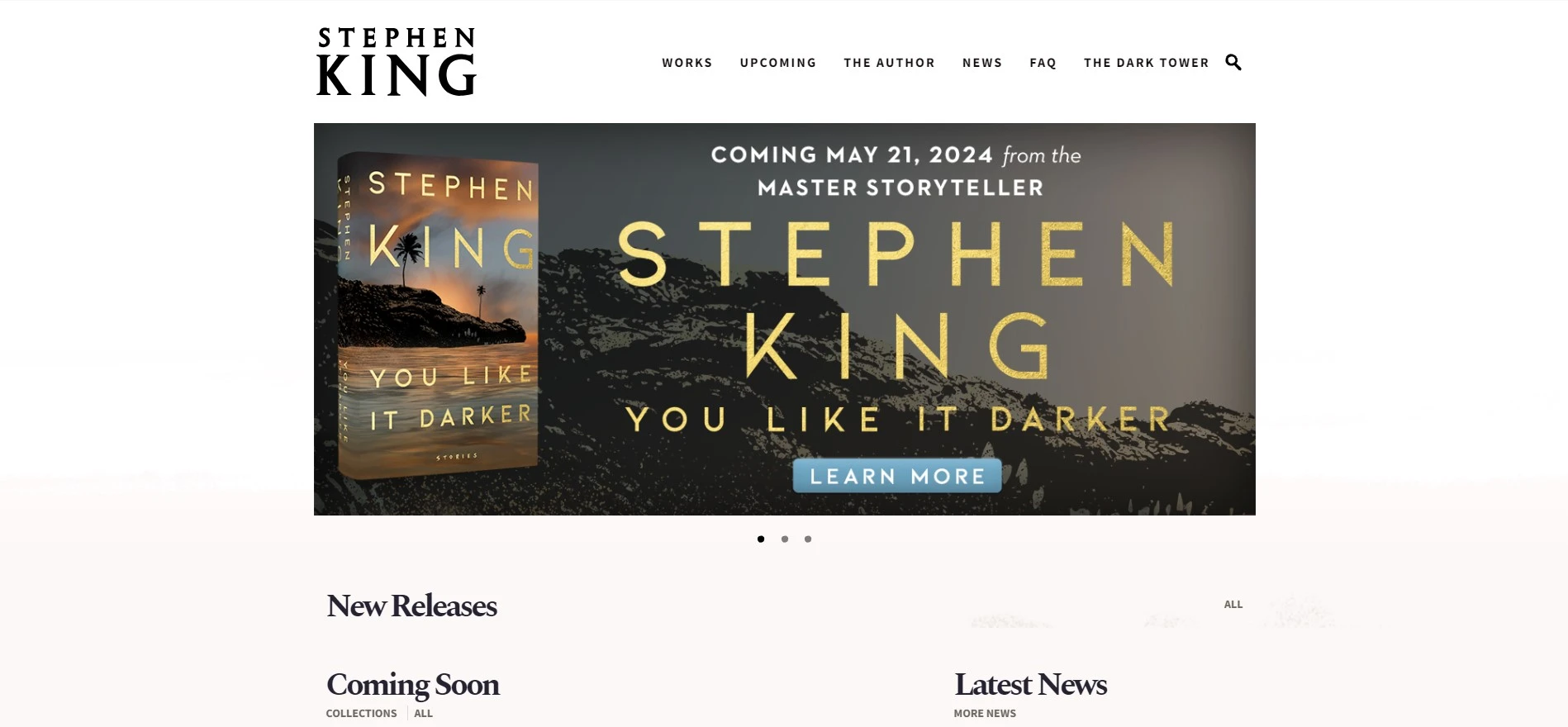
3. Stephen King

Stephen King is a popular author, and he writes really scary stories that make you jump. His website is like a treasure chest full of his books. His website is a great example of a good authors website as you can do many things on it, such as:

  • Look at all the books he’s written
  • Find out which ones he recommends
  • Sign up for his special newsletter called “The Clubhouse.”

However, the best thing about King’s website is the map. It lets you see all the real places that gave him ideas for his famous stories. You will not find this on any other author sites, but that is a great example to follow.

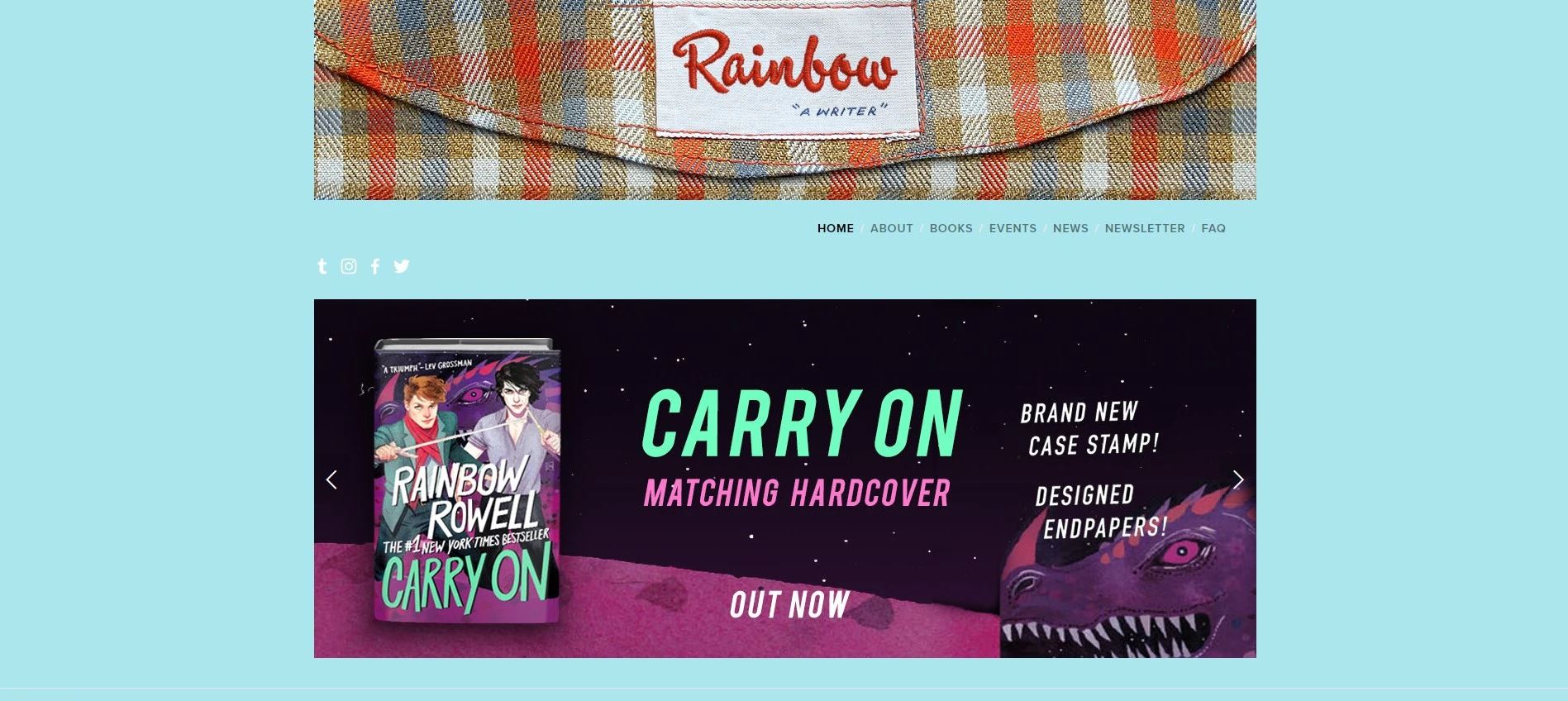
4. Rainbow Rowell

Rainbow Rowell’s website radiates warmth and charm, much like her heartfelt narratives about love and relationships. Here, readers can do a lot of stuff, such as:

  • Find information about Rowell’s upcoming releases
  • Browse through her blog posts
  • Connect with fellow fans on the discussion forums

One of the standout features is the “Fan Art Gallery.” Here, you can showcase your creative interpretations of Rowell’s characters and stories. In addition, this is one great way of engaging your readers and building interest in your stories.

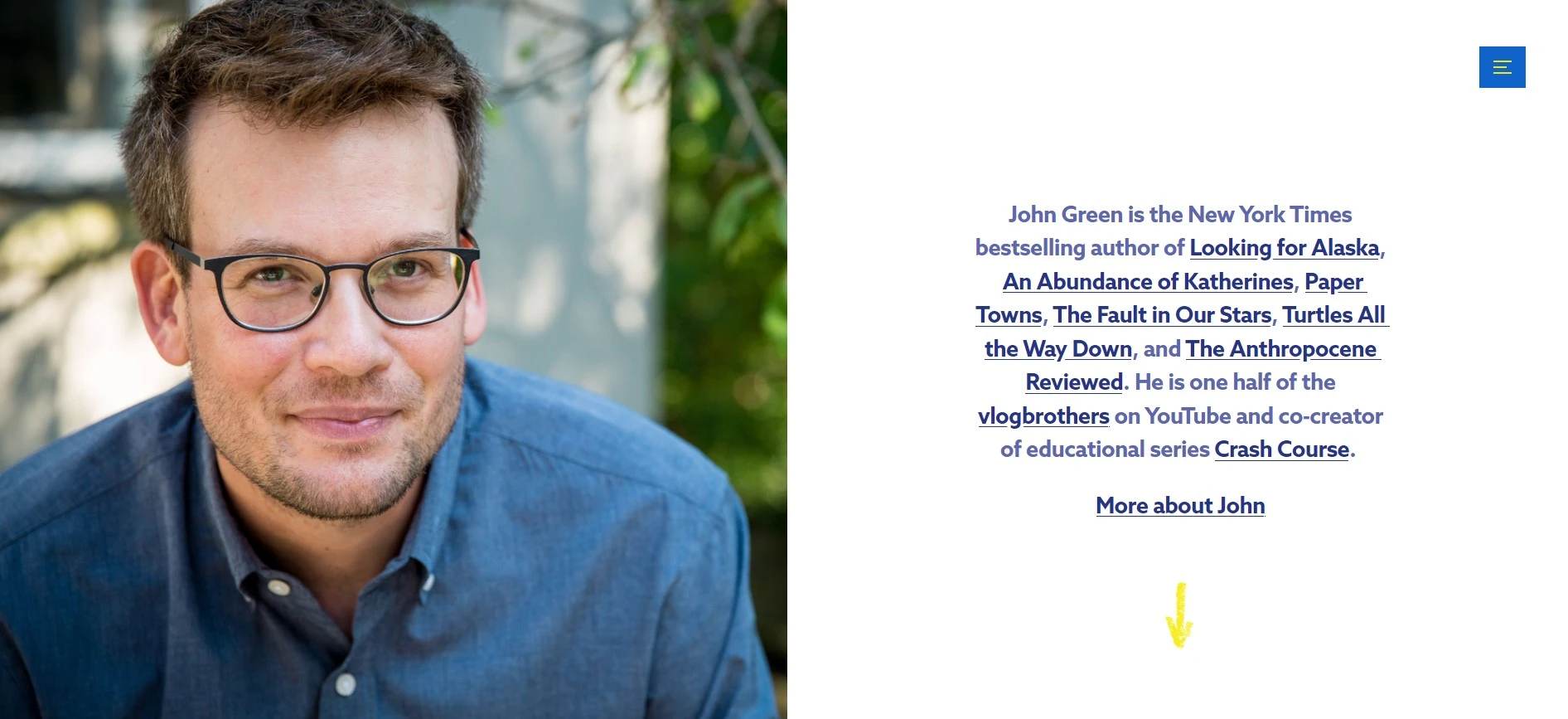
5. John Green

John Green’s website is a rich heaven. In addition, it shows how much he cares about being real and understanding others, just like in his popular books for young adults. Moreover, you can find out about his books and what he is working on next. There are also interesting things that you can find on his website, which include:

  • Videos
  • Podcasts
  • Essays

Fans can join the “Nerdfighter Community” to connect with each other as well as help with charity projects that Green supports. His website is a great place for people to learn. It also serves as a platform to share things and make a difference together.

6. Gillian Flynn

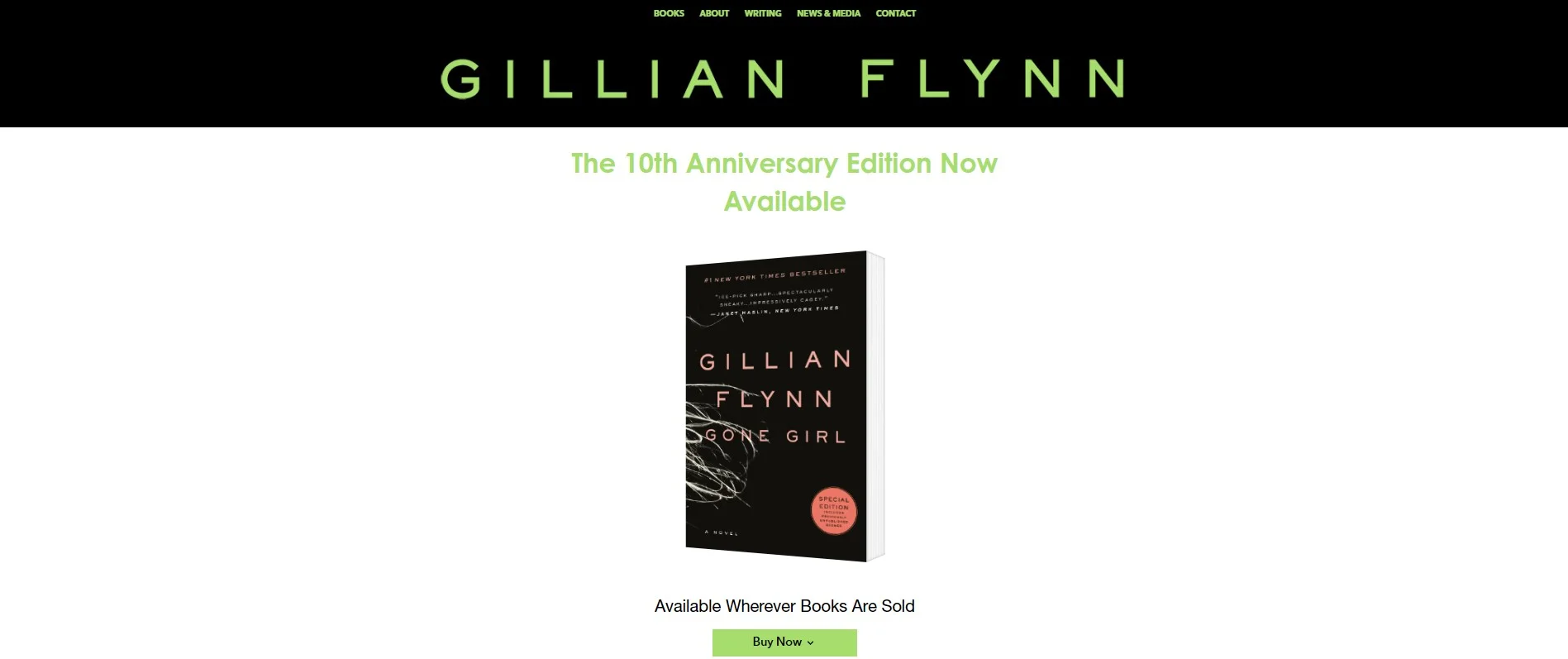
Gillian Flynn’s website gives off the same mysterious feelings as her intense psychological thrillers. You can find all of Flynn’s books, such as

  • Gone Girl
  • Sharp Objects

The website also offers links to commentary articles on her stories and new books that will be coming. Visitors can also do other things, such as:

  • Learn more about her writing
  • What others have to say about her books
  • Sign up for her author newsletter

If you’re a fan of Flynn’s thrilling stories, her website is a must-visit.

7. Veronica Roth

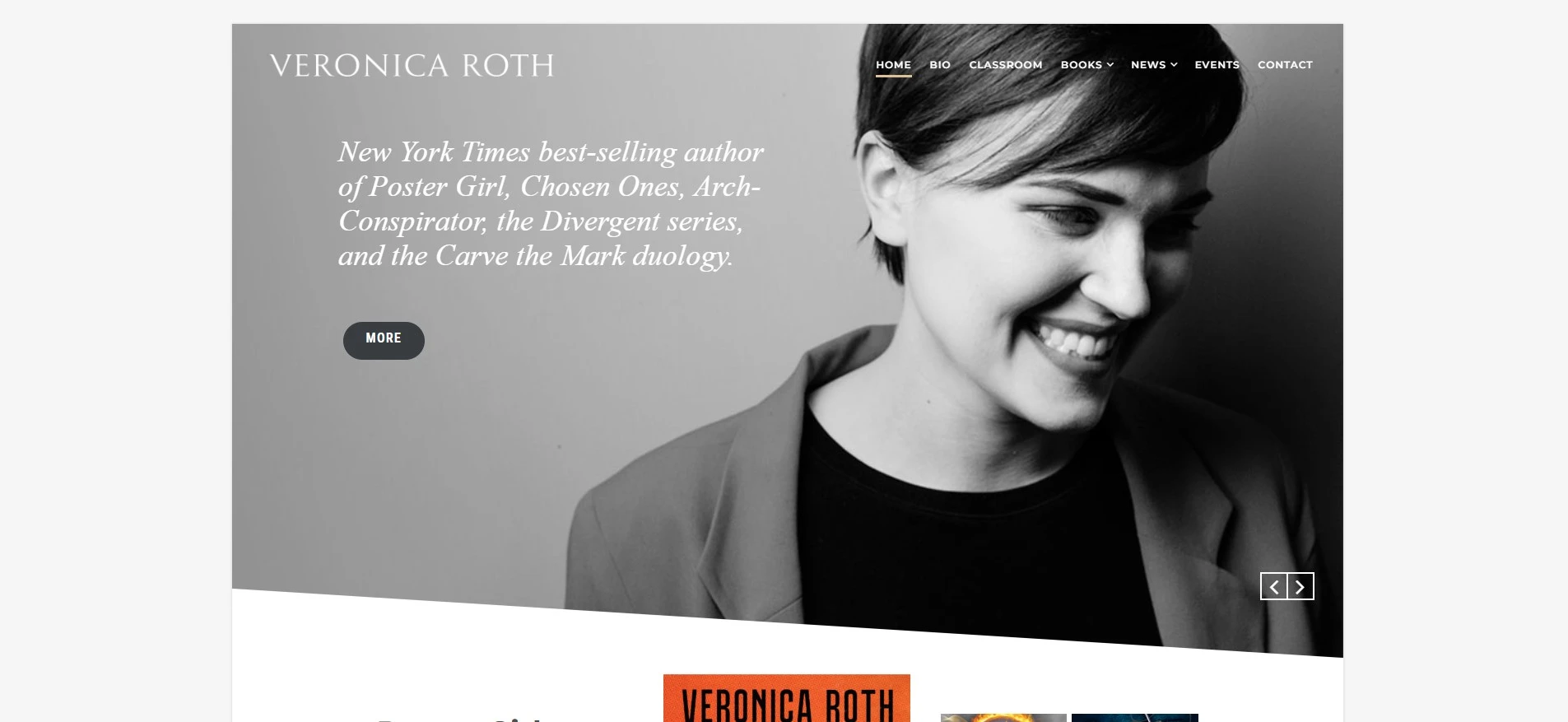
Veronica Roth’s website welcomes you to exciting adventures in strange worlds and future stories. In addition, it is full of colorful pictures and fun things. You can find out all about her famous “Divergent” series, as well as her other books.

Roth also shares her thoughts on writing in author blogs and interviews. Moreover, she loves hearing from fans on social media and gives tips to people who want to write their own stories. So, if you love reading or writing, her website has something to offer you.

8. Haruki Murakami

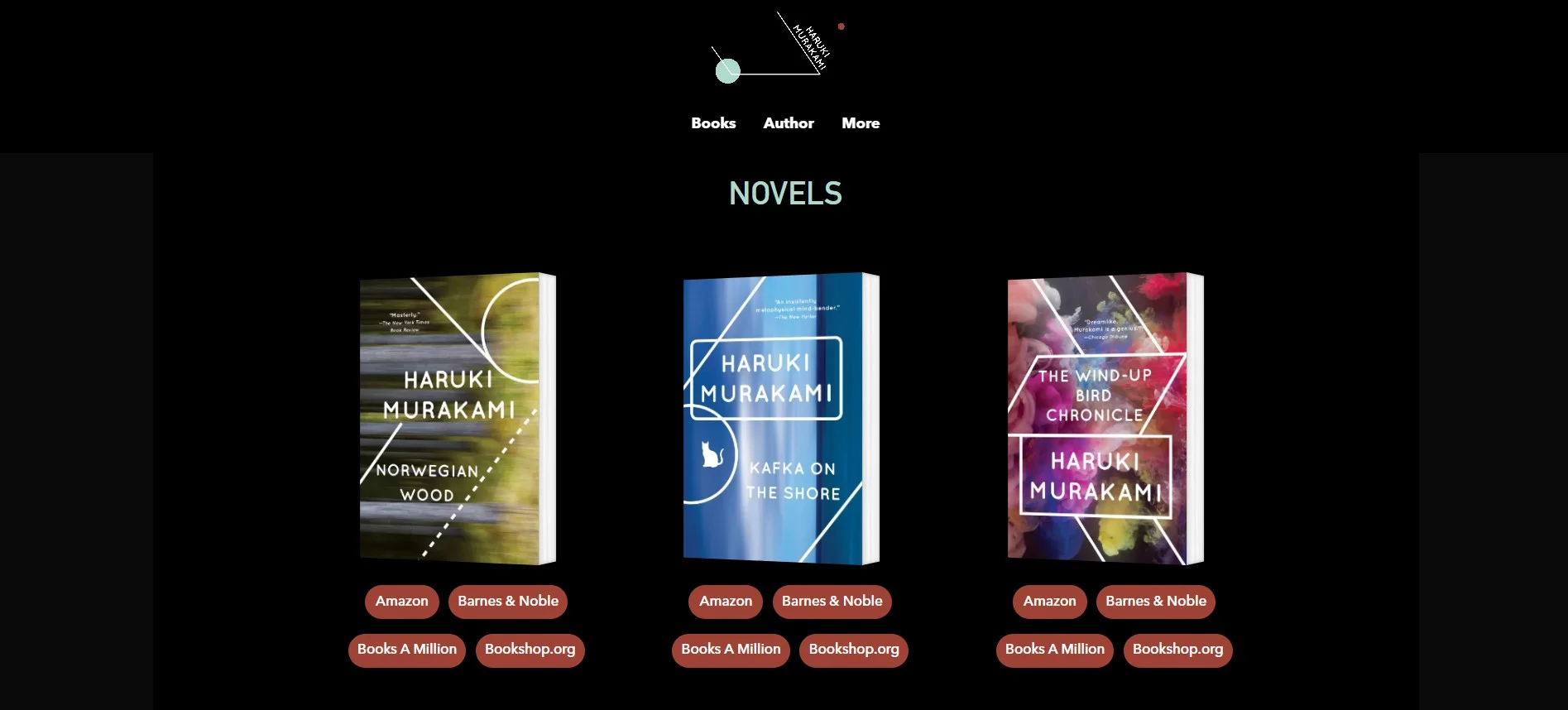
Haruki Murakami’s website feels just like his mysterious stories. In addition, it is simple and peaceful, with calming colors. On the website, you can check out various things, such as:

·         Books Murakami has written.

·         Read interviews with him.

·         Learn about what he is working on.

There is also something called “Murakami Radio,” where you can listen to playlists of music from his books. So, it is just as you are stepping into his stories and feeling the music come alive.

9. Jojo Moyes

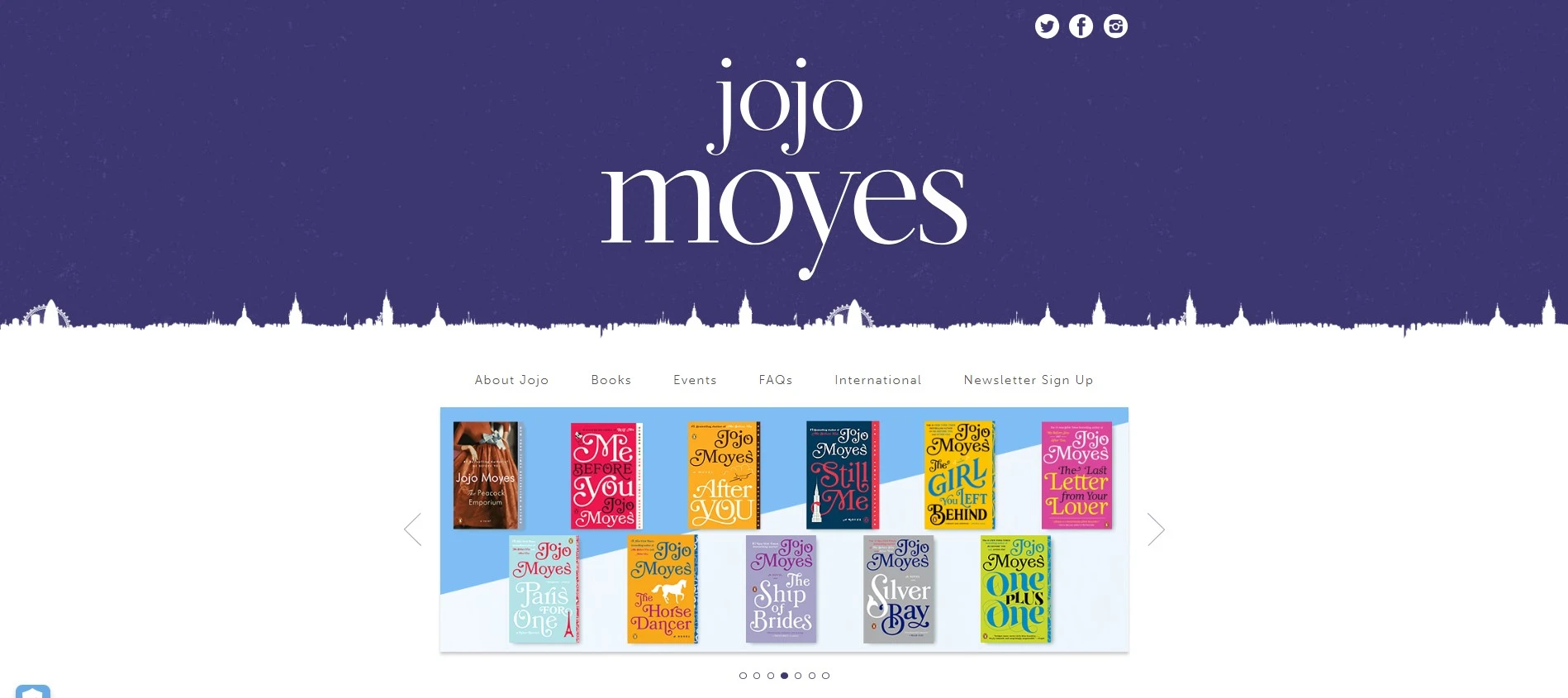
Jojo Moyes is one of the top authors, and her website is home to her lovely world of romantic stories. In addition, her author website design is nice to look at and has interesting content. You can do a ton of stuff on her website, such as:

  • Check out Moyes’s books
  • Learn how she writes
  • Parts that did not make it into the books

Furthermore, there is also a part just for book clubs. There, you can find things to talk about and other books Moyes recommends. If you want to know more about her stories then do check out her website.

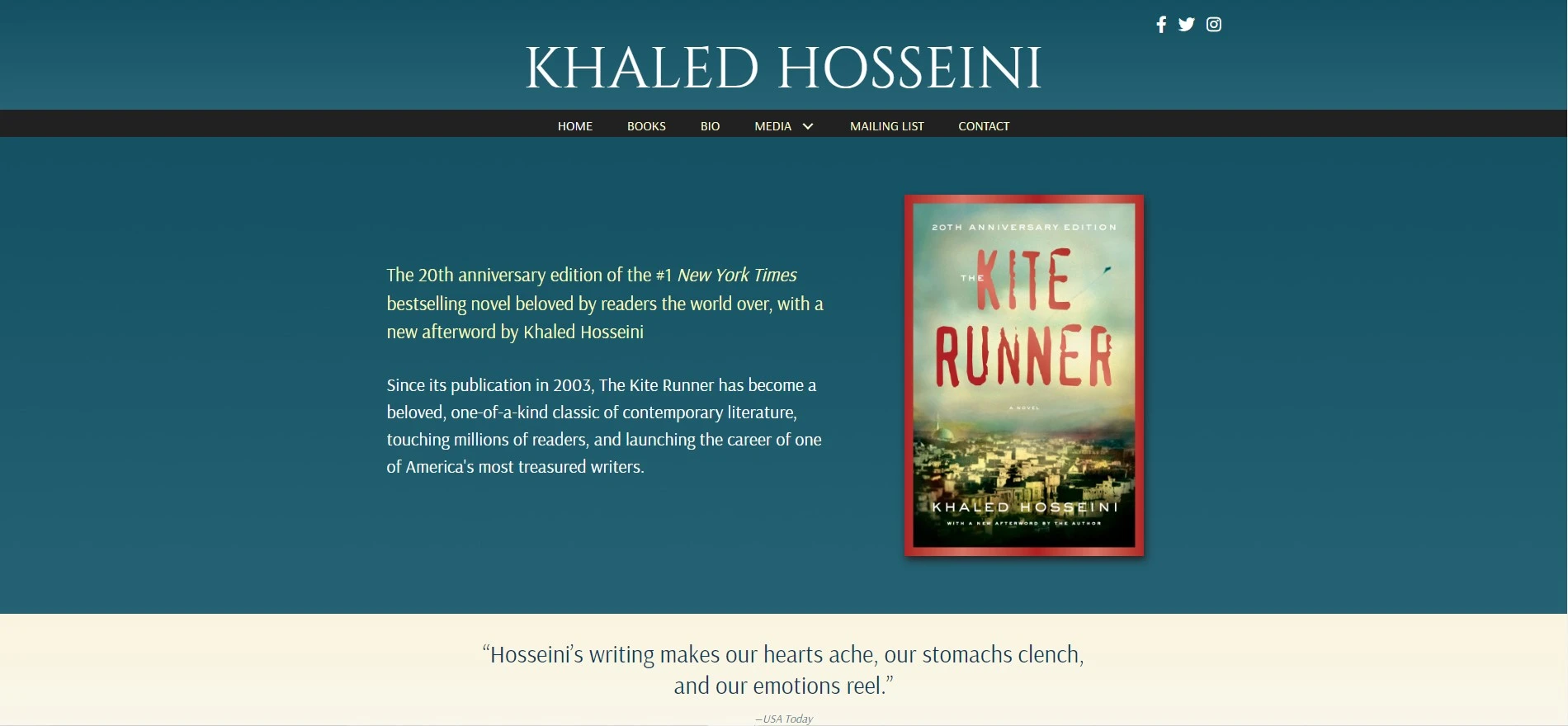
10. Khaled Hosseini

Khaled Hosseini’s website shows the powerful messages and emotional stories in his books. Additionally, You can read about all of Hosseini’s books and even watch videos where he talks about them. There are also interesting blog posts that talk about important issues, including society and culture.

In addition, the website talks about Hosseini’s work to help people, such as supporting education and refugees. So, if you want to make a difference, his website is one of the best book websites to check out.

Some More Honorable Mentions

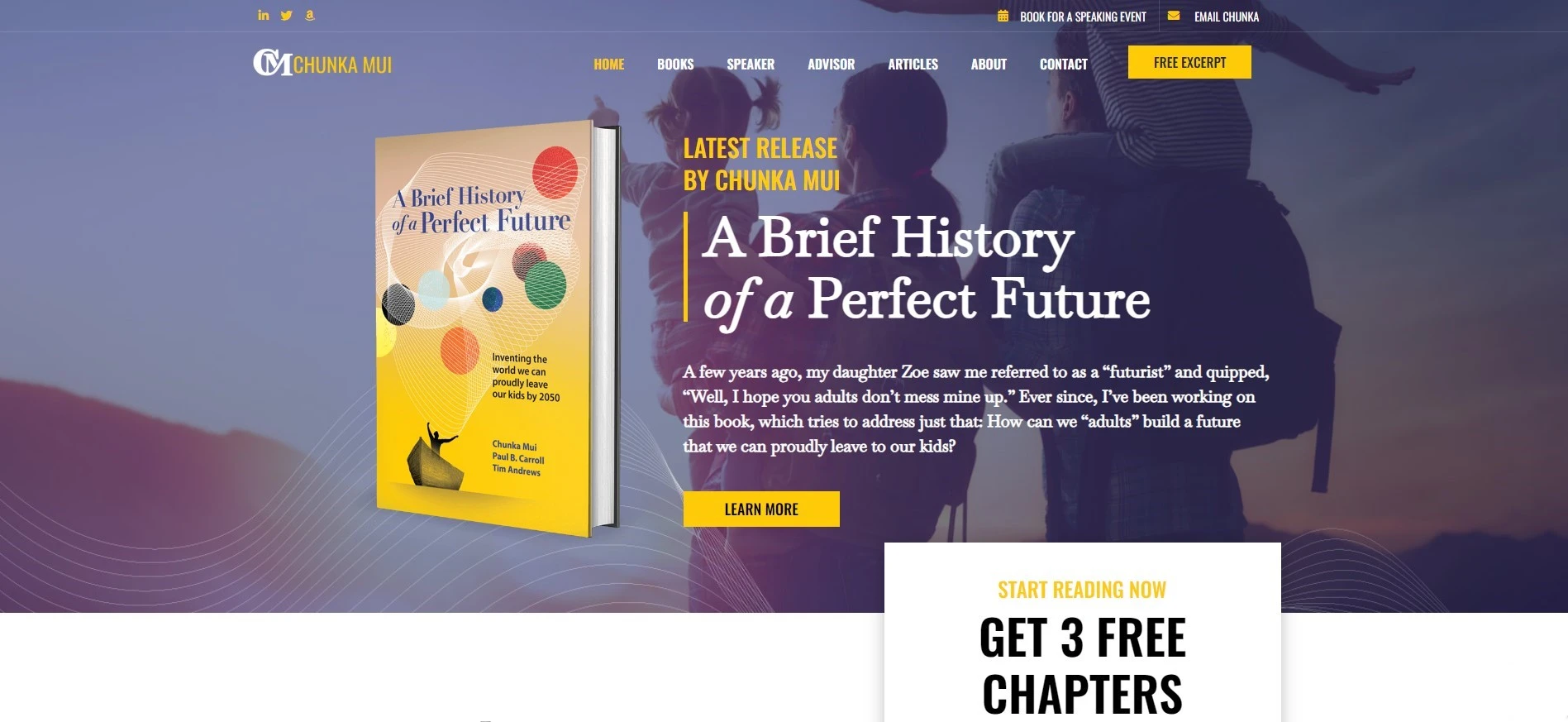
11. Chunka Mui – chunkamui.com

Chunka Mui’s website showcases his platform with bold colors as well as captivating content.

12. Leigh Bardugo – leighbardugo.com

Leigh Bardugo’s site has a rich graphic novel feel, perfect for her edgy fantasy brand.

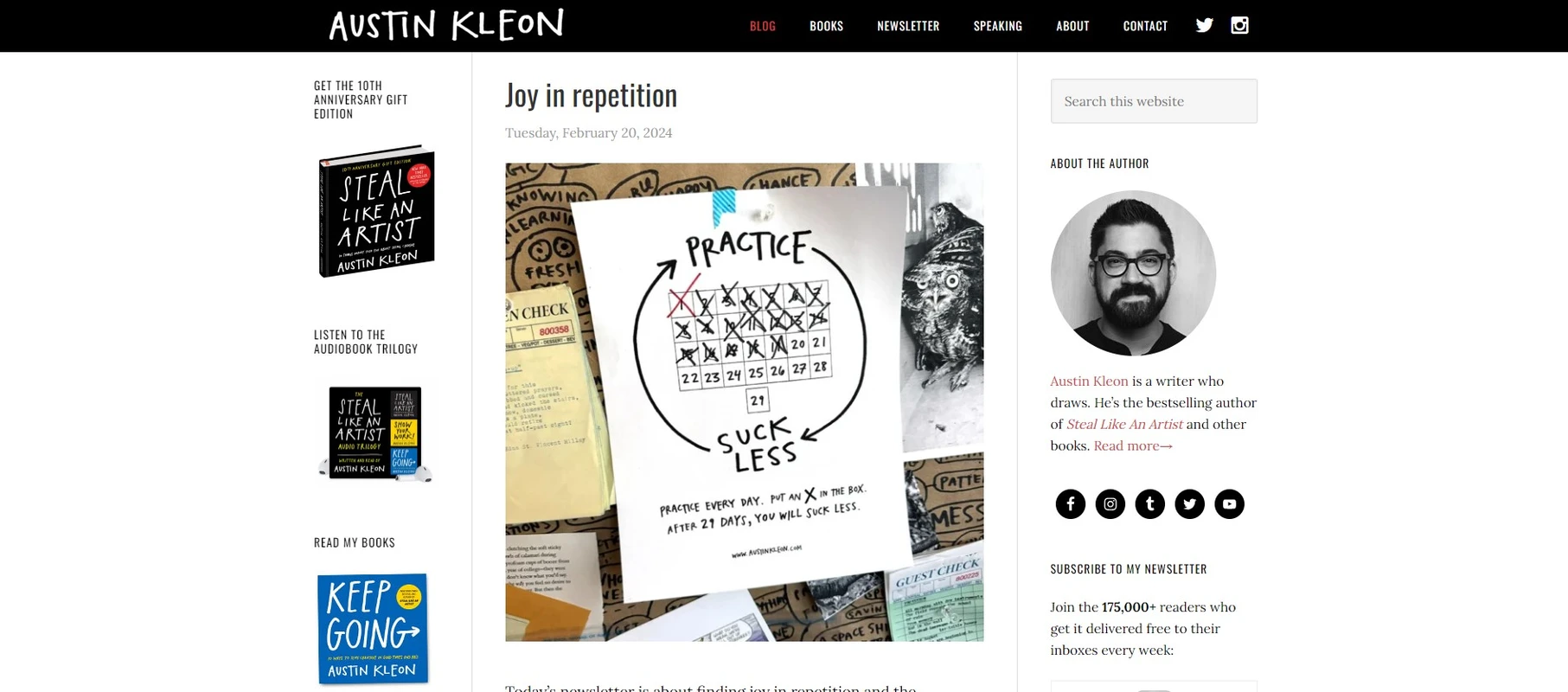
13. Austin Kleon – austinkleon.com

Austin Kleon’s blog-focused website keeps things fresh with daily posts and tasteful book displays.

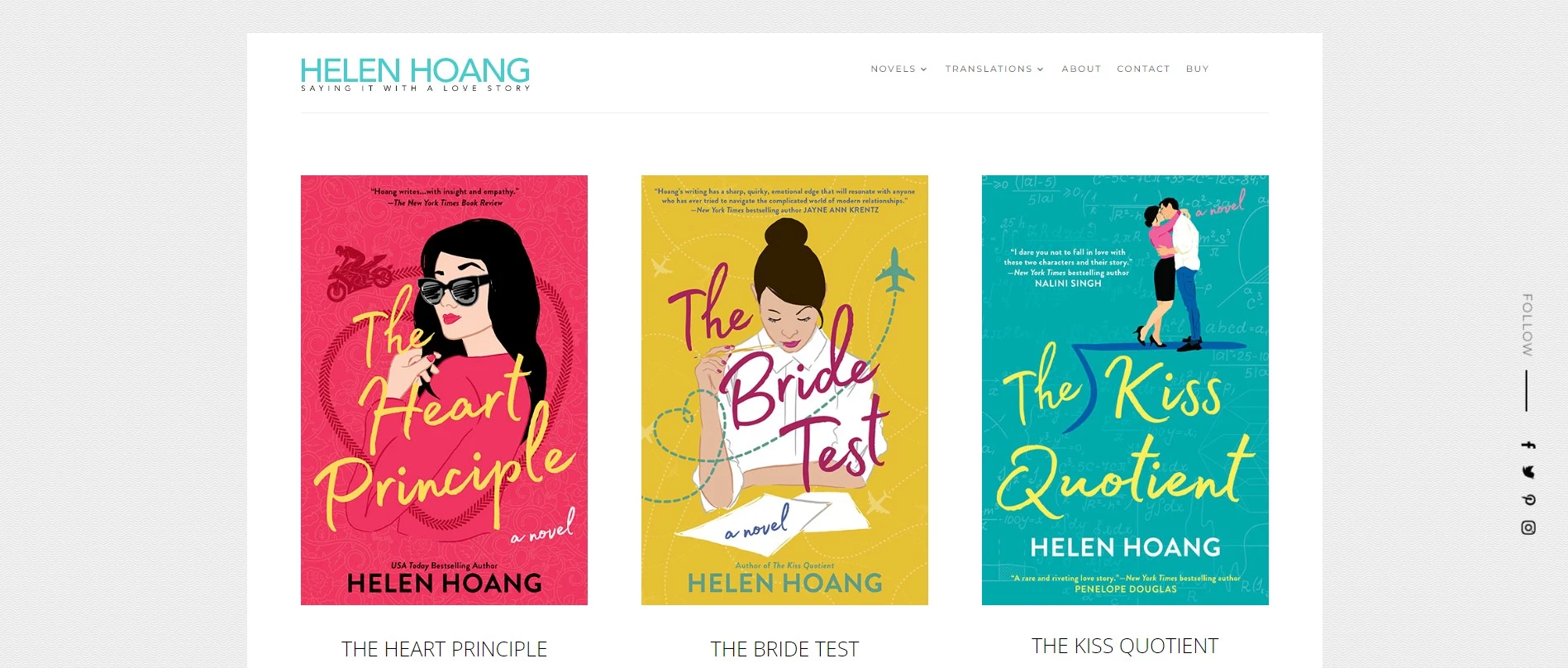
14. Helen Hoang – helenhoang.com

Helen Hoang’s website features feminine color schemes and translated editions of her books, catering to a wide audience.

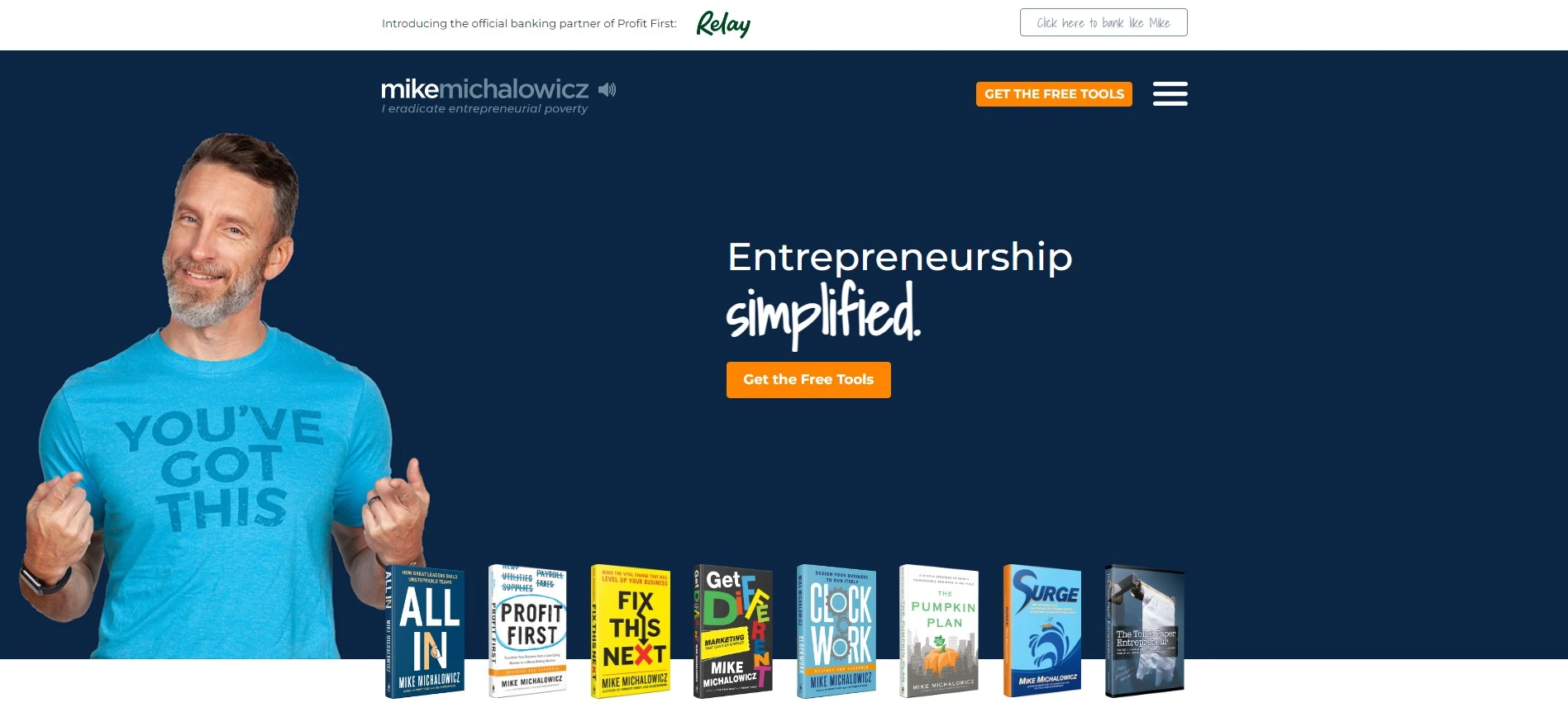
15. Mike Michalowicz – mikemichalowicz.com

Mike Michalowicz’s cheeky brand shines through his website, with fun animations and a focus on business education.

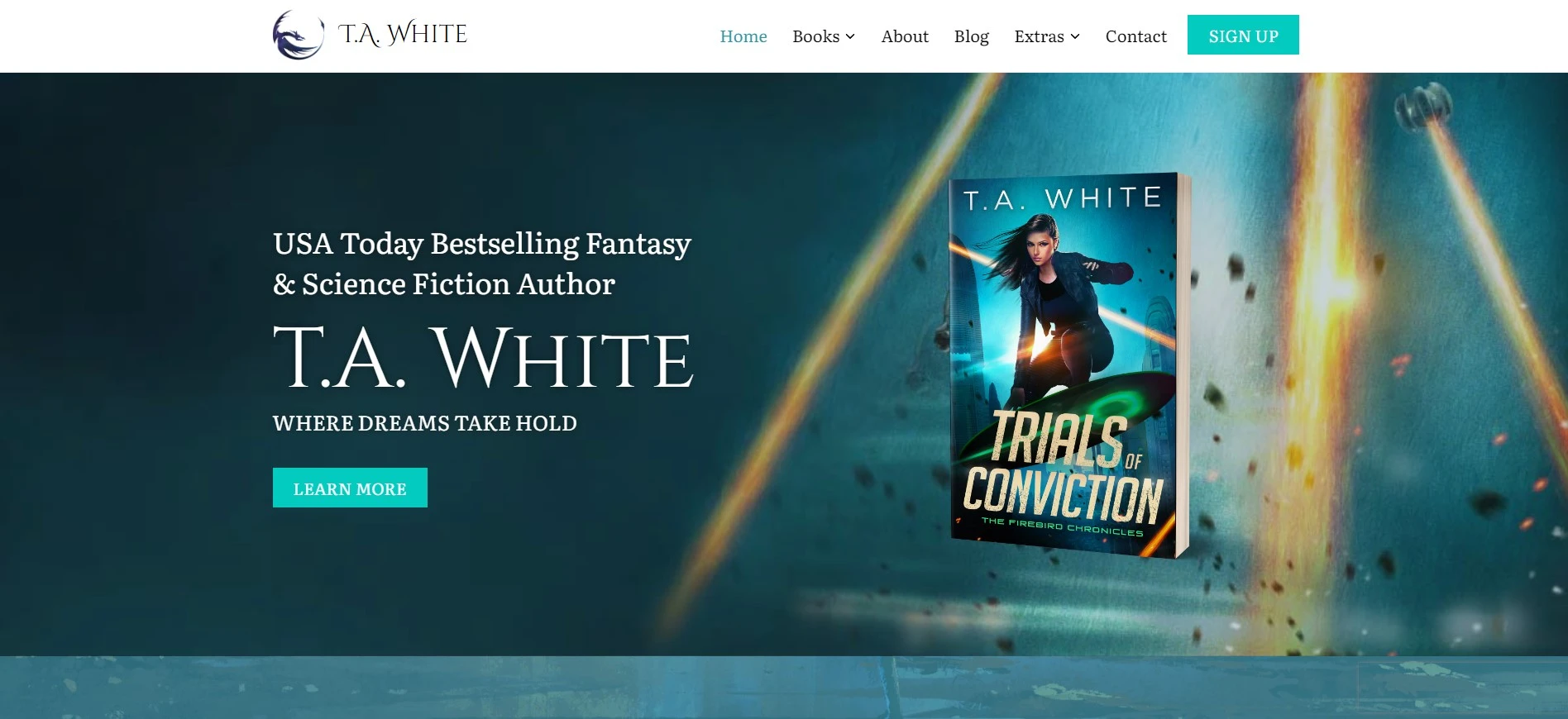
16. T.A White – tawhiteauthor.com

T.A. White’s website blends fantasy and sci-fi seamlessly, offering deleted scenes and a mystical feel.

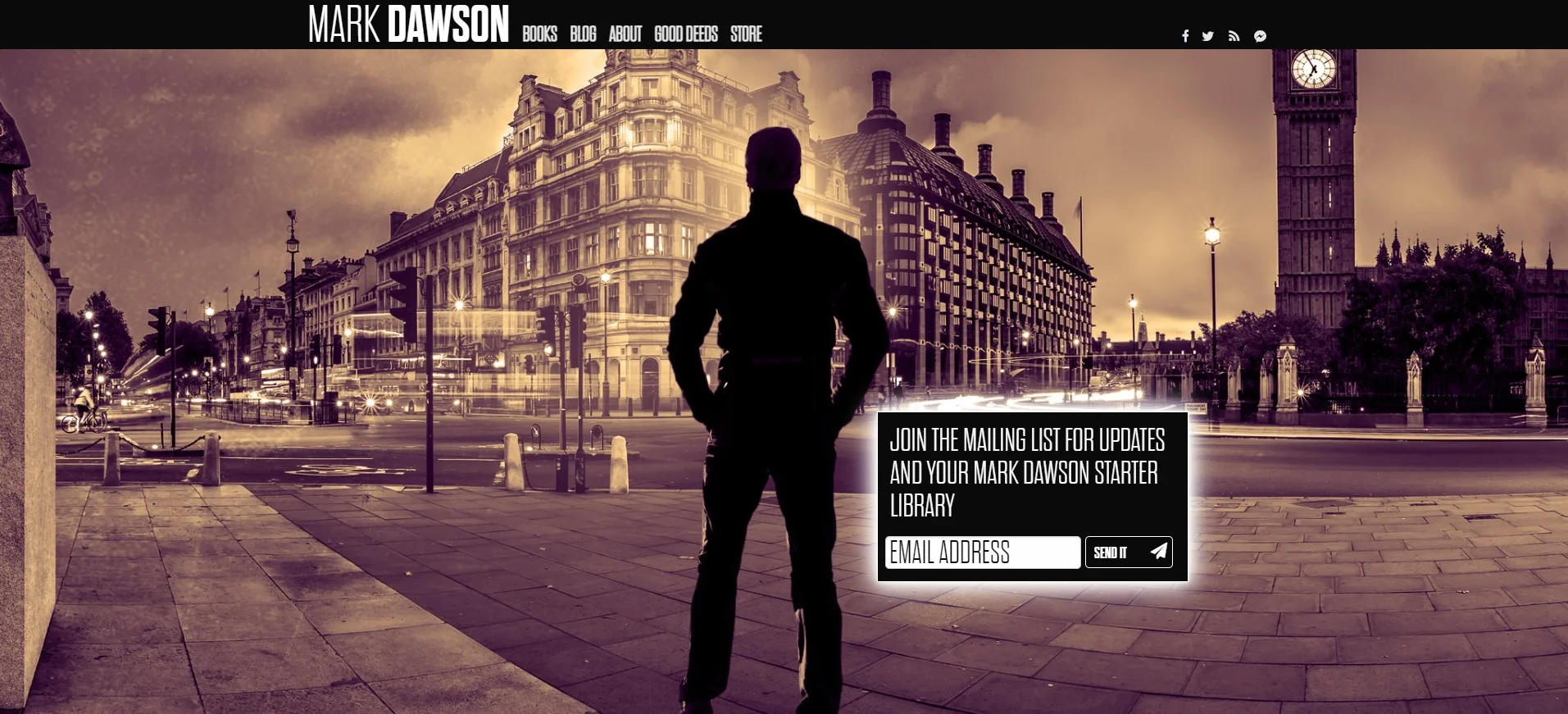
17. Mark Dawson – markjdawson.com

Mark Dawson’s site prioritizes growing his email list with a glowing opt-in box and dark, moody pages fitting his genre.

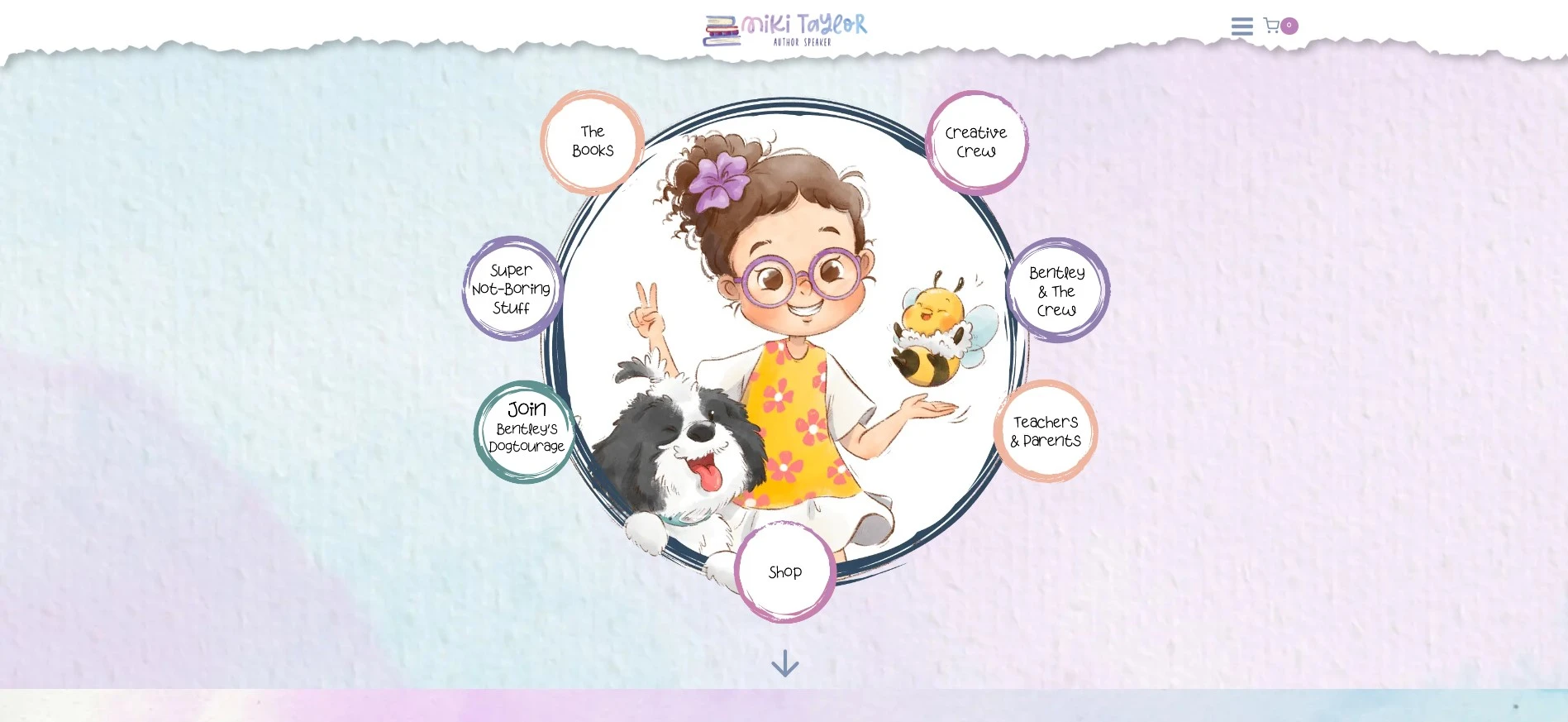
18. Miki Taylor – mikitaylor.com

Miki Taylor’s playful illustrations take center stage on her website, appealing to both children and adults.

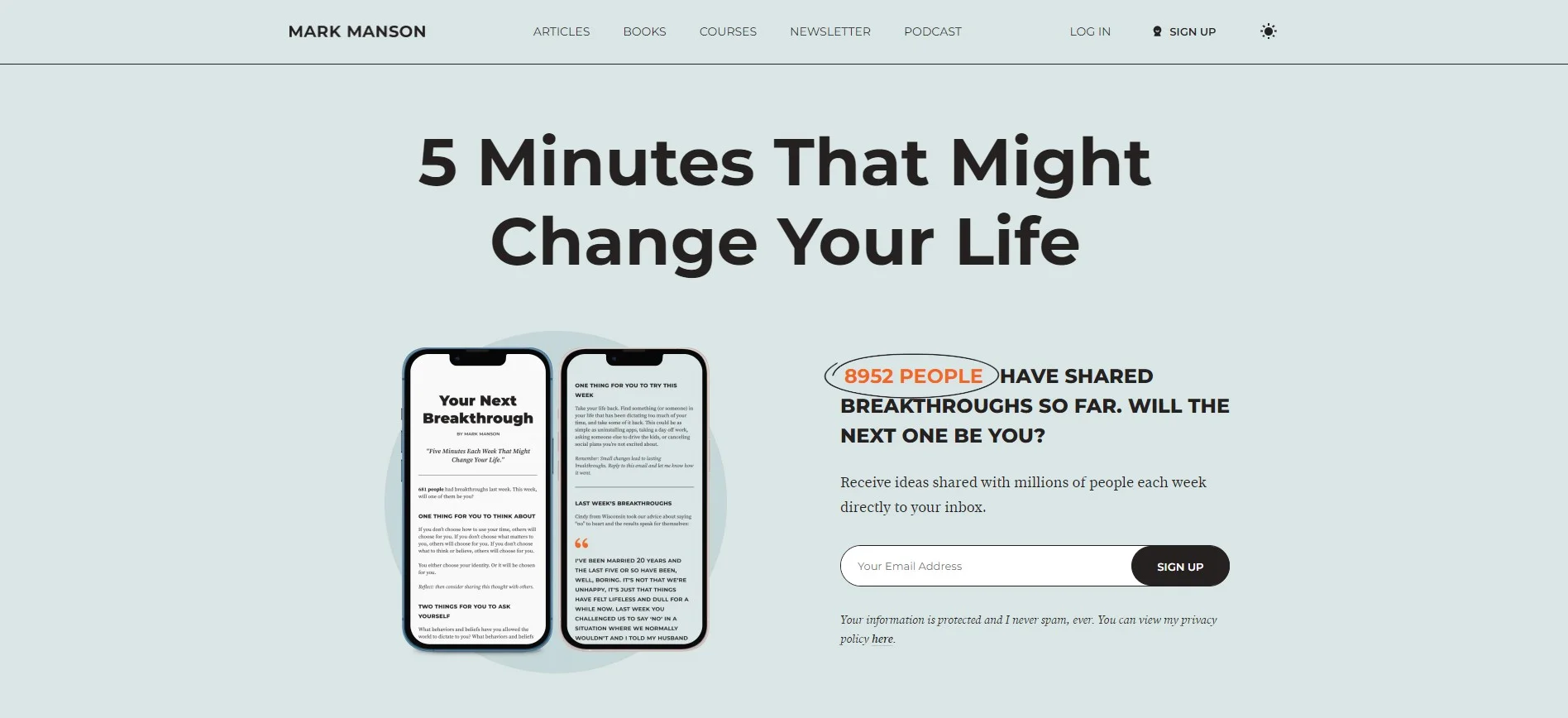
19. Mark Manson – markmanson.net

Mark Manson’s fun site matches his writing style with a casual tone and various tiers of membership for premium content.

20. Daniel Gibbs – danielgibbsauthor.com

Daniel Gibbs’s website features an engaging full-screen background video in addition to an encyclopedia of his fictional universe.

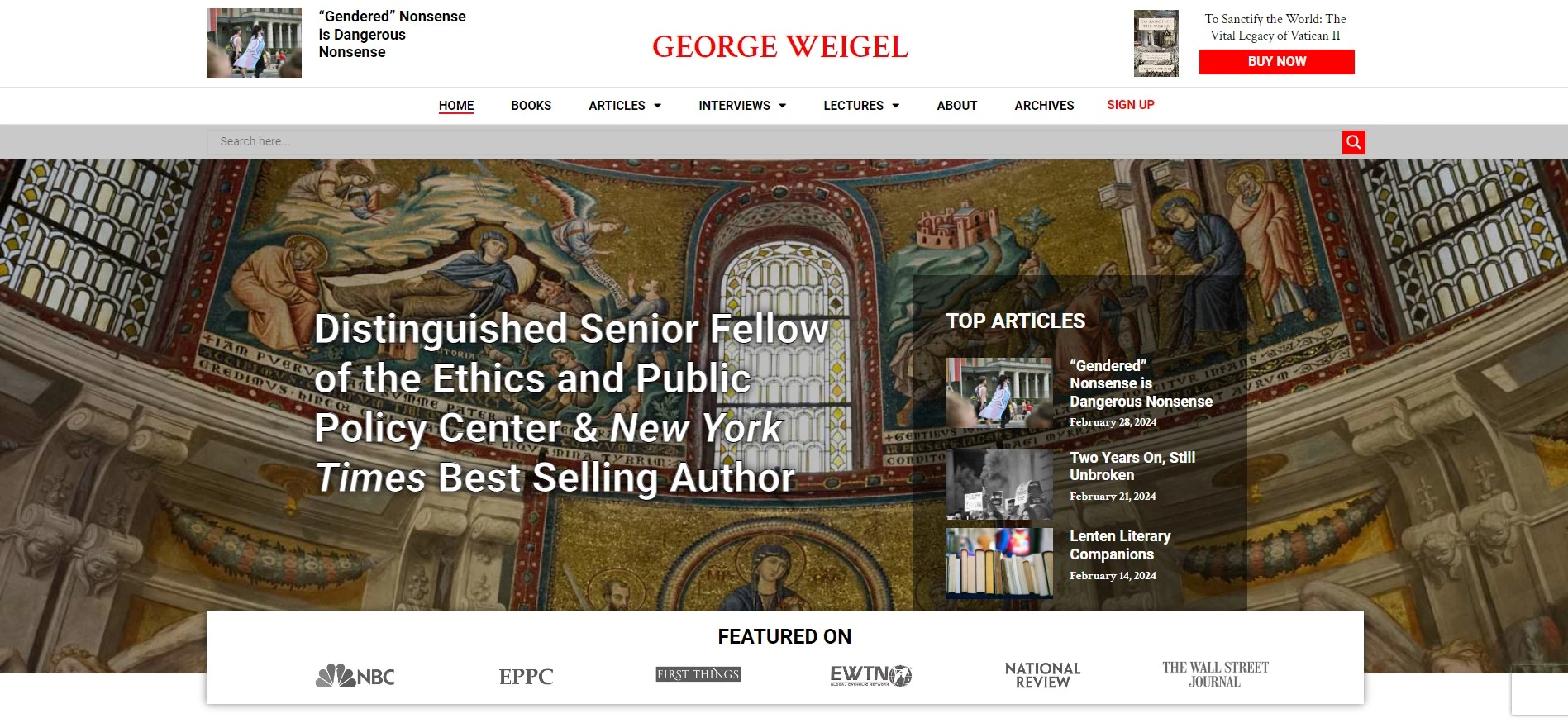
21. George Weigel – georgeweigel.com

George Weigel’s content-focused site reflects his genre and work as an author, allowing his work to speak for itself.

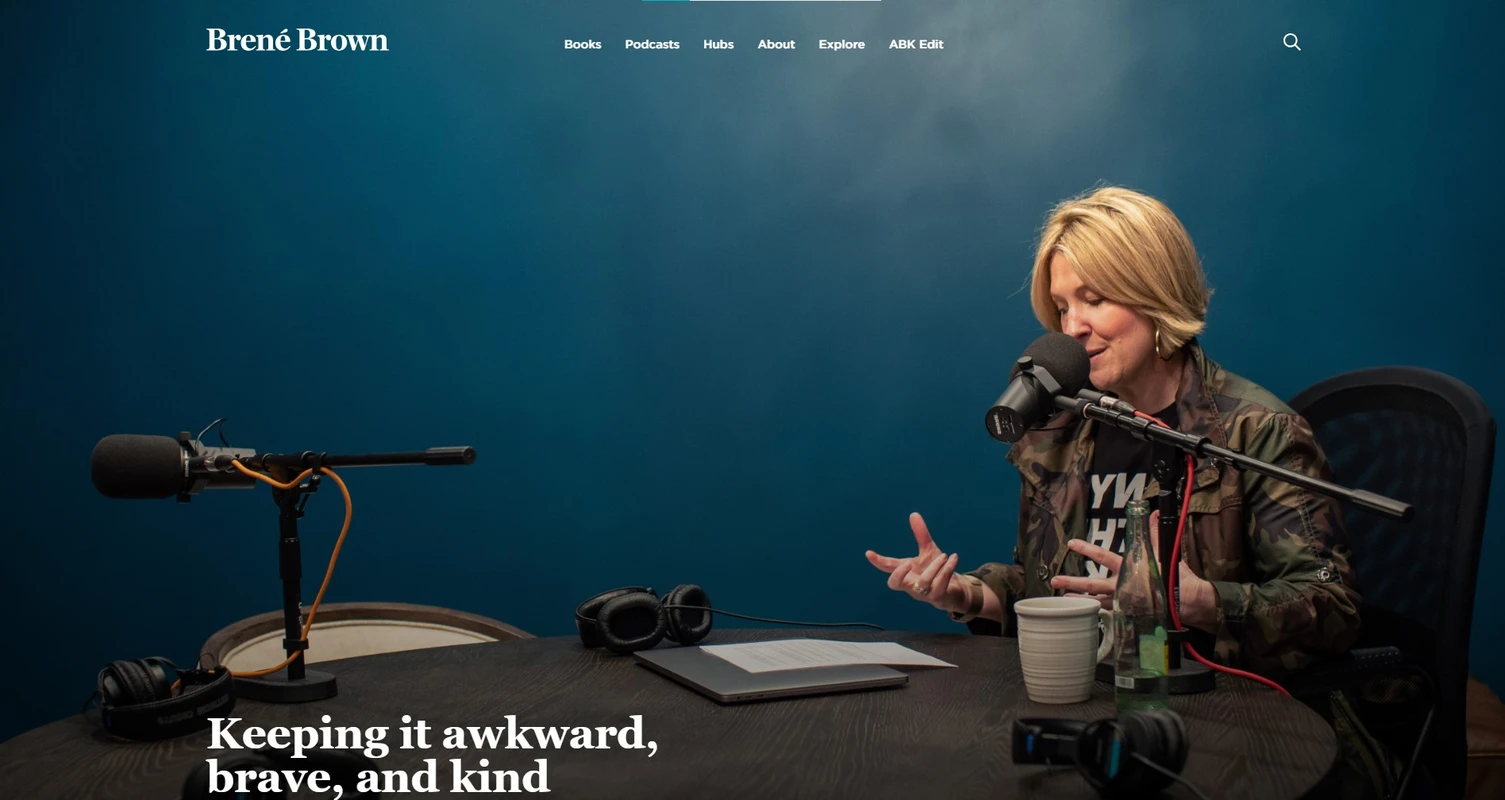
22. Brené Brown – brenebrown.com

Brené Brown’s sleek and organized website engages with her community through high-quality photography and downloadable resources.

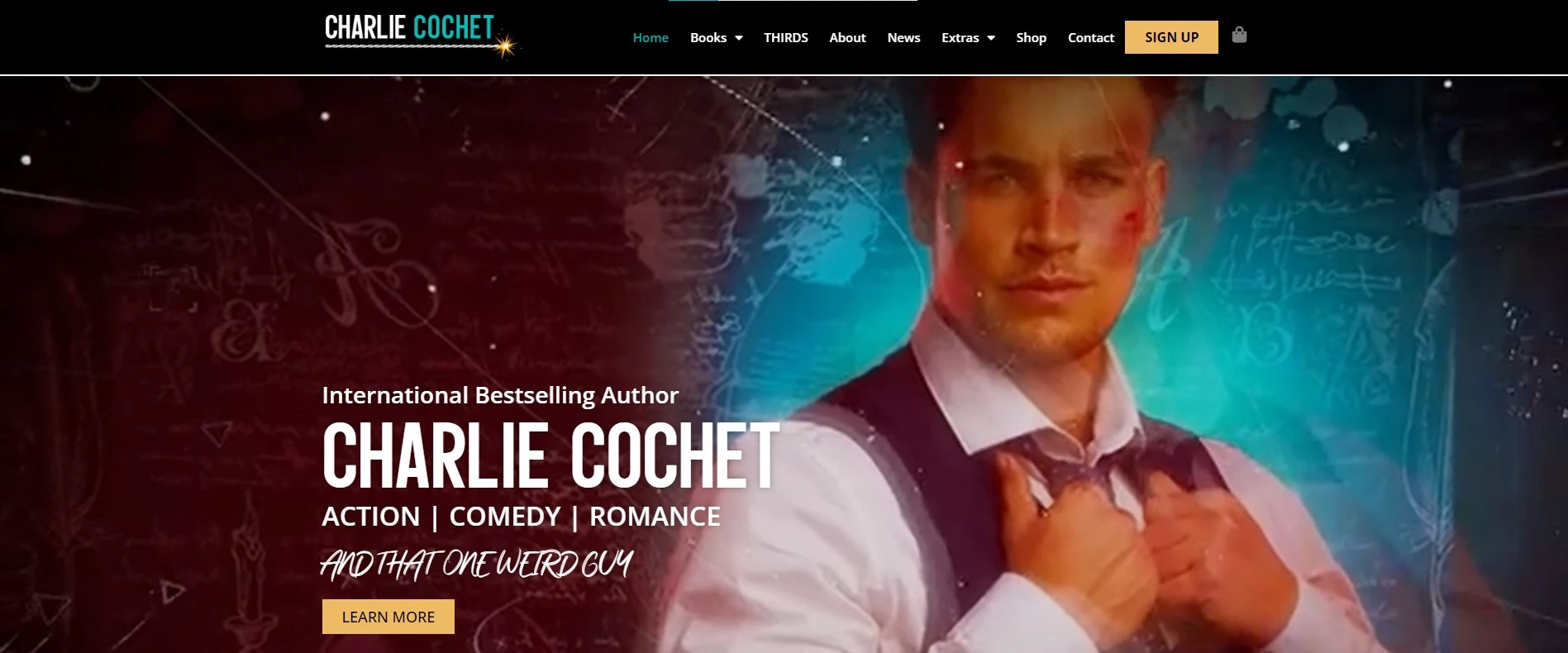
23. Charlie Cochet – charliecochet.com

Charlie Cochet’s jam-packed website is easy to navigate, offering exclusive content as well as merchandise for fans.

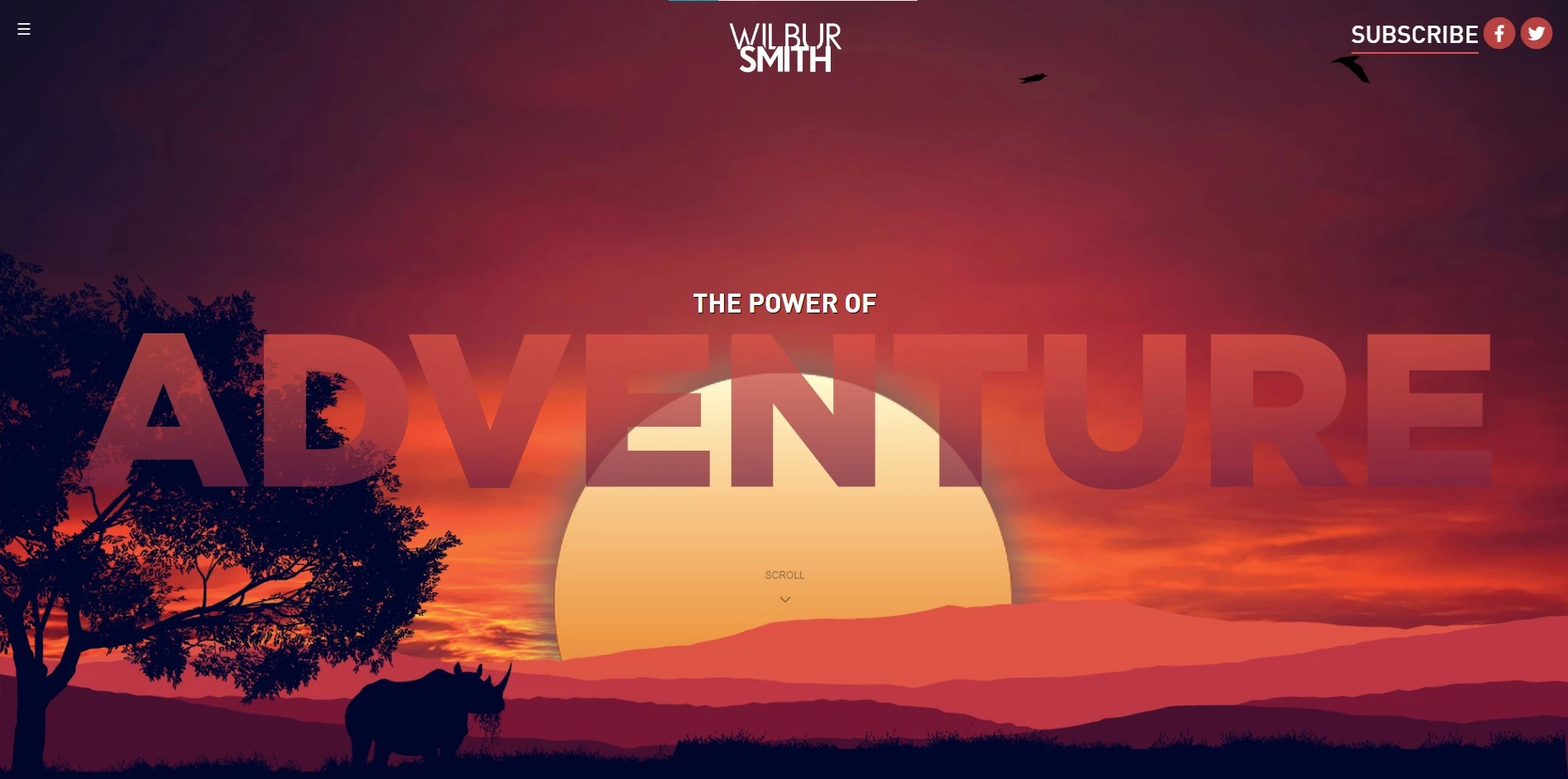
24. Wilbur Smith – wilbursmithbooks.com

Wilbur Smith’s captivating homepage sets the tone for adventure with striking colors and clean navigation.

25. Gary Vaynerchuk – garyvaynerchuk.com

Gary Vaynerchuk’s all-encompassing website welcomes fans into his world, offering various streams of media to engage with.

Ensure Flawless Publication

Eliminate errors as well as polish your book with the best proofreading services available.

Avail Best Proofreading Services

Frequently Asked Questions

What is the best author website?

Some of the best author websites are:

  • Ibram X. Kendi.
  • Miquel Reina.
  • Helen Hoang.
  • Jennifer Egan.
  • Sandra Cisneros.
  • Rupi Kaur.
  • LJ Ross.
  • Mark Dawson

Which website is best for writers?

The following freelancing websites offer excellent opportunities for writers:

  • Upwork
  • FlexJobs
  • BloggingPro
  • Guru
  • 5Freelancer.com

What is an author's website?

Your author website serves as your main online hub, embodying your brand, your "home base," and your platform as an author. In addition, it's the go-to place for readers seeking to learn more about you and your works. This presents a prime opportunity to showcase yourself and your books in the most favorable light and to establish your personal brand.

Who is the #1 author?

William Shakespeare is considered the number 1 author in the world. Born in 1564 in England, this renowned writer is hailed as the National Poet of England and has authored numerous plays and poems throughout his distinguished career.

Conclusion

We have explored the top author websites that serve as great examples of effective online platforms. In addition, we looked at the enchanting worlds of Neil Gaiman and J.K. Rowling, as well as the spine-tingling narratives of Stephen King and Gillian Flynn. Each website has qualities that draw readers in and keep them engaged.

If you are an author or an emerging writer, these examples offer invaluable inspiration for creating your own website as an author. So, take inspiration from these examples and take a step in the right direction. If you want a great website, then contact Authors Breeze. We offer great website design for authors.

Bring Your Book to Life

Turn your manuscript into a polished masterpiece with our comprehensive self-publishing services.

Hire Self-Publishing Company

Author : Christina N Hummel

EPUB vs MOBI: Which Ebook Format is Best for You?

EPUB vs Mobi

Key Takeaways: EPUB vs MOBI

  • It is important to choose the right format for an ebook between ePub vs MOBI as it impacts the reader’s experience.
  • ePub is widely supported and adaptable. In contrast, MOBI is specific to Kindle and has limited compatibility.
  • ePub is an open ebook format and offers flexibility and multimedia support.
  • MOBI is mainly used for Kindle and offers features such as bookmarks and text customization.
  • ePub offers flexible formatting, PDF ensures consistency, and MOBI offers a seamless experience for Kindle users.

Choose the Right Book Format

Author Breeze helps you not only format your manuscript but also choose the right book format, ePub vs MOBI.

Get Book Formatting Services

Introduction To EPUB vs MOBI

Do you want to choose the perfect ebook format for your book? The right format can make a huge difference. Therefore, you should know which one to choose. There are mainly two formats in ebook publishing:

  • ePub
  • MOBI
  • PDF

However, it is sometimes difficult to choose the best format for your book. This is the reason why we are here. We will guide you on which one you should select with this brief guide on ePub vs MOBI.

This blog will answer all your questions and help you choose the best one. We will break down the differences between both and explain which one you should pick. This ePub vs MOBI blog will help you make a better decision.

This is to help you write an ebook in the right format. We have written this well-researched blog. So what are you waiting for? Join us for this informative ride of ePub vs MOBI format and find out which one is the best for you.

[If you are new to ebook writing, then you can check out our blog on “What is an ebook?”

Why Choose the Right Ebook Format?

If you want to sell ebooks, then it is necessary to choose a format. You may wonder why it matters. However, in reality, the format matters a lot. When you select a format, you directly affect how your audience enjoys your ebooks. It is just as you choose the right pair of shoes for different activities. Each format comes with its own advantages. Therefore, you should pick the right one as it can impact your reader’s reading experience.

To understand this easily, imagine trying to watch a movie on your television with a CD. Will it work? No. The same happens with ebooks. If you try to open a format different than the supported format of your device, you will be confused. That is why Authors Breeze suggests picking the suitable ebook format from the start, especially if you want to sell an ebook on Amazon.

Each ebook format has its own features. Some are great for certain types of books. On the other hand, others are more flexible. When you format a book, you offer the best to your readers. The format will mostly depend on your reader’s preferences.

Brief Overview of EPUB vs MOBI

There are two popular ebook formats: ePub and MOBI. Writers often choose from both. Each format has its own strengths and weaknesses. The primary difference between MOBI and ePub is that ePub works on almost every device. At the same time, MOBI is mainly for Kindle devices. ePub is backed by the International Digital Publishing Forum (IDPF), which sets the rules for how ePub works.

ePub is a widely used format, and it has many benefits, such as:

  • Adaptable
  • Widely accepted
  • Supports various types of writing

It does not matter if you are reading the book on a:

  • Kindle
  • Nook
  • Phone

There is a high chance that it supports ePub.

On the other hand, MOBI is the format used by Kindle users. It is specifically designed for Amazon’s e-readers and fits smoothly into the Kindle’s ecosystem. At the same time, MOBI files may be a bit more difficult to handle on non-Kindle devices. However, they have some special features that make it a good choice.

EBUB vs MOBI: Which Is Better?

We are here to help you decide between the top formats. It is a battle of ePub vs MOBI. We will show you the differences between these two formats. This will help you understand what they are good at and where they fall short. This way, you can pick the one that works best for you. This brief blog will guide you to the best ebook format. So, get ready, and let us understand both ebook formats together.

What is EPUB?

ePub, or Electronic Publication, is a common digital ebook format. It works smoothly on all kinds of devices. The International Digital Publishing Forum (IDPF) introduced it as a standard format for ebooks.

Features and Advantages of EPUB

ePub has some neat features that readers really appreciate. One of them is the flexibility it offers. You can easily read ePub ebooks on any given screen size or orientation. In addition, ePub supports other features as well, such as:

  • Bookmarks
  • Notes
  • Customizable font

All of these features make reading even more enjoyable.

Furthermore, it also includes features such as:

  • Images
  • Audios
  • Videos

This means that it is equally good for all types of books, such as:

  • Fiction Book
  • Nonfiction Book
  • Children’s books

Turn Your Story into Audio

Bring your words to life with our audiobook production, perfectly tuned for the auditory reader’s journey.

Acquire Audiobook Services

Compatibility with Different Devices and Platforms

ePub files are compatible with almost all devices and platforms, which includes:

  • Amazon Kindle
  • Barnes & Noble Nook
  • Kobo

In addition, it also works on various devices as well including:

  • Smartphones
  • Tablets
  • Computers

So, no matter what gadget you prefer, you can read ePub books.

Examples of Popular E-readers that Support EPUB

Many well-known e-readers are compatible with ePub. You can find it on devices such as:

  • Amazon Kindle (with a few restrictions)
  • Kobo
  • Barnes & Noble Nook
  • Sony Reader

It also supports many reading apps for Android and iOS, such as Apple Books and Google Play Books.

Nonetheless, due to its various advantages and features, such as its flexibility and compatibility. ePub is a top choice for both readers and publishers alike.

What is MOBI?

MOBI stands for Mobipocket, and it’s a kind of book formatting that’s mainly used with Amazon’s Kindle devices. It was first made by a company called Mobipocket SA, which Amazon bought in 2005. You’ll usually see MOBI files with the .mobi ending, and they’re made to work really well on Kindle gadgets.

Features and Advantages of MOBI

MOBI format comes with special features that are specific to Kindles. One great thing is how smoothly it works with everything on the Kindle. Additionally, MOBI files let you do much more than just read; you can:

  • Add bookmarks
  • Make notes
  • Highlight text

This makes the reading experience more fun and interactive.

Furthermore, the MOBI format also lets you change the text to adapt to different screen sizes. With this format, you can change the font size and layout however you wish. This is especially beneficial when you are reading your book on different devices with different sizes.

Compatibility with Different Devices and Platforms

While MOBI format primarily supports Kindle devices. It is also compatible with other platforms and devices. The only catch is that you have to use conversion tools. There are some third-party e-reader apps and software that support MOBI files as well. This allows users to read their ebooks on different devices, such as smartphones and tablets.

Examples of Popular E-readers that Support MOBI

As mentioned, the MOBI format is most commonly used with Amazon Kindle devices, which include:

  • Kindle e-readers
  • Kindle Fire tablets

These devices offer support for MOBI files and provide users with a seamless reading experience. Additionally, some third-party e-reader apps, such as Calibre and FBReader, also support MOBI format.

MOBI vs EPUB vs PDF

Now let’s see ePub vs MOBI vs PDF.

EPUB vs PDF

ePub is a flexible format for ebooks that lets you adjust text and layout as you wish. It is great for ebooks due to various reasons. It supports multimedia and is also compatible across devices.

On the other hand, PDF maintains consistency. It ensures that the document looks the same everywhere. While PDF works for all kinds of files, including ebooks, its fixed layout can be tricky on smaller screens.

MOBI vs PDF

MOBI is all about Kindle. It offers a smooth experience only for Kindle users. Its features include bookmarks and annotations. It is perfect for Kindle devices.

In contrast, PDF keeps everything consistent across devices. It is best for many types of files, including ebooks, but its fixed layout is not ideal for smaller screens.

Frequently Asked Questions

What are the pros and cons of EPUB vs MOBI?

ePub is an open book that anyone can create using basic tools such as Notepad or TextEdit. It is easy to create because it is just a fancy zip file that contains a bunch of simple files. This openness makes it great because it works on many different devices, except for Kindles. ePub books can be read on Apple devices, Windows 10 with Edge, Kobo, Sony Reader, and Adobe Digital Editions.

MOBI, on the other hand, is mostly for Kindle devices. While you can use free software like Calibre to change other formats into MOBI, MOBI is mainly for Kindles.

Is MOBI better than EPUB?

ePub is the better choice because it has smaller file sizes and works on more devices. In the past, people used MOBI mainly for Amazon's e-reader. However, Kindle supports ePub, too, so that is no longer a problem.

Is EPUB the best format for ebooks?

ePub is the most popular and supported format for ebooks. It works on almost every device, which includes Kindle and Nook.

Does MOBI still exist?

As of August 2022, you cannot send MOBI files to Kindles using the Send to Kindle service anymore. MOBI does not have the latest features, while ePub does, and it is accepted by Kindle devices.

Conclusion

Now that you understand ePub vs MOBI, You also have an idea that it all depends on your audience. While both MOBI vs ePub formats have their strengths and weaknesses, it all depends on which of the devices your audience uses to read books.

Therefore, you have to know what your readers prefer based on your book. If you are still confused, then get on the back seat while Authors Breeze does the work for you. They have experts who can help you choose the format (ePub vs MOBI vs PDF) as per your book.

Publish Your Ebook in the Right Format

Publish with confidence and reach readers where they love to read. Start your publishing journey today!

Hire Self-Publishing Services

Author : Christina N Hummel

27th Feb 2024

How Much To Charge For A Blog Post

How Much To Charge For A Blog Post

Key Takeaways: How Much to Charge for a Blog Post

  • How much to charge for a blog post depends on the current market rates and factors such as content complexity and writer expertise.
  • You can determine rates by considering your experience level and the specialized knowledge you bring to the writing process.
  • Writers should adjust pricing based on the effort required, including research depth, SEO optimization, and multimedia elements.
  • Quick turnarounds and SEO-optimized content can command additional fees. Charges can increase if the post requires images, videos, or infographics.
  • Set clear expectations about the number of revisions included in your base rate to avoid scope creep.
  • Decide whether to charge per word, hour, project, or retainer based on what suits your work style and client needs.

Get the Blogging Help You Need

Facing difficulties writing blogs. Let our blog experts craft content that engages your audience and drive traffic

Get Blog Writing Services

Introduction: How Much to Charge for a Blog Post?

As a freelance writer or someone who creates content, you need to figure out how much to charge for a blog post. It will help you make sure you get paid right for your hard work. You would not want to sell your book for less than it’s worth. Similarly, you shouldn’t sell your writing for too little, either.

You do not just put a price tag on your words when you know how much to charge for writing a blog post. You also understand how valuable your skills are. In addition, you learn what clients can pay for your creativity and hard work.

In a market where everyone is shouting prices, you need to shout yours loud and clear. However, you must make sure it’s a fair price. As a result, you can stand out for being a great writer and also for being smart about your business.

Importance of Knowing the Right Cost for a Blog Post

So, why is it important to know how much to charge for a blog post? It is because when you know the worth of your work, you can set prices that are just right—not too high that nobody wants to work with you and not too low that you give your work away for free. You need to find that sweet spot where you feel happy. Moreover, your clients should feel they’re getting their money’s worth.

This is why you must grasp how much to charge for a blog post. It is a big deal for anyone in freelance writing and content creation. If you set the right price, it will attract the right customers and ensure your stand (or writing business) is successful.

The Impact of Industry, Topic Complexity, and Content-Length on Pricing

The amount you can charge can change a lot depending on what you’re writing about. Some topics need more research and expertise. So, they can cost more. For example, writing about simple blog writing tips might cost less than writing detailed guides on complex topics like technology or medicine. The length of your post also matters. The more time you need, the more you might charge.

So, when you’re setting your prices, think about:

  • The kind of writing you do.
  • How long does it take you to write?
  • The topic you’re writing about.

Once you understand these things, it can help you decide how much to charge for a blog post in a way that’s fair for you and your clients.

Capture Attention with Your Articles

Engage our expert writers, let them write articles for you, and make you stand out in your niche today

Hire Article Writing Services

Factors that Influence How Much to Charge for a Blog Post

Figuring out how much does a blog post cost? The price isn’t just about the words you use. It is also about:

  • Your skills
  • The blog complexity
  • How fast you have to deliver it
  • The special requirements

Let’s break down the factors influencing how much to charge for blog posts:

1. Experience and Expertise

Imagine two writers: one has been writing for years and knows exactly how to write something amazing. On the other hand, the other is just starting. The experienced writer will usually charge more because they know their writing will be top-notch. The same goes for you. If you’ve been writing blogs for a long time or you’re an expert in a specific topic, you can charge more for your work than someone who writes blogs about everything or is just starting out.

2. Content Complexity and Research Required

Some blog posts are simple and take an hour to write. In contrast, others have lots of parts and take days. If you’re writing about something complicated that needs a lot of research, such as a detailed guide on how to sell an ebook on Amazon, you will need to spend more time and effort. This means you can charge more for these posts than for simpler topics.

3. Turnaround Time

If someone asks to publish a book overnight, the publishing company will ask for extra money for working so fast, right? It’s the same with writing. If a client needs a post quickly, you can add an “urgency fee” to your usual rate.

4. SEO Requirements

Some clients want their blog posts to show up at the top of search engine results. Doing SEO requires extra skills and work, such as researching keywords and optimizing the content. So you can charge more for it.

5. Multimedia Elements

Adding images, videos, or infographics to a blog post makes it more engaging. Since these elements take extra time to create or find, you can increase your price for posts that include them.

6. Revisions and Edits

It’s common to make some changes in writing after the client reviews your work. You might include one or two rounds of revisions in your base price. However, if the client wants more changes after that, you can charge extra.

Keep in mind that if you want to figure out how much to charge for a blog post, you need to understand the value of your work and the effort you put into it.

Improve Your Brand

Transform your message into impactful content. Partner with us for content that engages and converts

Acquire Content Writing Services

Pricing Models for Blog Posts

Each of the blog posts’ pricing models has its perks. In addition, the best one for you depends on how you like to work and what your clients prefer. Remember, when you decide on how much to charge for a blog post, think about what makes sense for you and your writing business.

Some writers charge by the word. Others charge by the hour. Then, there are those who charge a set price for the whole project. So, when determining how much to charge for blog posts, you can pick from a few different ways to put your prices. Let’s look at these options:

Per Word

This is where you decide how much each word is worth and charge based on how many words you write. If you write a lot, you earn more. This model is great because it’s straightforward. In addition, clients know what they’re paying for exactly. However, you should know that not all words take the same effort to write. So, how much to charge per word can vary.

Per Hour

You can also set an hourly rate for your writing time. This way, if a post takes a long time to research and write, you get paid for all your effort. It is fair. However, it can be tricky because some clients might want to know how many hours it will take upfront.

Per Project

In this pricing model, you agree on a total price for the entire blog post or project, no matter how long it takes or how many words you write. This method suits big projects because it’s simple and clear for everyone involved. However, you need to estimate your time and effort correctly so you don’t end up undercharging.

Retainer Basis

A retainer is where clients pay you a set amount regularly (like monthly) to secure your services for a certain number of posts or hours. This is great for long-term projects because it gives you steady work and income. In addition, it helps clients know they’ve got your writing skills locked in.

How Do You Determine How Much to Charge for a Blog Post?

Know your worth, understand what you want to earn, and keep an eye on what others are charging. It will help you decide how much to charge for a blog post. It can feel a bit difficult for the first time. You know you can write perfectly. However, how much should you charge for it? Here’s a simple guide to help you set your prices:

1. Assess Your Skill Level and Expertise

First, think about how good you are at writing. Are you an expert who grows your own? Or are you just starting out? If you’ve been writing for a long time or you’re really good at writing about specific things (like tech or fashion), you can charge more.

2. Calculate Your Desired Annual Income

Now, decide how much money you want to make in a year. Once you have a number in mind, break it down. If you want to take weekends off and have holidays, you won’t be writing every day. So, calculate how much you need to make each day you work to hit your annual goal. From there, you can figure out how much to charge per hour or per word to meet your daily earnings target.

3. Consider the Market Rates and Positioning Yourself Competitively

Lastly, look around at other writers. How much are they charging? You don’t want to charge $10 for a blog post if everyone else is charging $2. But you also don’t want to charge 50 cents and lose out. Find out the going rate for someone with your writing skills. Then, adjust your prices so you’re competitive. Maybe you add a unique writing style or expertise that makes it worth a bit more.

Expand Your Book’s Reach

Give your story a voice. Transform your book into an audiobook and connect with listeners everywhere

Professional Audiobook Services

Frequently Asked Questions

How much should I charge for a 500-word blog post?

The blog post cost will depend on your experience and the complexity of the work. For a 500-word blog, if you are a beginner, you can charge between $3 to $25. On the other hand, if you are more experienced, you can charge between $30 to $150. In addition, if you are an expert, you can set costs up to $1,000 or more.

How much should I pay someone to write a blog post?

Many freelancers talk about charging around $100 for a simple blog post. For posts that require more technical knowledge, the price can be much higher. When it comes to payment per word, writers usually ask for between 10 cents to $2 for each word they write.

How do you price a blog post?

Begin by charging 10 cents for each word. Then, increase your fee based on how many people engage with your content. A good guideline is to add $100 for every 10,000 page views your blog gets. So, if your blog receives 5,000 pageviews, you would add an extra $50 to the cost of your blog post.

How much do freelancers charge for blog posts?

The most common price for a 1500-word blog post is between $250 and $399. About 21% of freelancers prefer to charge based on the number of words. Meanwhile, 34% of freelancers ask for less than 20 cents for each word they write.

Conclusion

We’ve been discussing how much to charge for a blog post. We have explored ways to find the best paths to take so you can get the right price for your writing adventures. Remember, your writing is valuable. It’s your business, and you’re the boss. Don’t be shy about setting prices that reflect the hard work, skill, and love you pour into your posts. You deserve to be paid well for your excellent writing!

Now, have you decided how much to charge for blog posts? Do you have any tips or experiences to share? Or maybe you have questions about finding the right price? You can contact Authors Breeze. We help writers and authors grow and help them with our services!

Credit: Brendan Dell 

Ignite Interest with Visuals

Bring your book to life before their eyes. Create a buzz with a captivating and stunning book video trailer

Make Video Book Trailers

Author : Caroline Chartrand

What is Historical Fiction? A Guide & Writing Techniques

historical fiction

Key Takeaways: What is Historical Fiction

  • Historical fiction is a genre that combines factual historical events, places, and time periods with fictional characters and narratives, offering an immersive experience of the past.
  • This genre has a long-standing tradition, allowing readers to explore various cultures and time periods through engaging stories, thereby making history accessible and compelling.
  • Historical fiction is not monolithic; it encompasses a wide range of sub-genres, settings, and time periods, from ancient civilizations to modern historical events, providing a rich tapestry of narratives for readers.
  • The genre is characterized by its meticulous setting, authentic characters, engaging plot, period-appropriate dialogue and language, and the exploration of timeless themes through the lens of history.
  • Authors should prioritize thorough research to ensure historical accuracy, balance fact with fiction to maintain engagement, create authentic characters that reflect their time, and vividly depict the atmosphere of the period to fully immerse readers in the story.
  • Careful attention must be paid to avoid anachronisms in language, technology, and social norms to preserve the authenticity of the historical setting.
  • Works like “The Book Thief” by Markus Zusak, “To Kill a Mockingbird” by Harper Lee, and “The Kite Runner” by Khaled Hosseini illustrate the genre’s potential to address significant themes and historical periods through powerful narratives.

Write an Exceptional Historical Fiction Book

Turn your ideas into a captivating ebook with Authors Breeze. We can help you craft a compelling ebook from start to finish.

Get Ebook Writing Services

Introduction to Historical Fiction

[“I believe that historical fiction is the closest thing we have to time travel” – Cassandra Clare]

There is fiction, and there is history. Historical fiction is a mix of both. It is an imaginative time machine that takes us back in time. Historical fiction lets us experience the past through the eyes of fictional characters. It is a great genre of literary fiction that describes history in the best form.

Historical fiction novels are extremely special. They help us experience different times and places from the comfort of our homes. Historical fiction books make history come alive and make us understand our past. The thing that makes them unique is the blend of real events and fictional stories. This makes our journey through the past interesting and immersive.

What Is Historical Fiction

First, we will break down what historical fiction means and what its history is. Then we will move on to our next section, which is types of historical fiction.

Historical Fiction Definition

Definition of Historical fiction: It is a mix of real history and fictional storytelling. It includes fictional characters such as a round character and stories with the addition of aspects of real life, such as:

  • Historical events
  • Places
  • Time periods

While the characters and plot are fictional, the historical setting and context are not. They are based on real facts and events.

History of Historical Fiction

Historical fiction is a very old genre and has been around for a long time. Events of history are difficult to understand which is why writers use fictional history as a base to explain it. They tell stories about the past, such as ancient days or more recent times. People love historical fiction because it lets them travel to the past and learn about different cultures. It has changed and gotten even more popular over time. It has now become one of the favorite types of books people love to read.

Types of Historical Fiction

There is not one type of historical fiction out there. It has many:

  • Biographical Historical Fiction
  • Historical Romance
  • Historical Novel

Authors can choose these to bring life to their stories.

Sub Categories within Historical Fiction

Historical fiction is not only of one category. It has many kinds. Authors can tell stories at many different times and locations. They can set stories in places such as:

  • Medieval Europe
  • Ancient Egypt
  • During World War II

Each type of historical fiction has its own special place. This gives readers a chance to discover different parts of history through exciting stories.

Different Time Periods and Settings

The great thing about historical fiction is that it can take you to any time in history. It allows you to roam in the streets of ancient Egypt or see the Roman Empire fall. Historical novels have everything that you may want to read or want to know about as per your interests. As an author, you can make lots of different stories by picking different times and places. This will also develop interest in readers and make history a fun-filled activity.

Elements of Historical Fiction

Now that you understood what historical fiction is, we will now explain the elements of it. Just as with any other genre, this also has some elements of fiction that make up a fictional story based on history. Here are some of its most important elements.

Setting

The setting of a historical novel is just like its background. It is where the story takes place and sets the stage for all the action. Authors work hard to paint a clear picture of the time and place of their story. They use details such as:

  • Architecture
  • Clothing
  • Daily life

This helps them take their readers back in time.

Characters

Just like in any story, characters are at the heart of a historical novel. Authors create fictional characters such as morally grey characters who spend their lives in the novel’s setting. The characters also face the challenges and experiences of their time period. These characters deal with issues that were common in their time. This gives readers an idea of what life was like in the past.

Plot

The story of a historical novel is what happens in it, set against the background of history. It could be about major historical events such as:

  • Wars
  • Revolutions
  • Conflicts

It may also be about smaller, personal stories from a certain time. However, it does not matter much. The plot should just be interesting. It should keep the readers hooked from the start to the finish.

Dialogue and Language

When it comes to historical novels, the way characters speak matters a lot. Authors use language that is appropriate to the time period in which their story is set. They ensure that characters sound just as they belong in that time. This helps create an immersive experience for readers and adds authenticity to the story.

Themes

Historical fiction often includes wide themes that are relevant to both the past and the present. These might include themes such as:

  • Love
  • War
  • Power
  • Justice

It can also include specific themes that relate to the time period the story is set in. This is a great way to address some crucial points. When authors explore these themes through the lens of history, they help highlight important issues.

Your Story, Our Words

Let your voice be heard, even if it’s not your own. We will help you tell your anonymously.

Hire Ghostwriting Services

Tips and Techniques for Writing Historical Fiction

So, how can you write a book on historical fiction on your own? We will explain everything in a bit. Below, you can find some helpful tips and techniques if you want to write a historical novel. This is especially true for aspiring writers who want to start their own historical fiction work.

Conduct Thorough Research

The first thing to have in mind is research. You have to know everything before you start writing and publishing. It is important to conduct thorough research about the history of your story. This means that you have to study everything, such as:

  • Everyday lives of people during that time
  • Major historical events that shaped the period

The more you know about the historical context, the more authentic and believable your story will be. It will also help readers know about the real history through your story.

Balance Fact and Fiction

One of the most important parts when writing historical fiction is to draw a line between facts and fiction. It is essential to find the right balance between historical facts and fictional elements in your story.

Many writers miss this, and they mess up the story. Therefore, this is key to creating a successful historical novel. While it is important to stay true to history, you can still try your creativity. You can create interesting characters, such as foil characters, and stories that bring history to life in new ways.

Create Authentic Characters

Your characters should feel like real people who belong in the historical setting of your story. For this, you can break down key aspects of your characters in parts such as:

  • Their backgrounds
  • Motivations
  • Personalities

Then make sure that they reflect the time period they live in. Pay attention to details such as

  • Language
  • Clothing
  • Social customs

This makes your characters feel authentic and relatable to readers.

Create an Atmosphere

Make readers feel like they are in a different time and place. The more the readers can immerse themselves in the story, the better it is for you. For this, you can make your writing full of atmosphere. Use detailed descriptions of:

  • What things look like
  • Sound like
  • Smell like

This sets the atmosphere and makes your historical setting feel real. Does not matter if it is the busy streets of ancient Rome or the quiet countryside of medieval England. Make sure that your readers feel like they are there with your characters.

Avoid Anachronisms

Anachronisms are when things do not belong to the time you are writing about. To avoid anachronisms, you need to be careful with everything, including:

  • Words
  • Technology
  • Cultural stuff

Check all the historical details to make sure they are accurate. Furthermore, watch out for using words or ideas that did not exist at that time. If you stick to what was true in history, your readers will feel like they are really there in the story.

Make Your History Book Shine

Ensure your book is error-free, reads smoothly, and connects with your readers.

Avail Book Editing Services

Historical Fiction Examples

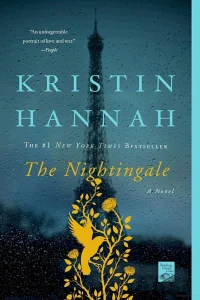
1- The Nightingale

Historical Ficton-The Nightingale

  • Book: The Nightingale
  • Author: Kristin Hannah
  • Date Published: 2015

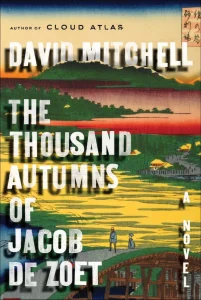
2- The Thousand Autumns of Jacob De Zoet

Historical Ficton-The Thousand Autumns of Jacob

  • Book: The Thousand Autumns of Jacob De Zoet
  • Author: David Mitchell
  • Date Published: 2010

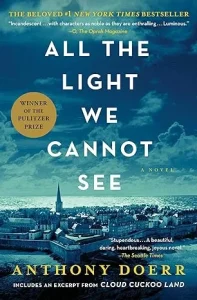
3- All the Light We Cannot See

Historical Fiction-All Light We cannot See

  • Book: All the Light We Cannot See
  • Author: Anthony Doerr
  • Date Published: 2014

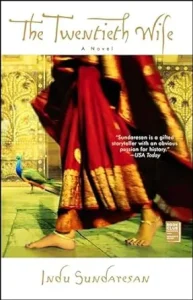
4- The Twentieth Wife

The Twentieth Wife

  • Book: The Twentieth Wife
  • Author: Indu Sundaresan
  • Date Published: 2002

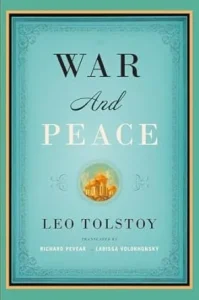
5- War and Peace

War and Peace

  • Book: War and Peace
  • Author: Leo Tolstoy
  • Date Published: 1867

Frequently Asked Questions

What defines historical fiction?

Historical fiction is a type of story that happens in the past. The books try to show what life was like back then, including how people acted and what they believed. This makes the stories feel real and helps readers learn about history.

What is the best historical fiction book of all time?

The following are some of the best works of historical fiction:

  1. Memoirs of a Geisha
  2. The Other Boleyn Girl
  3. Gone with the Wind
  4. The Pillars of the Earth
  5. The Book Thief

What is historical fiction known for?

Historical fiction takes place in a real location during a time that people can recognize from history. The story blends true events and the author's creative additions to fill in missing pieces. Characters might be completely made up or inspired by real individuals, often combining both elements.

What is an example of a historical fiction story?

Gone with the Wind" is an example of historical fiction. It's set during the Civil War and Reconstruction periods, focusing on the life of Scarlett, a fictional character, and her romantic pursuits. The story also delves into the challenges faced by her family following the war.

Conclusion

So, to conclude, we’ve talked a lot about historical fiction, which is a really interesting type of story. We learned how it mixes real history with made-up stories. We also looked at the different kinds of historical fiction and what makes them special. Plus, we shared some helpful tips for people who want to write their own historical fiction stories.

If you feel excited about writing historical fiction after reading this, we say go for it! You can explore all kinds of cool things from the past with a bit of research, creativity, and a love for storytelling.

Historical fiction isn’t just a type of story — it’s like going on a time-travel adventure! Whether you love reading about the past or you’re eager to write your own stories, we hope this blog made you see how amazing historical fiction can be. So, grab a book or a pen, and let the journey begin. You can have Authors Breeze with your side on the way.

Take Control of Your Book

Navigate the self-publishing process with expert guidance and support to reach your audience.

Acquire Self-Publishing Services

Author : Charles Maynes

26th Feb 2024

Self-Publishing Companies to Avoid and New Author Scams

self-publishing companies to avoid

Key Takeaways: Self-Publishing Companies to Avoid

  • With the rise in scams targeting new authors, it is important to know the self-publishing companies to avoid them.
  • Look out for warning signs like lack of transparency in pricing, poor reputation, and promises that seem too good to be true.
  • Be aware of common scams targeting new authors, such as vanity publishers, literary agent scams, and fake book reviews.
  • Thoroughly research self-publishing companies, understand publishing contracts, and stick to platforms with a proven track record.
  • Some reputable self-publishing platforms include Amazon Kindle Direct Publishing, Apple Books, and Authors Breeze.

Start Your Self-Publishing Journey

Take control and publish your book on your terms. We navigate the complexities, so you can focus on your story.

Avail Self-Publishing Services

Introduction To Self-Publishing Companies to Avoid

In 2023, 5,3940 reports of fraudulent scams were submitted in the world of magazines and books with 11% (568) of the reports indicating a loss. So, you should know that there are some self-publishing companies to avoid. If you don’t, then no worries, we will tell you about them. Self-publishing is the process of publishing your own books instead of going to traditional publishing companies. It gives authors more control over their work and a chance to share their work directly with their readers. It is a fairly new method, and before this, there were only traditional methods.

As an author, it is better to self-publish your book. It allows you to publish your book without the help of a big publishing company. Sadly, self-publishing can be risky as well. There has been an increase in scams targeting writers who want to write a book. Therefore, you should know what self-publishing companies to avoid in order to protect yourself from these scams.

These scams trick authors and can cause a lot of problems. So, today, we will explore how to know the self-publishing companies to avoid. We will also discuss new author scams and what self-publishing to avoid a safe publishing journey.

Red Flags: Signs of Self-Publishing Companies to Avoid

When you consider self-publishing companies, you should be aware of potential red flags that may indicate that they are untrustworthy or offer low-quality publishing experience. If you find any red flags, you should know that these are one of those self-publishing companies to avoid. Here are some red flags to watch out for:

Lack of Transparency in Pricing

Some publishing companies may not be clear about all the costs involved in the process. So, you need to watch out for hidden fees that can surprise you later. Make sure you understand how much money you will make from your book. Some companies might not explain this clearly.

As a result, this will make it hard for you to know what to expect. Some companies exploit new authors, and this is why you have to identify such self-publishing companies to avoid.

Poor Reputation and Bad Reviews

Before you choose a self-publishing company, take a look at its background. If it has a bad reputation, it is a sign that something might be wrong. So, it is important to read what other authors have to say about their experiences with that particular company.

If many writers have had a bad time with them, it is a warning to stay away. Knowing the background of a company also helps you know what will be thrown at you. This way, you can manage things better.

Promises That Sound Too Good to Be True

No one in the world can promise that your book will sell or be a success. Therefore, if a company claims or guarantees success, you need to be cautious. Success in writing is hard work and a bit of luck. Some companies focus too much on book marketing and less on helping your book succeed.

So, you should be wary of promises that sound a bit too much. This is one of the most prominent signs for self-publishing companies to avoid, so focus on it.

Lack of Editorial Services

Quality editing is essential if you want your book to be professional and well-written. If a self-publishing company does not offer or focus on the value of editing, it may not be the best company to work with. Such companies are not interested in investing in producing high-quality books. Therefore, look for those self-publishing companies to avoid.

Make Your Book Ideal

Eliminate errors, enhance flow, and elevate your writing with expert editors. Polish your book to perfection.

Get Book Editing Services

Complicated Rights and Royalty Structures

Review the company contract carefully. Be cautious if the company tries to retain excessive rights or has twisted royalty structures. Make sure that you maintain control over your work and vital decisions; this includes:

  • Cover Design
  • Pricing
  • Distribution

If a company insists on making these decisions without your input, it could be a sign of potential issues. It is of no use to work with a company that does not offer you value. Such companies also fall in the category of self-publishing companies to avoid.

Scams That Target New Authors

There is a long list of self-publishing companies to avoid. Such companies actively do scams and specifically aim for new authors who may have no idea about the publishing industry. Therefore, as an aspiring writer, you need to be aware of these scams to protect yourself. Here are some common scams that target new authors:

Vanity Publishers

Vanity publishers often promise to publish a book by an author for a fee. They make money from the author rather than from book sales. Legitimate publishers typically pay authors by selling the books. They do not take fees from them to sell ebooks of authors. This is one of the most common scams for self-publishing companies to avoid.

Literary Agent Scams

Some fraud agents may request upfront fees or charge reading fees. An authentic literary agent takes a percentage of the earnings from book sales and makes money from it. Therefore, if any publisher of a book or agent asks you for a fee to publish your book, decline this offer immediately. In addition, you can prioritize reputable sources such as the Association of Author Representatives to find agents.

Contest and Award

You need to be careful when writing contests that require an entry fee but offer little in return. Some scams use fake contests to exploit authors. They trap you by saying that this is an ‘entry fee’ for this contest and that you will get gifts if you win it. However, it is most probably a scam. They will take the fee and vanish.

Editing Scams

Scammers may act as editors and charge high fees for their editing services. So, you need to research before taking any services online. You can choose trustworthy editors or editing companies such as Authors Breeze.

Fake Book Reviews

Some services offer to provide positive reviews for a fee. This is not only unethical but can also harm the reputation of an author if discovered. Therefore, always maintain credibility and do not engage in unethical practices.

Copyright and ISBN Charges

Authors should not pay excessive fees for copyright registration or obtaining an ISBN (International Standard Book Number). These services are often available at reasonable costs or even for free. Check first before you are scammed.

Fake Literary Journals and Magazines

Some scammers create fake literary journals or magazines and charge authors for publishing their work. So, you research the credibility of publications before you submit your manuscript. This way, you can save both your time and money.

Phishing Scams

Authors may receive uninvited emails from fake literary agents or publishers. These emails may contain phishing links or request personal information. Therefore, always verify the legitimacy of such communications.

How to Protect Yourself from Scams? Tips for New Authors

If you remain careful, it can help you avoid falling victim to scams and navigate the publishing industry more safely. Also, you should keep informed of self-publishing companies to avoid. To protect yourself from scams, you should:

Thoroughly Research Self-Publishing Companies

You can look for info on websites that keep an eye on the self-publishing industry. These watchdogs often expose scams and give you insights into which companies are trustworthy. In addition, you can ask fellow authors, writing communities, or a writing coach. When you get advice from people who have been through the process, it can be incredibly valuable.

Understand the Publishing Contract

Before you sign any contract, it is wise to consult with a legal expert who understands publishing. They can help you navigate the terms. In addition, they can ensure you don’t get into a deal that could harm you. If the contract is hard to understand or has terms that seem unclear, it’s a red flag. A good contract should be transparent and fair. So don’t hesitate to ask questions or seek clarification.

Utilize Self-Publishing Platforms with a Proven Track Record

Stick to self-publishing platforms that have been around for a while and have a positive reputation. Read reviews from other authors to get a sense of their experiences. Moreover, look for companies that are open about their processes, fees, and royalty structures. Transparency is a good sign. It shows a platform wants to help authors succeed rather than taking advantage of them.

List of Self-Publishing Companies to Avoid

There is a massive list of book publishers you should avoid. The following are vanity publishing companies to look out for:

  • Author Solution
  • Balboa Press
  • Abbott Press
  • Barbara Bauer Literary Agency
  • Alliant Press
  • The Writing Crew
  • AlphaScript
  • The Clock Writing
  • America Star Books
  • Olympia Publishers
  • Archway Publishing
  • Indie Writer Support

What are the Best Book Publishing Companies?

Now that you know the worst self-publishing companies to avoid, we will take a step further. Here are some of the legitimate and best publishing companies.

  • Amazon Kindle Direct Publishing
  • Apple Books
  • Lulu
  • BookBaby
  • IngramSpark
  • Barnes and Noble
  • Authors Breeze

While Authors Breeze is not where you publish books, they do help in various aspects of publishing. They help you with many things, such as writing and editing.

Capture the Digital Market

Transform your content or book ideas into engaging and optimized ebooks. Make your literary way to the digital world!

Acquire Ebook Writing Services

FAQs

What are the most reputable self-publishing companies?

Here is a list of some of the best self-publishing companies for writers:

  • Kindle Direct Publishing
  • Apple Books
  • KOBO
  • Barnes and Noble Press
  • Draft2Digital

What are the pitfalls of self-publishing?

There are mainly 5 common self-publishing mistakes:

  • Not researching the self-publishing process
  • Editing too quickly
  • Creating your own book cover
  • Writing a boring blurb
  • Not establishing a brand identity

Has anyone been successful in self-publishing?

Yes, Here is an example of Amanda Hocking. She wrote 17 books while working full-time. She published them herself online, selling over a million copies. Ashwin Sanghi, who wrote popular books like The Rozabal Line, also started self-publishing after many publishers turned him down.

What is the best publishing company for first-time authors?

Here are some of the best publishers for first-time authors:

  • Black & White Publishing
  • Coffee House Press
  • Chicago Review Press
  • Chronicle Books
  • DAW
  • Entangled Publishing

Conclusion

In this discussion about self-publishing, we have talked about why many new writers are attracted to it. Unfortunately, we have also talked about how some companies take advantage of these writers through scams. We have pointed out signs of self-publishing companies to avoid and talked about some common ones to watch out for.

Self-publishing can be great, but it is important to be careful and know what to look for. Knowledge is power, and when writers have the right information, they can make smart choices about their books. Work with authentic companies like Authors Breeze that will help you grow as an author.

Find Your Perfect Ghostwriting Match

Turn your vision into a reality with a skilled ghostwriter. Share your ideas, we craft compelling content to bring them to life.

Hire Ghostwriting Services

Author : Shirley Gibson

22nd Feb 2024

10 Reasons Why a Personal Authors Website is Essential

authors website

Key Takeaways: Why Personal Authors Website is Essential

  • The authors website establishes a personal identity by showcasing achievements and works on your authors website.
  • You can introduce yourself to the audience by sharing your passions and also inspirations.
  • You can engage directly with readers, answer their questions, as well as share exclusive content.
  • Authors websites increase visibility and reach through effective SEO strategies and quality content.
  • It can promote books and upcoming releases by offering sneak peeks and engaging with readers.
  • You can sell books directly from your authors website to retain more profits and offer convenience to readers.

Design Your Dream Authors Website

You know an author website is essential. So, now craft a website that captivates just like your books. Build your author brand with Authors Breeze.

Get Author Website Design Services

Introduction To Why a Personal Authors Website is Essential

What is an authors website? Why do you need one? Branding is needed for big companies and small startups. However, an author and a writer need it too. It is a powerful tool that you can use to help your readers recognize and remember you. In addition, it is essential to establish a professional identity, and the best way to do this is by creating an author website.

As you may know, websites are essential for:

  • Businesses
  • Brands
  • Corporations

However, in this blog, we will not talk about businesses or brands but individuals. This does not stress much about how important a website is for them (Businesses) but for those who write a book or blogs as well.

It is essential to have your very own website as a writer or author. Moreover, it is as if you have a home on the internet, where you put all your work. Apart from that, you can also:

  • Showcase your achievements
  • Connect with your audience
  • Important updates regarding your work

In this blog, we will explore why you should have a personal author website. So, join us as we list all the reasons why it is essential to build an author website.

10 Reasons to Have a Personal Authors Website

An authors website is your own personal website where you showcase all your work as an author. While there are a lot more reasons to have one, we have listed the 10 best.

1. It Establishes Your Professional Identity

Your portfolio is a treasure of your best work. It is where you show your skills and what you are capable of. In addition, your website gives you the perfect platform to display your work. You can showcase everything, such as:

  • Excerpts from your latest novel
  • Snippets from your blog posts
  • Links to articles you have written

So, focusing on the author website design is all that you have, and it is the best place to showcase all of your work.

2. You Can Introduce Yourself

Have you published a fiction or nonfiction book? How would anyone know about it? So, this is where an author website comes in. It is a great place where you can tell everyone that:

  • Who are you?
  • What do you write about?
  • What is your expertise?

Your biography helps everyone, not just your readers, to get to know the person behind the works. It is your chance to share everything that you came across in your career, such as:

  • Your journey
  • Your passions
  • What inspires you

In addition, you can add:

  • Awards you have won
  • Degrees you have earned
  • Writing courses you have completed

This adds credibility to your name. Your website is the perfect place to compile it all and show it to everyone.

3. You Can Engage With Readers

Communication is the key, but how do you communicate with your readers? This is one of the reasons why it is vital and beneficial to create an authors website. An author website offers you a direct line of communication with your readers and potential readers as well. Through your website, you can do a lot of communication; this means you can:

  • Interact with them
  • Answer their questions
  • Share exclusive content

It is an exceptional tool to connect with your readers, as mentioned by Authors Breeze. Your website is the ultimate hub for connecting with your audience.

4. Authors Website Increases Your Visibility and Reach

In this era of the competitive market, you have to have a strong online presence. It is the key to success as an author. Moreover, your website acts as your home base on the internet. It is the place where your readers can find you no matter where they are. You can help your readers to discover you easily with the right SEO strategies in place, such as:

  • Using relevant keywords
  • Creating quality content
  • Optimizing your site for mobile devices

In addition, you can attract more readers to your work.

5. It Connects You With Other Professionals

Writing alone is normal, but you do not have to do everything by yourself. Your website as a writer or an author is similar to a helpful friend. It helps you meet other people as well, such as:

  • Writers
  • Authors
  • Professionals of related work

You can work with them on almost all things. This can include:

  • Writing blog posts
  • Authoring a book
  • Taking help on a particular topic

Your website can give you many chances to work with others and get better at what you do.

6. It Helps Promote Books and Upcoming Releases

Authors have to do many things if they want to self-publish, such as:

  • Writing and Publishing
  • Editing and Proofreading
  • Book Marketing

Apart from doing the marketing, they may also have to do the book advertisements. In this case, your website is the perfect platform. You can take full advantage of your website by giving sneak peeks of:

  • Book Cover
  • Book Video Trailer

This way, you can build interest in users, too. In addition, you can engage with readers in meaningful ways, too. This can also help drive sales and boost your author brand. Nonetheless, having a website for a book can be highly beneficial.

Launch Your Book Marketing Campaign

Reach new readers and boost your book sales. Our expert book marketing strategies get your book noticed and loved.

Avail Book Marketing Services

7. Authors Website Can be a Central Hub for All Author-Related Activities.

Your author’s website is your home of content and work, both published and unpublished. It is where readers can go to learn more about your work. It also helps them discover your books and audiobooks. In addition, it also helps you manage all of your author-related work in one location.

You can do much with your website, such as:

  • Updates and Announcements
  • Manage Your Author Newsletter
  • Track Your Analytics

Your website serves as a central hub for everything you pen down as an author or writer. With everything in one place, you can manage your workflow and focus on what you do best, which is writing outstanding books.

8. You Can Provide Resources, Tips, and Insights for Aspiring Writers

As an author, you have a wealth of knowledge and experience to share with aspiring writers. Your author’s website is the perfect platform to do just that. In addition, you can help new authors if you:

  • Share writing tips and techniques
  • Recommend helpful resources
  • Offer insights into the publishing process

Your website can be a valuable resource for writers at every stage of their journey. By providing helpful content that helps others succeed, you can establish yourself as an authority in your field. In addition, you can also build trust and credibility with your audience.

9. You Can Highlight Testimonials, Reviews, and Endorsements

What do readers and industry professionals have to say about your work? Let your reviews do that for you. An authors website can help you highlight the following:

  • Testimonials from satisfied readers
  • Glowing Amazon book reviews from critics
  • Endorsements from fellow authors or influencers

By highlighting these things, you can build credibility and trust with potential readers and industry insiders as well.

10. You Can Sell Books Directly from the Author’s Website

Why let retailers get ahead of you? With your own author website, you can sell your books directly to readers. This way, you can also keep more profits in the process. With the help of:

  • A dedicated bookshop page
  • A custom-built storefront
  • Integrated buy buttons on your book pages

Your website makes it easy for readers to purchase your books with just a few clicks. With your website, you can also put a subscription option and also sell ebooks through it. This way you can earn more too.

Make a First Impression That Sells

A stunning cover grabs attention and speaks to your genre. Get your eye-catching book cover from Authors Breeze.

Acquire Professional Book Cover Design

Frequently Asked Questions

Why is it important to have an author website?

Your author's website is like your online home where people can learn about you and your books. It's where you can show yourself and your books in the best way and build your brand.

Should authors have their own website?

Yes, it's a good idea, especially for authors who publish their own books. If you're self-publishing, you'll be responsible for marketing your books, and a website can help with that.

Do I really need an author website?

Yes, especially if you're a new author. It's important to have a website so people can find you and learn about your work.

What are the things that the author should provide on the website?

Your website should have:

  • Links to your social media profiles
  • Blogs
  • Sign up for your newsletter
  • "About me" page
  • A media kit with information for journalists or bloggers
  • Pages about you and your books
  • Reviews or testimonials from readers or industry professionals.

Conclusion

Having a personal author website is essential for so many reasons. From establishing a professional identity to marketing your books, you can do a lot. Therefore, invest time and effort into creating a website that reflects your brand and showcases your work. This way, you can unlock endless opportunities for growth and success as an author.

So what are you waiting for? Get started on your author website today. Do not know where to start? Ask Authors Breeze; they can help you build your own authors website. They help make the best author websites and have professionals on their team who can ensure your success as an author.

Start Your Self-Publishing Journey

Publish Your Book with Confidence and Ease. We guide you through every step, from manuscript to bestseller.

Hire Self-Publishing Company

Author : Caroline Chartrand

Creative Writing Prompts for Writers: 80 Ideas Will Inspire You

Writing Prompts

Key Takeaways: Creative Writing Prompts

  • Writing prompts are designed to spark creativity and help overcome writer’s block. They serve as a starting point for storytelling by providing a scenario, question, as well as theme to explore.
  • Prompts can vary widely, from single words or phrases to sentences, questions, or even images. They are versatile tools that can be tailored to any genre, theme, or writing style.
  • Effective prompts should balance specificity and openness, spark curiosity, encourage imagination, evoke an emotional response, and sometimes utilize visual stimuli to inspire creativity.
  • The guide provides examples of prompts for various genres, including mystery and thriller, romance, science fiction, fantasy and paranormal, general fiction, travel and adventure, horror, and young adult.
  • Beyond the initial prompt, developing a story involves character development, setting the scene, as well as creating conflict and plot twists to drive the narrative forward.
  • Regular writing practice using prompts can boost creativity, improve discipline, and enhance one’s writing skills over time.
  • Books, online communities, and daily prompt apps are valuable resources for finding new writing prompts and engaging with a community of writers for feedback and inspiration.

Craft Your Book Using Writing Prompts

Write your next ebook with us. Authors Breeze use creative writing prompts to create compelling narratives that captivate your readers.

Acquire Ebook Writing Services

Introduction to Creative Writing Prompts

Ever found yourself staring at a blank page, blinking your eyes as you try to summon words that seem to have taken a vacation? You’re not alone. Every writer, at some point, faces writer’s block. But fear not! Creative writing prompts and writing ideas are here to rescue you from the lack of creativity. In this comprehensive guide, we will explore creative writing prompts. They can ignite your imagination, help you weave compelling stories, and significantly improve your writing craft.

Feeling stuck when you want to write is something many of us experience. It can be really tough to come up with ideas or even know where to start. This challenge is something even professional writers face, especially before their work reaches bookshelves or sells books on Amazon. But there’s a helpful solution for when you feel like you’re hitting a dead end: writing prompts. So, these prompts can kickstart your creativity and help you get your writing and publishing going.

What is a Writing Prompt?

At its core, a writing prompt is a starting point to get your creativity flowing. But what does prompt mean in writing? A prompt is 1 to 3 sentences that raise an issue or ask a question that fuels your writing ideas.

No matter if it is a single word, a phrase, a sentence, or even a picture, a writing prompt can open doors to untold stories waiting to be told. So, if you learn how to write a prompt, you can enhance its effectiveness in sparking creativity.

However, what makes prompts for writing so magical? Well, they come with built-in writing challenges: to conjure up a unique story based on a predefined starting point. This constraint, surprisingly, liberates rather than confines creativity. It is a paradox of the creative process. Boundaries often lead to the most boundless imagination.

How to Write a Writing Prompt?

Writing Prompt

Crafting effective writer prompts is an art in itself. Your goal should be to strike a delicate balance between specificity and openness. In addition, you need to provide just enough detail to guide the writer, but not so much that it stifles their creativity. Here are some tips to consider:

Spark Curiosity

An excellent prompt should pique interest. It could be something as simple as:

“The clock struck thirteen,” prompting the question, “Why thirteen?”

This could serve as a fantastic mystery and thriller writing prompt.

Encourage Imagination

Allow room for interpretation. A prompt like the following opens up endless narrative possibilities:

“In a world where dreams are currency.”

It is perfect for science fiction writing prompts or even dystopian writing prompts.

Emotional Connect

Try to evoke an emotional response. Prompts that relate to universal feelings, love, fear, and joy, can be particularly compelling.

Visual Stimulus

Sometimes, a picture can be worth a thousand words. For example, a mysterious photograph or a bizarre painting. It can serve as a powerful prompt.

The beauty of writing prompts lies in their versatility. You can tailor them for any genre, theme, or writing style. It makes them invaluable tools for writers of all stripes.

Pro Writing Tip: Incorporate direct quotations, summaries, and rephrased content from the provided material to bolster your opinions and insights. It’s crucial to demonstrate to your audience that you are actively interacting with the author’s ideas and the content they’ve shared. For instance, if you find yourself at odds with a recommendation in the material, refer to a specific section and articulate your reasons for disagreement. This approach will aid in convincing others to understand and possibly align with your perspective.

How to Start a Writing Prompt?

Staring down a prompt can be as intimidating as the blank page itself. Here’s how to leap over that initial hurdle:

Free Write

Allow yourself to write without judgment or editing. Let the prompt lead you wherever it may, even if it initially seems nonsensical.

Ask Questions

Who? What? Where? When? Why? How? These questions can help you unpack the prompt and start weaving a narrative web.

Play with Perspectives

If the prompt is a sentence, try writing from the perspective of different characters or objects within that scenario.

Mix and Match

Combine the prompt with another idea you’ve been toying with. The intersection of two ideas can often be where the magic happens.

Genre-Specific Creative Writing Book Prompts

Let’s look at some writing prompt examples that will help you with more writing prompt ideas:

Mystery and Thriller Writing Prompts

Everyone loves a good mystery or a heart-pounding thriller. These genres keep readers on the edge, eager to turn the page. So, here are a few prompts for mysterious writings:

  1. While renovating your grandmother’s attic, you discover a diary belonging to a relative you never knew existed. The entries hint at a family secret buried for decades.
  2. You receive a series of anonymous letters, each with a clue that leads you closer to uncovering the identity of a person who claims to have changed your life forever.
  3. A renowned magician disappears during a live performance. However, this time, it is not part of the act.
  4. A detective receives a series of cryptic letters. They seem to be linked to unsolved cases from decades ago.
  5. You witness a crime that hasn’t happened yet. Can you be able to prevent it, or will you become part of it?
  6. A journalist stumbles upon a conspiracy tied to a secret society that has influenced historical events.
  7. An ordinary book contains a secret message. It leads to a dangerous treasure hunt across the city.
  8. A family heirloom is stolen on the eve of a meaningful ceremony. It reveals long-buried family secrets.
  9. Someone is following you, always a step behind. However, when you turn around, there’s never anyone there.
  10. A small town is gripped by fear as residents receive anonymous threats predicting their deaths.

Pro Writing Tip: Always start with a relatable scenario but add a twist that invites curiosity. For example, instead of presenting a generic setting like “walking in a park,” twist it into something unexpected like “walking in a park where every bench tells a story of a lost civilization.” This approach not only grabs the reader’s attention but also provides a fertile ground for their imagination to take off. It encourages them to think beyond the ordinary and dive into the creative process with enthusiasm.

Romance Writing Prompts

Love fuels countless stories, from the tragic to the transcendent. Therefore, with the help of romantic writing prompts, you can explore the complexities of relationships and the human heart. In addition, you can try these creative writing prompts for romance novels:

  1. Two former lovers unexpectedly reunite in a small coffee shop after years apart. What led to their separation? Moreover, what secrets have they held onto?
  2. A love letter meant for someone else lands in your hands. It leads you on a quest to find the intended recipient and, perhaps, a love of your own.
  3. Messages in bottles wash up on the shore. They are penned by a lovelorn sailor from the past.
  4. A scientist discovers a way to time travel, only to fall in love with someone from a different era.
  5. Two rival dance champions are forced to partner up, finding love in their quest for the title.
  6. An astronomer and a poet, sharing a love for the stars, find their paths intertwined under a celestial event.
  7. Two strangers exchange notes daily in a coffee shop’s suggestion box, leading to an unexpected romance.
  8. A musician rediscovers a love song written by their late partner. It leads them to a new beginning.
  9. Two people meet on a cross-country train ride. They form a connection that challenges their destinations.
  10. Longtime friends make a pact to marry if they’re both single at 30. Then, as the deadline approaches, real feelings emerge.

Science Fiction Writing Prompts

The future is a playground for the imagination. It offers endless possibilities for exploration. Moreover, science fiction writing prompts can take you on journeys through time, space, and the depths of the human mind. Here are some short fiction ideas:

  1. You discover the last remaining library in the future where all books are banned. What will you do to protect it?
  2. In a world where memories can be bought and sold, you wake up one day with no recollection of your past. The quest for your identity leads you to dark and unexpected places.
  3. Earth’s sun is dying. Humanity’s last hope rests on a crew sent to reignite it with untested technology.
  4. A new technology allows people to swap consciousnesses. However, one person discovers they can’t switch back.
  5. An ancient alien artifact is unearthed. It holds the key to unlimited energy and the potential for interstellar war.
  6. A scientist accidentally opens a portal to a parallel dimension where history turns dark.
  7. There is a world where memoirs can be engineered. One person uncovers a conspiracy to manipulate the human race.
  8. AI servants start to develop consciousness. It leads to a society-wide debate on rights and existence.
  9. On a distant space colony, sabotage reveals deep-seated corruption and a fight for survival.
  10. A time capsule meant to be opened in a thousand years is accidentally triggered early. It reveals the unforeseen future of humanity.

Fantasy and Paranormal Writing Prompts

Get into worlds where magic is real and the paranormal is just another part of life. These prompts invite you to explore good story starters:

  1. You stumble upon a forest that everyone in your village avoids. Inside, you find a world that is teemed with creatures and magic you never believed possible.
  2. A ghost bound to an ancient mansion seeks your help to solve the mystery of their death. They reveal secrets that will change the history of the place.
  3. A librarian discovers their library is alive, with books that can transport readers into their stories.
  4. There is a discovery of the last dragon egg. It threatens to ignite a war between humans and dragonkin.
  5. A person makes a deal with a ghost to solve their unfinished business, entangling their fates.
  6. A royal heir finds their destiny intertwined with a crown that grants immense power and a deadly curse.
  7. Magic is banned in a world where a young mage discovers a hidden truth about their power.
  8. A keeper of magical portals between worlds faces a dilemma when a forbidden love crosses boundaries.
  9. An unlikely hero is chosen as the apprentice to the last witch in the world, tasked with saving magic.
  10. A mysterious carnival appears in town overnight, offering fantastical wonders and hidden dangers.

Pro Writing Tip: When crafting a fantasy or paranormal novel, the key to captivating your audience is to blend the familiar with the extraordinary.

Simple Writing Prompt: Imagine a world where everyone has a magical talent that manifests on their 16th birthday. Your protagonist, however, wakes up on their 16th birthday to discover they have no talent. Explore their journey as they navigate a world where they feel out of place, only to uncover a hidden power within themselves that transcends the known talents.

Creative Writing Prompt: In a city where the night brings out not just stars but also portals to other dimensions, your main character is a night courier, delivering packages to these alternate realms. One night, they receive a mysterious package that is not to be delivered to another dimension, but to a being that hasn’t been seen in centuries. This delivery leads them on an adventure through various dimensions, uncovering secrets about the city, its night-time wonders, and themselves.

General Fiction Writing Prompts

Sometimes, the most compelling stories to write are those that reflect our own world, warts and all. General fiction story ideas and prompts offer a canvas for the human condition:

  1. You find a phone with one unread message that changes your perspective on life.
  2. At a pivotal moment in your life, you meet a stranger. He offers you advice that could change everything.
  3. Once a year, a lottery gives one person the chance to change their life completely—but at what cost?
  4. An artist discovers they can paint pictures that make others relive memories. It alters their perception of the past.
  5. A café sits at the crossroads of reality. The customers of the café find themselves confronted with life-changing decisions.
  6. A box of unsent letters was found in an attic. They tell the story of a family’s hidden history.
  7. The last bookstore in a world dominated by digital media. It becomes the center of a community’s struggle to remember its humanity.
  8. A watchmaker creates a watch that can stop time for everyone but the wearer, exploring the consequences of isolation.
  9. A series of balcony gardens across a city weaves together the lives of its residents in unexpected ways.
  10. Two childhood friends make a promise to achieve their dreams. However, life takes them on very different paths.

Travel and Adventure Writing Prompts

For the wanderlust-driven soul, travel and adventure prompts whisk you away to far-off lands and thrilling escapades:

  1. You get an old map that leads to a place not found on any modern map. What do you discover at the end of the journey?
  2. After a storm at sea, you wash up on the shores of an island. It hides a civilization untouched by the outside world.
  3. A map is marked with unknown names. It leads to a journey uncovering hidden histories and forgotten places.
  4. In the heart of the desert, a mirage reveals a hidden oasis with secrets of its own.
  5. An expedition to an uncharted island reveals a civilization thought to be a myth.
  6. A trip to see the Northern Lights uncovers a phenomenon more magical. But it is more dangerous than ever expected.
  7. A hidden path in an ancient forest leads to a world untouched by time.
  8. An urban explorer discovers an underground city beneath the streets of a bustling metropolis.
  9. A mysterious castle appears in the sky. It is accessible only to those who dare to find a way up.
  10. A traveller returns from an otherworldly journey with tales. They challenge the limits of belief.

Horror Writing Prompts

Horror writing prompts are a great resource for vampire romance books and other horror-related genres. So, tap into the depths of fear with horror story prompts that are sure to send shivers down your spine:

  1. A painting you acquire at an estate sale changes each time you look at it. Eventually, it reveals something horrifying.
  2. A person discovers their reflection. It has a mind of its own. In addition, it reveals dark truths.
  3. The woods near your house are said to be haunted. One night, you hear your name whispered among the trees.
  4. You hear about a melody that haunts a town. It drives its listeners to madness and reveals a sinister history.
  5. A house filled with lifelike dolls that seem to watch your every move. It hides a grim secret.
  6. A fog rolls into a small town, and with it comes whispers that drive people to do unspeakable things.
  7. You see a door in the basement that was never there before. It leads to a dark and forgotten place.
  8. Residents of a small town are visited by a figure in the night, who watches from afar, never approaching until.
  9. A grave that doesn’t appear on any map is found to hold the key to a century-old curse.
  10. A rare lunar eclipse reveals a horrifying figure walking across the moon’s surface. It signals a dark event.

Young Adult Writing Prompts

Young adult fiction often tackles the tumultuous journey of growing up. The following prompts focus on the challenges and triumphs of youth:

  1. At your new school, you’re invited to join a secret society. It promises adventure but hides a dark secret.
  2. On your sixteenth birthday, you discover you have a power. It could change the world or destroy it.
  3. A group of friends discovers a hidden bunker during summer break. It leads to a mystery that tests their friendship.
  4. A secret society meets at midnight to share stories. However, their tales start to come true.
  5. A teen discovers their ancestry is linked to an ancient legend. It thrusts them into a world of magic and danger.
  6. Teens have the power to enter dreams. They must save one of their own from a nightmare that could trap them forever.
  7. A high school talent show reveals a student’s unique ability. It attracts unwanted attention.
  8. There is a society where books are banned. A group of teens starts an underground library and fights for the right to read.
  9. A teen discovers a parallel world where their every decision creates ripples. It affects both worlds in unexpected ways.
  10. At a summer camp set to close, campers encounter a mystery that ties the camp’s history to their own lives.

Transform Your Content Writing

Revitalize your content across platforms with our creative writers. Ensure your content captures attention and engages effectively.

Hire Content Writing Services

Beyond the Prompt: Develop Your Story with Creative Writing Prompts

You now have ideas for writing prompts. Then, it is time to transition from story writing prompts to a fully realized story. Writing prompts serve as the initial stage. However, the journey from prompt to page is where the real magic happens. Let’s look at how you can develop writing prompts into captivating narratives.

Character Development

Start with Questions

Who is your protagonist? What do they want more than anything? What’s stopping them? Characters drive stories, such as:

  • Foil Characters
  • Morally Grey Characters
  • Round Characters

Therefore, you need to understand the motivations, fears, and strengths of your characters.

Give Them Flaws

Perfect characters are boring. Flaws make characters relatable and their journeys compelling. So, think about how the weaknesses of your character might impact their decisions and the outcome of the story.

Set the Scene

World-Building

World-building is especially important in genres such as fantasy and science fiction. However, every story needs a setting. Look at how the environment affects the story. Is it a dystopian future that challenges the characters at every turn, or a buzzing city filled with opportunities and threats?

Sensory Details

Bring your world to life with sensory details. What does it smell like in the haunted mansion or on the alien planet? In addition, what sounds fill the air in the bustling marketplace or the quiet village?

Plot Twists and Turns

Outline the Journey

Even if you’re not an outliner by nature, you should have a rough idea of where your story is headed. As a result, it can help keep you on track. So, think of it as a map with room for detours.

Conflict is Key

Conflict is one of the top elements of fiction. No conflict, no story. So, your characters should face challenges, make decisions, and deal with the consequences. In addition, these conflicts can be external (a villain, a natural disaster) or internal (fear of failure, struggling with identity).

Bring Your Story to Life

Our ghostwriters transform your ideas into mesmerizing stories using creative writing prompts to ensure your voice shines through.

Get Ghostwriting Services

The Value of Practice

Keep in mind that the goal is not to write a book on your first try. The goal is to write. Each story you write and each prompt you explore help hone your skills and deepen your learning of the craft. So, practice regularly with writing prompts. As a result, it will:

Boost Creativity

The more you write, the easier it becomes to develop new ideas for writing a book and solve narrative problems.

Improve Discipline

Set a writing routine, even if it’s just a few minutes a day. It can help turn writing from a hobby into a habit.

Resources and Ideas for Creative Writing Prompts

Find new and exciting prompts. It doesn’t have to be a chore. Here are some resources to keep your prompt well full:

Books and Journals

Many books are dedicated to providing writers with prompts. Similarly, literary journals sometimes offer prompt-based contests.

Online Communities

Websites like Reddit have communities dedicated to writing prompts. Participating can also provide you with feedback from fellow writers. Such platforms are excellent sources of free writing prompts, daily writing prompts as well as random writing prompts.

Daily Prompt Apps

There are several apps available that deliver a new writing prompt to you each day. In addition, they ensure you always have a source of inspiration at your fingertips.

Captivate Your Audience with Unique Articles

Infuse your articles with creativity and depth. Our article writers leverage unique prompts to craft articles that stand out.

Obtain Article Writing Services

Additional Resources:

Books on Writing Craft:

  • “On Writing: A Memoir of the Craft” by Stephen King
  • “Bird by Bird: Some Instructions on Writing and Life” by Anne Lamott
  • “The Elements of Style” by William Strunk Jr. and E.B. White
  • “Writing Down the Bones: Freeing the Writer Within” by Natalie Goldberg
  • “The War of Art: Break Through the Blocks and Win Your Inner Creative Battles” by Steven Pressfield

Online Writing Communities:

  • Reddit‘s r/Writing and r/WritingPrompts
  • Wattpad: A platform for writers to share their work and connect with readers
  • Scribophile: A writing group and online writing workshop where writers can critique each other’s work
  • NaNoWriMo (National Novel Writing Month): An annual event that encourages writers to complete a novel in a month, held every November

Writing Software and Tools:

  • Scrivener: A powerful content-generation tool for long documents
  • Grammarly: A writing assistant that helps with grammar, punctuation, and style
  • Hemingway Editor: A tool that highlights complex sentences and common errors to improve readability
  • Evernote: A note-taking app that can be useful for organizing research and ideas

Creative Writing Courses and Workshops:

  • Local community colleges or universities often offer creative writing courses
  • Online platforms like Coursera, Udemy, and Skillshare offer a variety of writing courses taught by experienced authors
  • Writing retreats and workshops, such as those offered by The Highlights Foundation or The Loft Literary Center


Frequently Asked Questions

What are some cool prompts?

Here are a few writing prompts to get you started:

  • Write about a song that evokes a strong emotion in you.
  • Narrate a childhood memory from the perspective of someone else who was there.
  • Describe an object that isn't valuable but means a lot to you.
  • Today's color: What color do you feel like today and why?

What are 500 writing prompts?

The "500 Writing Prompts" journal is a treasure trove for writers. It offers a wide range of prompts across genres and themes. Moreover, it is designed to spark your creativity and help you explore the depths of your imagination, one prompt at a time.

What are 5-minute writing prompts?

These quick prompts are perfect for daily journaling or warming up your writing muscles. They include gratitudes, aspirations, affirmations, reflections on the day, and thoughts on improvement.

What are some good writing questions?

Here are a few journal prompts to ponder:

  • What do you aspire to be?
  • List five adventures you want to have before you turn 20.
  • What's your dream job?
  • Imagine your life at 30. What does it look like?
  • What are the three most impactful jobs in the world, in your opinion?
  • Would you ever want to be president?

Conclusion

Writing prompts are not just a cure for writer’s block. They’re an excellent tool that can help your growth as a writer. In addition, they make your way to explore new genres and a method for honing your craft. Every word you write brings you one step closer to the writer you aspire to be. So, grab some good writing prompts from the many creative writing topics we have discussed. Then, see where it leads you. In addition, if you face any problems, you can always come to Authors Breeze.

Enhance Your Blog with Writing Prompts

Our blog writers use innovative writing prompts to produce posts that engage, inform, and delight your audience.

Avail Blog Writing Services

Author : Charles Maynes

20th Feb 2024

Why Kindle Direct Publishing is Ideal for Authors?

kindle direct publishing

Key Takeaways: Kindle Direct Publishing

  • Kindle Direct Publishing helps you publish books without the need for a traditional publishing company.
  • Self-publishing lets authors control everything regarding their book, from editing to profits.
  • KDP is easy to use and lets authors decide when to publish and how much to charge.
  • KDP authors face competition and need effective marketing strategies to stand out.
  • Authors should focus on quality and understand their readers to market their books effectively.

Publish Your Book on KDP

Reach a global audience of Kindle Direct Publishing with the help of our expert publishing company.

Avail Our Self-Publishing Services

Introduction to Kindle Direct Publishing

If you are an author, then you must know Kindle Direct Publishing (KDP). 30-34% of the books sold on KDP are self-published. On average, these self-published book sells 250 copies and self-published authors earn up to $1,000 per year from their books. Moreover, 33% of self-published authors earn less than $500 per year.

So, which writer would not want to see their book in the reach of KDP readers? If you want the same, then this blog is for you. We will explain why Kindle Direct Publishing (KDP) is the best platform for authors and writers.

To have the power to publish your book without waiting for traditional publishing houses. It is now possible with KDP, popularly known as Kindle Direct Publishing. If you want to write any type of book, including:

  • Fiction Book
  • Nonfiction Book
  • Poetry Book
  • Children’s Book

KDP is the best platform for all equally. It is a user-friendly platform that can bring your words to life. Kindle Direct Publishing also helps you connect with your readers.

In this blog, we will guide you on Kindle Direct Publishing and everything related to it. We will explain different things, such as:

  • Advantages of KDP for authors.
  • Challenges and how to avoid them.
  • Tips for Successful Kindle Direct Publishing.

This is a comprehensive blog and will entertain all your questions related to KDP. You will understand its importance and its many advantages, such as:

  • Ease of use
  • Control over your content
  • Potential for global reach

KDP is a powerful tool that you can use as an author or writer. It helps you take control of your publishing. In addition, we will also tell some tips for overcoming common challenges and pitfalls related to Kindle Direct Publishing.

So, get ready to be successful in your writing career and share your stories with everyone. Join us as we explain why Kindle Direct Publishing is the best choice for authors everywhere.

What is Self-Publishing?

To explain it thoroughly, we will start from the basics. So, let’s begin with self-publishing. Have you ever thought to publish a book? Then you may know that there are mainly three types of publishing:

  • Self-Publishing
  • Traditional Publishing
  • Hybrid Publishing

Self-publishing is when an author takes full control of the publishing process. This helps authors in many ways, especially if they want everything to be perfect, from the book launch to book advertisements. The author has control over everything, such as:

  • Editing
  • Marketing
  • Profits

For any of these, they do not have to rely on a publishing house. Moreover, with the self-publish option, authors often have to use online platforms to distribute the books.

In traditional publishing, the publishing company itself takes care of all the steps of publishing a book. An author just has to pass the manuscript and pay for the process.

Hybrid publishing is a mix of both traditional and self-publishing. In this, authors pay the company to have more control and share of profits.

The choice of process depends on you, but every process has its own purpose. However, most modern authors suggest self-publishing more than the others. The reason for that is that in shelf publishing, you can share your book without the need for a company.

This is a fairly new method. Before this, there was only traditional publishing. If you wanted to publish a book, you would have to go to a traditional publishing company. However, with technology, now anyone can become an author and can share their books.

What is Kindle Direct Publishing?

Now that you have a sense of all types of publishing methods, we will get on to Kindle Direct Publishing. We will explain each and everything pertaining to Kindle Direct Publishing, or KDP for short. Kindle Direct Publishing is made by Amazon. It is a platform that lets authors publish their books online. It works just like Amazon itself.

Just like Amazon, you can:

  • Upload Your Book
  • Set The Price
  • Design The Cover

Moreover, you can do this all by yourself. It is super easy to use, and the best part is you get to keep most of the profits you make when you sell an ebook on Amazon. KDP mainly supports two ebook formats, which are:

  • EPUB
  • MOBI

You can find out more about which files are better for you in this EPUB vs MOBI guide. Besides not having to pay to publish on KDP, authors who self-publish also invest in various services to get their books ready for readers. These services include:

  • Book Cover Design
  • Formatting
  • Editing

You Write, We Edit

Make your book flawless with our professional editing services.

Get Effective Book Editing Services

Why KDP is Ideal for Authors?

Finally, here is the exciting part: the advantages of Kindle Direct Publishing for authors. With KDP, you are in charge of everything. You can publish your book whenever you want without waiting for someone else to give you the approval. Plus, you have total control over your book’s price and how it looks. Moreover, because KDP is part of Amazon, your book can reach millions of readers all around the world.

For more information read more on how to create a book on KDP : https://kdp.amazon.com/en_US/help/topic/G202172740

Keep reading to know why KDP is the best option for you to publish a book.

Advantages of Kindle Direct Publishing

Suppose you want to publish your book through Kindle Direct Publishing, but you’re not sure. Do not worry; here are all the great advantages it offers:

Accessibility and Ease of Use

One of the top and best advantages of Kindle Direct Publishing is you do not depend on anyone. This is a huge advantage as you do not have to impress big publishing companies to share your book. With Kindle Direct Publishing, you are the boss, and you have full control.

Moreover, Kindle Direct Publishing is a user-friendly platform that is made for everyone. This means even if you are not great with technology. It is super easy to understand and use. This helps you to manage and publish your book without any issues.

In addition to these, it is also a much faster process and takes less time. When your book is all set and ready to go, Kindle Direct Publishing makes the publishing process fast. It takes no time to go from you to your readers. Your book can be up for readers to read in just a short time.

Control and Flexibility

To have freedom is all one needs. With Amazon’s KDP, you get everything you ask for. You can decide exactly how your book looks and what the content will be. You have control over everything, such as:

  • Cover design
  • Layout
  • Contents of the book

Apart from that, you can also decide the price of the book. You have all the freedom to offer your book at a discount for a limited time. With KDP, you can set and change your book’s price whenever you want. This is a huge benefit in terms of the profit you get from your book.

As a writer or an author, you must have updated or revised your work after completion. This is normal for writers. The thing that is not normal is the inability to do that. If you notice a typing mistake or want to update your work after publishing, then KDP is your best choice. This was not possible with traditional publishing.

Royalties and Revenue Potential

Due to the freedom you get with Kindle Direct Publishing, you get to keep a good portion of the money. With KDP, you get most of the profit made from each sale of your book. This means more money in your pocket; what can be better than this?

Being a global platform, KDP gives you global reach and potential readership. Your book can be available to readers all around the world. This means no supply chain and no marketing worldwide. Just publish your book, and people around the globe can buy it with just an internet connection.

With this amazing platform, you also get opportunities for multiple income streams. KDP does not limit you to just selling your book. You can also earn money through programs such as Kindle Unlimited and Kindle Owners’ Lending Library.

Data and Analytics

Kindle Direct Publishing offers you valuable insights into how your book is performing. This is highly valuable because you can see things such as:

  • How many copies have been sold
  • Where your readers are located
  • Feedback of readers

With the data and insights, you can build your own custom book marketing campaign. This can help you target the exact audience, which will maximize the chances of your book’s success.

Knowing what people want and their interests can help you customize your strategies easily. You can make changes to your strategies based on the performance metrics. KDP allows you to analyze your book’s performance metrics, which in turn helps you make better decisions. This includes many things, such as:

  • Pricing
  • Promotions
  • Advertising

Brand Building and Exposure

Imagine you have your shop in the biggest mall in the city. How would it feel like? The same goes for Amazon, but just stretch the scale from the city to the globe. Amazon is an international platform, and by being on it, you get the utmost visibility. It is the largest online retailer in the world and one of the top in terms of ebooks. This means that your book will get a lot of exposure just by being on their platform.

Apart from that, it also offers the potential to reach a vast audience with millions of potential readers who browse Amazon every single day. There is a good chance that your book will catch someone’s eye. If your book relates with the readers, then your book can ensure sales.

In addition to the above benefits, it also helps you build your brand and reputation. When you publish through KDP, it helps you establish yourself as a professional author. It also helps you build a loyal fan base over time, which can be great for new authors.

So, as you can see, there are plenty of advantages if you publish your book through Kindle Direct Publishing. It is an amazing way to get your work published as an author.

Challenges Related to KDP and How to Overcome Them

Publishing your book through Kindle Direct Publishing (KDP) can be great. However, it comes with its own challenges. There is still a good part left, which is that you can avoid most of them. Now, we will talk about some common challenges that authors might face and how to overcome them.

Competition and Saturation

Due to being an international platform, it has a lot of competition as well. However, there are some strategies that you can follow if you want to stand out in a crowded marketplace. While it can be tough to get noticed with so many books available on KDP, you can try this. Find unique ways to make your book stand out, such as:

  • Offer something different
  • Focus on a niche audience

Another strategy that you can apply is navigating competition effectively. What does that mean? This means that, instead of competing with other authors, treat them as colleagues. You can learn a lot from other authors and even collaborate with them to reach more readers. Thus, it is better to have a positive mindset when you are with others in the race.

Marketing and Promotion

Effective book marketing strategies are highly important when it comes to KDP. Just publishing your book is not enough. You need to promote it to reach your target audience actively. Think about who your readers are and how you can best reach them.

KDP offers promotional tools which you can use for your own benefit. It offers a variety of promotional tools, such as:

  • Kindle Countdown Deals
  • Free Book Promotions

These tools help you boost your book’s visibility. You can take advantage of these tools to attract more and more readers.

With KDP, you can and should also use external marketing tools apart from KDP. Do not rely solely on KDP for marketing. Explore other options as well, such as:

  • Social media
  • Book bloggers
  • Local events

This way, you can boost your book even further to your audience.

Quality Control and Professionalism

Professional editing and formatting are highly essential, and you should be careful with it. Readers are more likely to choose books that are well-written and error-free. Therefore, you should invest in professional editing to ensure that your book is of the highest quality.

Have you heard the phrase, “Don’t judge a book by its cover”? This is true, but at the same time, it is not as accurate. A high-quality book cover design and presentation means a lot to readers. In fact, this is the first thing that catches their eyes, so you should focus solely on the cover. It is important to make sure it looks professional and eye-catching as well.

Entice Readers With Your Book Cover

Contact Authors Breeze and get a cover that reflects the content of your book in the best way.

Acquire Professional Book Cover Design

Legal and Copyright Considerations

The most essential step in book publishing is understanding copyright laws and regulations. This can directly affect your work and efforts. Therefore, make sure you understand your rights as an author and how to protect your work from copyright infringement. If it is difficult for you to learn all the rules and regulations, then you can connect with a publishing company. They know all the copyright laws and also help you register your work with the relevant authorities.

A drawback of online publishing is that you need to protect intellectual property. For that, you need to be vigilant about protecting your intellectual property rights. However, to keep track of who has access to your work is not easy to manage. To help you in this regard, Authors Breeze offers great services. They manage every legal aspect of your book and use copyright notices to tackle potential thefts.

Nonetheless, by effectively managing these challenges, you can increase your chances of success as an author on Kindle Direct Publishing. Remember, every challenge you face is an opportunity to learn and grow as a writer. It is good that you are taking steps to overcome them.

Tips and Best Practices for Success on KDP

So, you have decided to publish your book on Kindle Direct Publishing. That is awesome. Now, let’s talk about some tips and best practices that will help you make success on KDP.

Invest in Professionalism and Quality

The first and best tip that we can offer is to maintain the highest quality and professionalism. Make sure that your book is the best it can be before you publish it. Put all your effort and your money if you want your book to stand out. You should invest in:

  • Professional editing
  • Formatting
  • Cover design

Always remember this rule: readers expect high-quality books, so do not cut corners when it comes to professionalism. You can also ask for help from experts and publishing companies in this regard.

Research and Understand Your Target Audience

Before you start marketing your book, take some time and research your target audience. Make a list of questions to make it clear, such as:

  • Who are they?
  • What do they like to read?
  • Where do they hang out online?

The more you know about your readers, the better you can customize your marketing strategies to reach them.

Use KDP’s Marketing Tools and Resources

KDP offers a great set of marketing tools and resources to help you promote your book. Take advantage of these tools, such as

  • Kindle Countdown Deals
  • Free Book Promotions

KDP also offers webinars and resources designed to help authors maximize their success on the platform.

Webinars: https://kdp.amazon.com/en_US/help/topic/G202193640

With marketing tools and resources, you can boost your book’s visibility and attract more readers.

Experiment and Adapt Your Strategies

Do not be afraid to try new things and experiment with different marketing strategies. What works for one book might not work for another. Therefore, it is important to be flexible and adapt your strategies based on what is effective and what is not.

Network and Collaborate with Other Authors

Networking with other authors can be highly valuable. You can learn a lot from their experiences. With that, you can also collaborate on marketing efforts and help each other reach new readers. You can do a lot, such as:

  • Join author groups and forums
  • Attend writer’s conferences
  • Connect with other authors online

By following these tips, you can increase your chances of success on Kindle Direct Publishing. Publishing a book is a journey, and it is okay to make mistakes along the way. You just have to make sure that you are:

  • Learning
  • Experimenting
  • Growing

Hugh Howey shares his journey to success through KDP. He offers valuable insights and inspiration for aspiring authors. Look what he has to say:

https://www.writersandartists.co.uk/advice/interview-with-hugh-howey

Frequently Asked Questions

Can you really make money on Kindle Direct Publishing?

Yes, you can make money by publishing your books on KDP. They give you a big part of the money when someone buys your ebook - up to 70%! But there are some rules you need to follow.

How much does it cost to publish a book with Kindle Direct Publishing?

Publishing your ebook or even printed books with KDP is free. You can easily put your book on Amazon for people to buy and even create a page to describe your book.

How many books can I publish on KDP per day?

Amazon now says authors can only publish up to three books a day on their platform. They made this rule because they noticed too many books that seemed to be made by computers and not real authors.

What is the shortest book you can publish on KDP?

Your book needs to have at least 24 pages. But how long it can be depends on things like the type of paper, the size of the words, and how big the book is.

Conclusion

In a nutshell, Kindle Direct Publishing (KDP) is a great choice for authors who want to share their stories with the world. It lets you publish your book without the need for traditional publishing companies. KDP is a user-friendly platform that helps you connect with readers easily.

With KDP, you have all the freedom to:

  • Set your own price
  • Design your cover
  • Reach a global audience easily

Plus, you get to keep most of the profits from your sales. While there are challenges such as competition and marketing, KDP offers promotional tools and resources to help you succeed as well. Regardless of the challenges you face, Authors Breeze will always be there to help you.

Write Your First Ebook

Take full advantage of our ebook writers. We help you craft a book that perfectly conveys your story.

Get Our Ebook Writing Services

Author : Caroline Chartrand

How to Become a Proofreader? Tips To Become a Professional

how to become a proofreader

Key Takeaways: How to Become a Proofreader?

  • A proofreader ensures that the written content is error-free and easy to understand.
  • To be a good proofreader, you must pay attention to detail and know the language well.
  • There are different types of proofreaders, such as legal, academic, technical, etc., each with specific tasks.
  • Proofreading is the last step of the writing process. Editing makes broader improvements to the writing.
  • Having certification and experience can enhance your chances of getting hired as a proofreader.

Start Your Path to Book Perfection

You can be a proofreader but still need experts to make your book manuscript flawless. Make your book publish-ready with our professionals.

Get the Best Proofreading Services.

Introduction to Become a Proofreader

Do you know who is a proofreader? Have you ever seen a small mistake? A wrong word or a comma in the wrong place? When reading something? That is where proofreaders come in. They are the ones who work behind the scenes to make sure that every word is perfect. Proofreaders make sure that your documents are free of errors before you publish them.

In this blog, we will explore proofreading and whatever has anything to do with it. We will uncover why it is important and how you can become a professional proofreader. If you love playing with language and want to get better at it, or you are curious about making a job out of it, then this guide will help you. This blog will give you insights on how you can start on the path to becoming a professional proofreader. So, get ready as we jump into the pool of proofreading.

The Importance Of Proofreading

Proofreading might seem like a small task to many. However, the importance of proofreading is highlighted time by time by Authors Breeze. It is the final polish of a piece of writing before you publish a book or any other content. Imagine reading a book or an article that is filled with problematic language, such as:

  • Spelling Mistakes
  • Grammatical Errors
  • Unclear Sentences

Would you like to read such a piece of content? Of course not. No one wants to drink water from a broken cup. The same goes for written content. It can be annoying for the reader. That is where proofreading comes in. Here are some of the top reasons why proofreading is essential.

Brings Clarity

Proofreaders carefully check for errors and make sure that the message being conveyed is crystal clear. They fix a lot of things, which include:

  • Typing Errors
  • Grammar Mistakes
  • Unclear Sentence Structures

All of this helps make the text clear and easy to understand.

Adds Professionalism

Proofreading is the one fine tool that maintains professionalism. Do not think that only a business report or a website should be professional. It goes for books as well, no matter fiction, nonfiction, or any other genre. Polished writing reflects positively on the author or the organization. It shows that you care about quality. This can be highly beneficial for you and your work.

Improves Credibility

It also helps improve the credibility of the content. Accuracy is paramount in all types of work, such as:

  • Books
  • Blogs
  • Articles

It is so important that even a tiny mistake can cause people to doubt the credibility of your work. Therefore, you have to carefully review the content to maintain accuracy and keep the information honest and trustworthy.

What Does a Proofreader Do?

A proofreader is a word detective. They search for mistakes in writing and make it better. There are many types of proofreaders, such as:

  • Legal Proofreader
  • Academic Proofreader
  • Document Proofreader
  • Technical Proofreader
  • Content Proofreader
  • Scientific Proofreader

The one who proofreads a book for publication is called a book proofreader. Proofreaders have many tasks and responsibilities on them. Below are some of their functions.

Check Spelling Mistakes

The first and most important part of their work is to check for spelling mistakes. They look at every word to make sure that there are no typing mistakes. They fix any words that are spelled wrong. Examples can include if a word has misplaced alphabets. It also involves words that are almost similar but have different meanings, such as specially and especially.

Identify Grammar Mistakes

After that, they fix all grammar mistakes in the document or work. They spot errors such as the ones where a sentence does not make sense. The grammar mistakes can also include punctuation errors such as the wrong use of “quotation marks” and more. It is their responsibility to make sure that the final piece of writing sounds right and is easy to understand.

Improve Sentence Structures

Third, proofreaders make sentences better. They rearrange words to make them clearer and easier to read. They fix any parts that are hard to understand.

Maintain Consistency

Apart from the errors and mistakes, they also make sure that everything looks the same. They check that the writing styles and spellings are consistent throughout the whole document. This makes the writing look professional as well. Here are some of its examples:

  • If “color” is used in one section, they make sure not to spell it as “colour” in another section.
  • In case the document starts with a formal tone, they maintain that tone consistently.
  • If headings are bold and in the center of one section, they format it the same way in other sections, too.

Fix Format

In addition to all of the above tasks, they have one more. It is the responsibility of a proofreader to know how the writing looks on the page. They make sure everything is perfect, such as:

  • Headings
  • Fonts
  • Spacing

This makes the document look nice and easy to read.

Their work does not end here. They also can give advice, which makes writing and publishing even better. They suggest changes to make the writing stronger or clearer. This could include rearranging paragraphs or removing unnecessary information.

Let Your Book Meet Formatting Standards

Ensure your book looks impeccable on every page, whether it is a paperback, ebook, or both.

Acquire Book Formatting Services

What is Proofreading?

So, what is proofreading? Proofreading is the final checkup of a piece of writing before publishing or sharing it with everyone. It is all about finding and fixing mistakes. This process ensures that the text is perfect in terms of:

  • Clarity
  • Correctness
  • Refinement

At its core, proofreading is the careful reading of a document to spot errors in:

  • Spelling
  • Grammar
  • Punctuation
  • Formatting

It is just like being a detective. You search for hidden mistakes in grammar and punctuation. It helps fix the errors that might have been neglected in the writing and editing, which can affect the book publishing process.

Proofreaders are the ones who proofread. They pay attention to detail and make sure that every word is spelled correctly and that sentences are grammatically perfect. In addition, they also check for consistency in things such as:

  • Spelling
  • Punctuation
  • Writing Style

They do this to ensure that the text is perfect and flows smoothly.

In addition, proofreading is more than just fixing mistakes. It is about improving the overall quality of the written work. Proofreaders may suggest changes for several things to improve clarity and readability such as:

  • Sentence Structure
  • Word Choice
  • Phrasing

So, the aim of proofreading is to make the work error-free and professional. It helps effectively convey the intended message to the reader. Proofreading is highly important as it ensures that written content is of the highest quality.

Difference Between Proofreading and Editing

It is important to understand the difference between proofreading and editing if you are a:

  • Writer
  • Editor
  • Author

Both of them have distinct purposes, but both make written content better. Let’s see how both differ in the writing process.

Proofreading is the last step in the process, and it includes checking for small mistakes such as:

  • Spelling
  • Grammar
  • Punctuation

Proofreaders make sure that the writing is perfect before you share or publish it.

There are different types of editing, and all have just one purpose: to have a deeper look at the writing. Editors aim to make the written content better overall. They fix various things, which include how:

  • The writing is organized
  • It flows
  • Easy it is to understand

They might suggest changes to different things, such as:

  • Words
  • Sentences
  • Overall clarity

Editors also give feedback to help improve the content itself. Making arguments stronger or adding more information, whereas proofreading catches surface-level mistakes.

While editing makes the writing better overall. Both are important steps to make the written work look professional and polished.

Don’t Let Errors Hold Your Book Back

Our editing experts refine your narrative, enhance your voice, and perfect your prose. Your story has potential; let’s unlock it together!

Avail Book Editing Services

Skills Required To Become a Proofreader

Good proofreading needs a mix of skills to make sure writing is:

  • Correct
  • Clear
  • Consistent

It is essential to know these if you want to become an online proofreader or a freelance proofreader. There are many proofreading skills that you will need if you want to become a professional proofreader. Below are some of the proofreading requirements:

Attention to Detail

If you want to learn to proofread, then the first thing you should do is pay attention to detail. It is vital for proofreading. It means looking at everything, including:

  • Word
  • Sentence
  • Paragraph

Look at everything very carefully to find even the smallest mistakes. Proofreaders have to be very careful so they can catch things such as:

  • Spelling mistakes
  • Grammar errors
  • Parts that do not look right

This skill helps make sure the final piece is free of mistakes and looks perfect.

Language Proficiency

When you work as a proofreader, it is your responsibility to know the language you are proofreading. It is extremely essential as you need to understand all the little rules of that language. This includes:

  • Grammar
  • Vocabulary
  • How words fit together

Apart from that, you also have to know the meaning of the words of the language. It does not matter if it is English, French, or another language for this matter. You need to be really good at it to find mistakes and fix them.

Grammar and Punctuation Knowledge

If you want to become a proofreader, you should know about grammar and punctuation. You need to follow these basic rules to write a book. In addition, you should understand things such as:

  • How sentences should be structured
  • When to use commas or semicolons

This helps make sure that the written content makes sense and looks right.

Additional Requirements

To become a proofreader, you will need some extra qualifications. First is a proofreader certification. This can help show that you have the right skills for the job. The second thing is to have proofreading experience. It is important as this could help proofreading companies to hire you. With both certification and experience, you will be well-prepared to take on the role of a proofreader. You can also make a proofreading portfolio to showcase your skills.

Strategies for Efficient Proofreading

Break it down

To make your proofreading process easy, break it into smaller parts. This can make it easier to catch mistakes. Instead of trying to check the whole document at once, focus on one paragraph at a time. This allows you to give each section your full attention and ensures that you do not miss any mistakes.

Read Aloud

Reading your writing aloud can help you find mistakes that you might miss when reading silently. Hearing your words spoken aloud can make mistakes more visible. When you listen to your writing, you can identify many errors, such as:

  • Awkward Phrasing
  • Grammar Errors
  • Misspelling

Take Breaks

Proofreading can be tiring, so it is important to take breaks when you need them. This allows you to rest and recharge so that you can come back with fresh eyes and full energy. This can help you catch more errors and maintain your focus throughout the process. So, do not forget to take breaks and give yourself time to relax.

Frequently Asked Questions

How do I become a professional proofreader?

If you want to become a proofreader, you have to have these skills:

  • Enjoy reading and learning new things
  • Learn about what proofreading involves
  • Look for proofreading jobs that match what you want
  • Practice proofreading to get better at it
  • Promote yourself and make connections in the field
  • Be prepared to run your own freelance business
  • Keep improving your skills and adding to your experience
  • Believe in yourself and your abilities

How do I become a better proofreader?

Here are some effective ways to proofread writing:

  • Do not only trust spelling and grammar tools
  • Focus on finding one mistake at a time
  • Read each word slowly and carefully
  • Break the text into smaller parts to check
  • Circle punctuation marks to check them
  • Read the writing in reverse order
  • Keep track of the mistakes you often make

How do you succeed as a proofreader?

A good proofreader uses their ability to notice even tiny mistakes to make sure the text has no errors. Apart from that, they also use their skills to manage time effectively. They handle all their work and finish it on schedule.

What qualifications do I need to be a proofreader?

The qualifications you need depend on what area you want to work in. For instance, if you want to be a proofreader for academics or scientists, you usually need a university degree in a related subject. But for many proofreading jobs, having experience and showing you're good at it matters more than having specific qualifications.

Conclusion

To become a professional proofreader, you have to have the right skills. An expert proofreader works hard and pays close attention to details. Proofreaders do many things, which include:

  • Check spelling and grammar mistakes
  • Fix how sentences are written
  • Keep everything consistent
  • Make sure the layout looks good

To be good at this job, you have to have some necessary things, including:

  • Language
  • Experience
  • A Certification

By practicing and learning, you can not only be better at proofreading but also become a professional proofreader. If you have more questions or want to hand over this task to an existing professional or proofreading company, then you can connect with Authors Breeze. They have skilled professionals who can make all your documents or manuscripts error-free.

Publish Your Book Confidently

We empower authors to bring their stories to life and share them with the world. Your story deserves to be told. Let’s make it happen together.

Choose Our Self-Publishing Company

Posts navigation

Older posts
Newer posts

Categories

  • Audio Book
  • Author Website
  • Blog Writing
  • Book Cover
  • Book Editing
  • Book Formatting
  • Book Marketing
  • Book Writing
  • Content Writing
  • Creative Exploration
  • eBooks
  • Fictional Writing
  • Ghost Writing
  • Novel
  • Proofreading
  • Publishing
Authors Breeze Home Logo

We create content that converts. Every asset aligns with your commercial goals, speaks directly to your audience and builds a conversation around your brand.

  • US OFFICE:
  • Address: 5101 Santa Monica Blvd # 8, Los Angeles, CA 90029, United States
  • Phone: +1 (855) 479-4213
  • UK OFFICE:
  • Address: 43 ELM PARK ROAD READING BERKSHIRE RG30 2TP
  • Phone: +44 204 586 1189

Services We Provide :

  • e-Book Cover
  • e-Book Marketing
  • e-Book Formatting
  • e-Book Writing
  • Book Video Trailer
  • Author Website
  • Article Writing
  • Ghost Writing
  • e-Book Editing
  • e-Book Publishing
  • e-Book Proofreading
  • Audio Book
  • Blog Writing
  • Website Content Writing

Company :

  • About Us
  • Testimonials
  • Contact Us
  • FAQ's

    Follow Us

Trust verified, protected by Copy Escape icon Visa, master, Discover Logo
  • © Authors Breeze 2026. All rights reserved.

  • |
  • Terms of Services
  • |
  • Privacy Policy

Disclaimer:
The services provided by Authors Breeze become clients' property once delivered. Authors Breeze will not hold any ownership rights once your work is successfully accepted by a publishing house.

X
Book
Authors Breeze BookPublishing AT 50% OFF
Contact No Incorrect

Signup Today to Claim Your Discount. Get Started before it’s too late!